- Awards
- 21
What would become TV's biggest western ever, GUNSMOKE started out on radio in 1952 with William Conrad (later, TV's roly-poly CANNON) voicing U.S. Marshal Matt Dillon of Dodge City, Kansas, in the 1870s. The audio version was a hit, but when they went to cast the small screen version, no one thought Conrad had the right look physically.
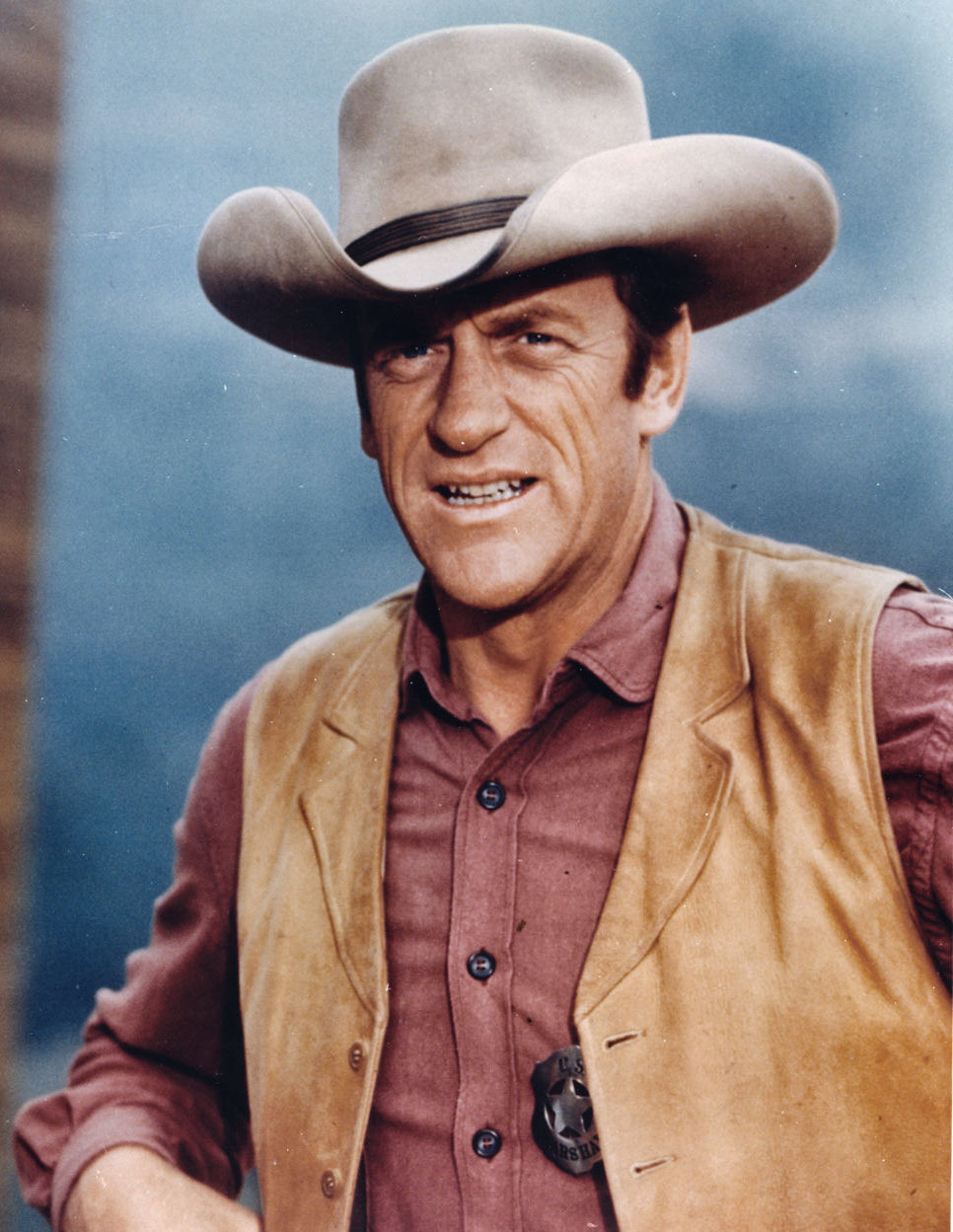
John Wayne had a young James Arness under contract and recommended him for the role, even going so far as to introduce the series on 10 September 1955.
Brought in to be a prestige series, the network was disappointed by its merely adequate ratings for its first season, and cancelled it (for the first of three times) in 1956. But it became the first series ever revived due to a write-in campaign by the fans. Within a year, GUNSMOKE was the #1 series on television, especially once Lucy retired.
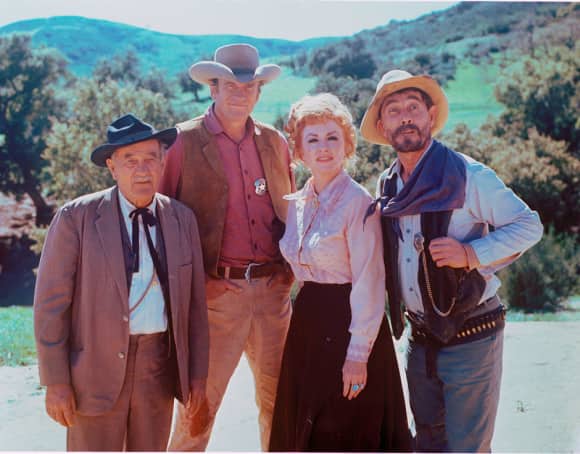
Milburn Stone played crusty Doc Adams; Amanda Blake played crusty saloon girl-turned-owner of the Long Branch, Miss Kitty Russell; Dennis Weaver played limping Chester Goode, Dillon's ineffectual deputy; Ken Curtis later played Festus Haggen, Dillon's somewhat less ineffectual deputy; Burt Reynolds played Quint Asper, the town's half-breed ironsmith for three seasons from 1962 to 1965; and Buck Taylor played gunsmith/medical student Newly O'Brien, also ineffectual.
A show on as long as GUNSMOKE, especially when the culture was going through so many rapid changes, is bound to manifest its own very different phases, and GUNSMOKE certainly did.
The original the B&W half-hour GUNSMOKEs from 1955 to 1961 saw the show go to #1 in the ratings for four years, and while all that macho "you kilt mah woman!" *bang!-bang!* stuff appealed to the '50s quasi-hetero males out there, the half-hour format quickly felt truncated and too constraining. Expanding it to an hour (as most half-hour dramas were doing during the early-'60s) the older, half-hour installments were rerun in primetime and temporarily re-titled MARSHAL DILLON (and in some markets even today they retain that re-title). The creator-producer of GUNSMOKE, Norman McDonnell, was removed ~1964 because James Arness and CBS thought, correctly, that the new full-hour version of GUNSMOKE felt padded with the ratings drooping slightly.
So they brought in Philip Leacock to take over producing duties. But when the show dropped to #35 for its twelfth season in 1967, after being on Saturday nights the entire time, CBS indeed again cancelled it, with William Paley overriding the decision and placing the show early Monday nights (cancelling Top 10 GILLIGAN'S ISLAND to make way for it) where GUNSMOKE would remain for another eight years -- and would indeed go as high as #4 during some of those later seasons.
Leacock, during the brief 1967 cancellation, went over to do a 90-minute western for Stuart Whitman called CIMARRON STRIP, so Leacock's line producer, John Mantley, became the boss of GUNSMOKE for the remaining years. And when Mantley's line producer, Joseph Dackow, died around 1970, Leonard Katzman of future DALLAS fame came in and warmed-up GUNSMOKE significantly for the '70s, doing some really excellent work and helping GUNSMOKE survive the slaughter of TV rural western dramas and comedies, at least for a while.
Katzman would later bring many of GUNSMOKE's composers, directors and crew to DALLAS -- as well as some of the actors (like Morgan Woodward, who'd made nearly 20 appearances in Dodge City before lumbering down to Southfork Ranch).
During GUNSMOKE's 20th and final season, Katzman gave the first half of that year some of the best work it had ever seen and the series was often in the Top 10 for the week, but Katzman reportedly had issues with his boss, John Mantley (as Katzman later did with Phillip Capice on DALLAS) and Katzman exited mid-season to go produce PETROCELLI. Following Katzman's departure, Mantley brought in John G. Stephens to be the line producer for the remaining part of Season 20, and while the show got some critical praise for their socially conscious scripts, the darker and more ponderous shift in tone was too extreme and ratings started to drop sharply, with an ending-season average at #29th place --- not a bad rating, but far below the numbers GUNSMOKE was getting just five or sixth months earlier.
Arness, Mantley and Stephens went on to do HOW THE WEST WAS WON for ABC which often pulled good ratings, satisfying Mantley and Arness who'd been furious about the third and last cancellation of GUNSMOKE in 1975, despite good-to-very-good Neilsen ratings in its last year.
When GUNSMOKE ended, it became the longest-running, scripted primetime show in American television history, tied many years later by LAW & ORDER and surpassed by THE SIMPSONS which is now in its 31st season.

The 1966 installment "The Jailer" with Bette Davis has been cited by some publications as one of the best episodes of any TV series of all time.
James Arness and casting executive Pam Polifroni discuss Bette Davis:

Frankly, I always want to see 1970's gatling-gunned "Morgan" guest star Steve Forrest re-cast with Joan Crawford.
John Wayne had a young James Arness under contract and recommended him for the role, even going so far as to introduce the series on 10 September 1955.
Brought in to be a prestige series, the network was disappointed by its merely adequate ratings for its first season, and cancelled it (for the first of three times) in 1956. But it became the first series ever revived due to a write-in campaign by the fans. Within a year, GUNSMOKE was the #1 series on television, especially once Lucy retired.
Milburn Stone played crusty Doc Adams; Amanda Blake played crusty saloon girl-turned-owner of the Long Branch, Miss Kitty Russell; Dennis Weaver played limping Chester Goode, Dillon's ineffectual deputy; Ken Curtis later played Festus Haggen, Dillon's somewhat less ineffectual deputy; Burt Reynolds played Quint Asper, the town's half-breed ironsmith for three seasons from 1962 to 1965; and Buck Taylor played gunsmith/medical student Newly O'Brien, also ineffectual.
A show on as long as GUNSMOKE, especially when the culture was going through so many rapid changes, is bound to manifest its own very different phases, and GUNSMOKE certainly did.
The original the B&W half-hour GUNSMOKEs from 1955 to 1961 saw the show go to #1 in the ratings for four years, and while all that macho "you kilt mah woman!" *bang!-bang!* stuff appealed to the '50s quasi-hetero males out there, the half-hour format quickly felt truncated and too constraining. Expanding it to an hour (as most half-hour dramas were doing during the early-'60s) the older, half-hour installments were rerun in primetime and temporarily re-titled MARSHAL DILLON (and in some markets even today they retain that re-title). The creator-producer of GUNSMOKE, Norman McDonnell, was removed ~1964 because James Arness and CBS thought, correctly, that the new full-hour version of GUNSMOKE felt padded with the ratings drooping slightly.
So they brought in Philip Leacock to take over producing duties. But when the show dropped to #35 for its twelfth season in 1967, after being on Saturday nights the entire time, CBS indeed again cancelled it, with William Paley overriding the decision and placing the show early Monday nights (cancelling Top 10 GILLIGAN'S ISLAND to make way for it) where GUNSMOKE would remain for another eight years -- and would indeed go as high as #4 during some of those later seasons.
Leacock, during the brief 1967 cancellation, went over to do a 90-minute western for Stuart Whitman called CIMARRON STRIP, so Leacock's line producer, John Mantley, became the boss of GUNSMOKE for the remaining years. And when Mantley's line producer, Joseph Dackow, died around 1970, Leonard Katzman of future DALLAS fame came in and warmed-up GUNSMOKE significantly for the '70s, doing some really excellent work and helping GUNSMOKE survive the slaughter of TV rural western dramas and comedies, at least for a while.
Katzman would later bring many of GUNSMOKE's composers, directors and crew to DALLAS -- as well as some of the actors (like Morgan Woodward, who'd made nearly 20 appearances in Dodge City before lumbering down to Southfork Ranch).
During GUNSMOKE's 20th and final season, Katzman gave the first half of that year some of the best work it had ever seen and the series was often in the Top 10 for the week, but Katzman reportedly had issues with his boss, John Mantley (as Katzman later did with Phillip Capice on DALLAS) and Katzman exited mid-season to go produce PETROCELLI. Following Katzman's departure, Mantley brought in John G. Stephens to be the line producer for the remaining part of Season 20, and while the show got some critical praise for their socially conscious scripts, the darker and more ponderous shift in tone was too extreme and ratings started to drop sharply, with an ending-season average at #29th place --- not a bad rating, but far below the numbers GUNSMOKE was getting just five or sixth months earlier.
Arness, Mantley and Stephens went on to do HOW THE WEST WAS WON for ABC which often pulled good ratings, satisfying Mantley and Arness who'd been furious about the third and last cancellation of GUNSMOKE in 1975, despite good-to-very-good Neilsen ratings in its last year.
When GUNSMOKE ended, it became the longest-running, scripted primetime show in American television history, tied many years later by LAW & ORDER and surpassed by THE SIMPSONS which is now in its 31st season.
The 1966 installment "The Jailer" with Bette Davis has been cited by some publications as one of the best episodes of any TV series of all time.
James Arness and casting executive Pam Polifroni discuss Bette Davis:
Frankly, I always want to see 1970's gatling-gunned "Morgan" guest star Steve Forrest re-cast with Joan Crawford.
Last edited by a moderator: