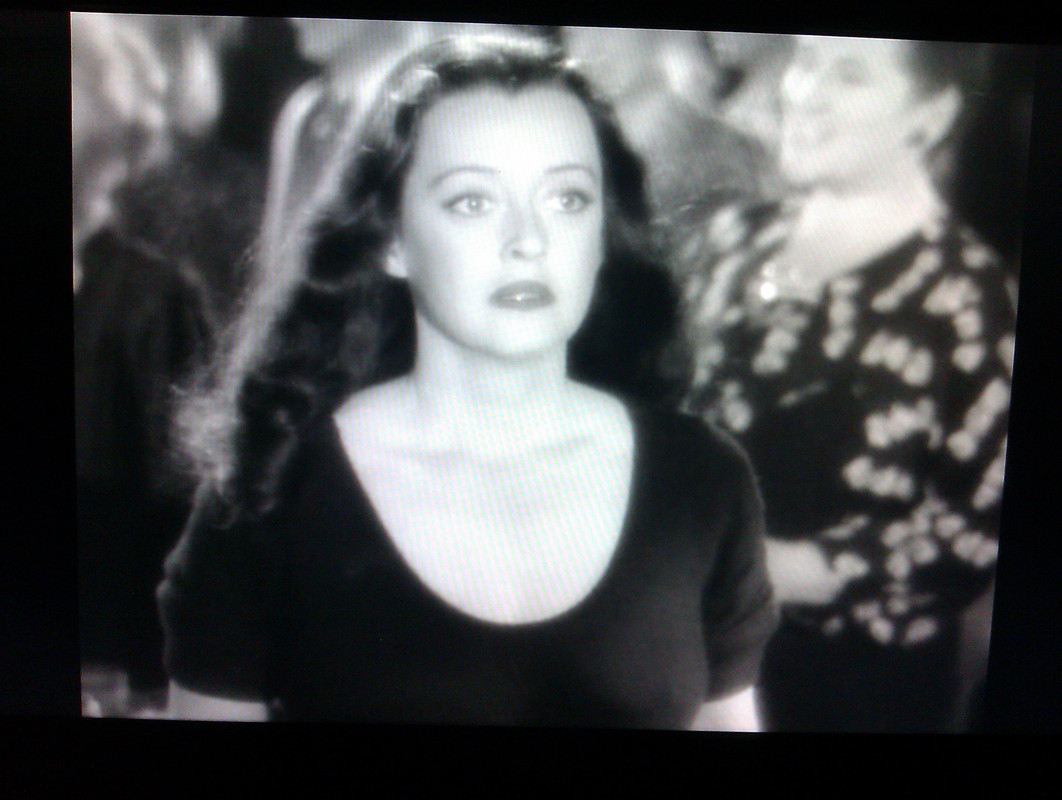
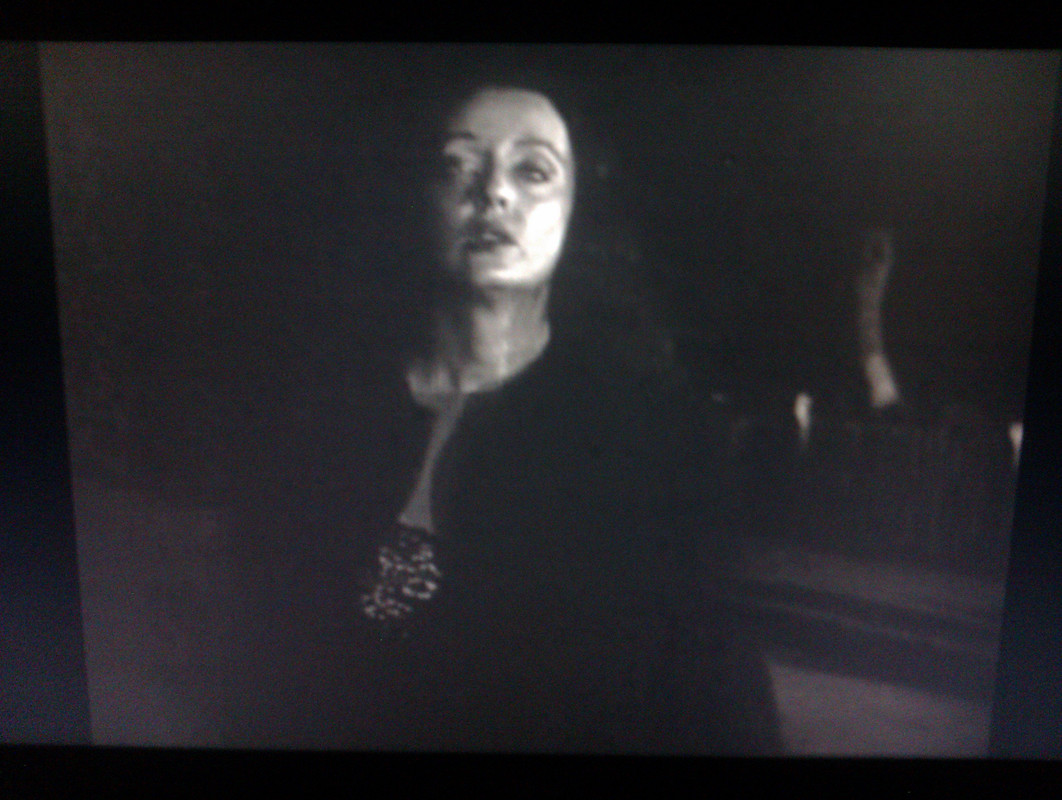
Beyond the Forest (1949) is the kind of film that has to be seen to be believed. The last film Bette Davis made under contract at Warner Brothers, and was a huge flop when released, it is interesting for those reasons alone. Davis was terribly miscast she was at least ten years older then what the character of Rosa Moline was written for.
Fans of the overripe cinema of director King Vidor (Duel in the Sun, The Fountainhead, Ruby Gentry) and Edward Albee’s Who’s Afraid of Virginia Woolf? will recognize Beyond the Forest as the film whose title George is stumped to recall when Martha mimics Bette Davis and utters the oft-parodied line “What a dump!” But for that bit of theatrical immortality bestowed upon this hotly contested post-war melodrama that was plagued by censorship interference, it's a film Davis did only under protest and asked to be let out of her contract when the filming was done. Which is why, rather than simply escaping Loyalton on her own and paving an independent path for herself in the big city. As Rosa asks, "what as a telephone girl, a stenographer, a waitress?” Rosa sticks around, thumbing her nose at the low-rent aspirations of the townswomen ("You certainly go in for mass production", don't you?" she remarks to a local mom and her brood) and settling for a life of not-so-quiet desperation as a doctor’s wife in the town’s finest house (said aforementioned dump). Joining the ranks of the many discontented housewives of great literature: Ibsen’s Hedda Gabler, Flaubert’s Emma Bovary, Tolstoy’s Anna Karenina, Rosa Moline is a woman who longs for more out of life. Feeling constrained and stifled by marriage and the conventional morality of small town life, Rosa not only wants more, but feels she deserves more. Through a Loyalton native, Rosa has always clung to the idea that she is somehow “different” from the other women in town; a grade above the ordinary and therefore meant for better things.
But Rosa is a woman with a dream. Well, to be honest, more like a scheme. Not one to content herself with merely the best that Loyalton has to offer, Rosa sets her sights on wealthy Chicago businessman Neil Latimer (David Brian), the owner of a nearby hunting lodge overseen by family friend Moose Lawson (Minor Watson). After carrying on a torrid, year-long love affair with the bachelor industrialist practically under her husband’s (Joseph Cotton) saintly, overworked nose, Rosa plans on getting Neil to marry her and whisk her away with him to Chicago. Sure, she's already married, but what’s a little detail like that when she has it in her mind to fulfill her destiny. Like many film noirs, Beyond the Forest is a tale told in flashback. When we first meet Rosa she is on trial for shooting a man, the who and why melodramatically divulged once the film kicks into high gear and takes us back five months prior. Here, Rosa is revealed to be a crack shot with a lousy disposition (after using her rifle to take out a poor, defenseless porcupine minding its own business, her only explanation is "I don't like porkies...they irritate me."), the film conveniently supplies three likely targets for her trigger-happy temperament.
There's her goody-goody husband who is too nice to press his clients into paying their bills (those ankle-strap sandals aren't going to pay for themselves, y'know). Next, there's Moose, the town drunkard and Lewis' fishing buddy. Moose's only offense is he, like the character of Leroy in The Bad Seed (1956, Warner Brothers), is one of the few people in town who sees right through Rosa. Their mutual antipathy: Moose says to Rosa, "You're something for the birds," "Rosa". "Something for the birds." Rosa's response is, "You're something to make the corn grow tall!" I can't vouch for how 1949 audiences reacted to Beyond the Forest (we can all agree it wasn't particularly favorable), but I remember getting a huge kick out of watching Davis—Vampira wigged, with Edith Head designed low-neck peasant blouses, lumpy-figured, clomping about in Joan Crawford's ankle-strapped pumps and spitting out her campy dialogue in her best self-parodying, Bette Davis drag queen impersonation—while trying to guess which one of these male clay pigeons would irritate her to the point of having to mete out a little "porcupine justice." There’s no getting past the fact that Beyond the Forest’s single main attraction for me is the staggeringly miscast Bette Davis. Looking awkward, sullen and unable to get even a remotely credible foothold on the type of bad-to-the-bone vexed vixen Gloria Grahame could play in her sleep; Davis gives us a mannered (read: ludicrous) vamp posturing and broad-as-a-barn emoting. Beyond the Forest's allusions to adultery, abortion, miscarriage, sexual dissatisfaction and (gasp!) the lead character’s blatant disdain for all the things postwar women were supposed to want, must have been pretty heady stuff back in the late 1940's. Bette Davis supplies the film’s only spark of energy and interest, its Davis’ completely off the rails performance. it doesn't seem fair to lay all the blame at the actress' ankle-strapped feet.
For example, I'm not sure who came up with Davis' almost Vampria appearance here, but you'd have to look to Joan Crawford's garish getup in Strait-Jacket (1964, William Castle Production) to find a campier image of toxic sexuality. I don't happen to find Beyond the Forest to be particularly persuasive as drama, but as arch melodrama, it can't be beat. Director King Vidor ratchets up the excess to the point that everything about it feels satirical, even when the film is deadly earnest. The natural performances of the rest of the cast, Joseph Cotten especially, grounds the film just enough to provide Davis' over-the-moon emoting with a solid springboard from which to soar.
Rosa is an interesting character mostly because she isn't explained. This could be the film's strength -- explaining her would reveal her as a less complex character, and Rosa is one of the most complex the screen has encountered. Just hearing her name--Rosa Moline--and you know instantly what kind of woman she is. I guess that was enough.
What Rosa really wants is a life in the big city. She can't stand being married to her Doctor husband who is presented as good and well liked in town. All his patients owe him money (the script never really gives us any reasons to feel for him or think of him in any other way than how Rosa sees him--boring). Therefore, we find ourselves shamelessly rooting for Rosa--hoping she'll get out of her boring marriage, and out of the boring hick town but in her way are an amazing amount of obstacles.
What the film becomes, which surprised me, is an almost intelligent and (intended or not) humorous look at a woman stuck in a cow-town, surrounded by idiots, willing to do anything (including murder) to get out! The last scene, in which Rosa stares endearingly at the rain leaving for Chicago, is a stunner. It amazes me how a film as trashy as Beyond the Forest, bad script and all, can be such a brilliant film.
Beyond the Forest is the story of Madame Bovary by Flaubert, and so it is going to be over the top all the way, as is the novel. This film is much loved in Europe, especially France, and this is so because Bette Davis captures the the spirit of Emma Bovary when she thrashes out against men at every turn, beginning with her husband, who is a doctor as in the novel.
In this version Bette Davis is not lured by the opera or by fashions of Paris; she wants to go to Chicago and frequent cocktail lounges and slick bars, with her well-heeled tycoon lover, who likes passionate women, who kiss with gusto (their kisses are unbelievable), and who dresses up for sex. Bette does this, and with tremendous enthusiasm and great artistry. In this film; every move, gesture, outburst, tells us of her hot desires. Near the house where she lives are the saw mills with large phallic smoke stacks that bellow smoke and fire, like a hell for sex-driven dames. Beyond the Forest lies that great encounters with men, in Chicago or any place where the atmosphere suggests heat and dirt.
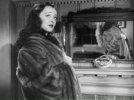
Hard as it is to believe, Bette Davis doesn't give Beyond The Forest's worst performance. That dubious honor goes to actress Dona Drake as . Admittedly it can't be easy doing anything under that dreadful fright wig and three pounds of Max Factor's Dark Egyptian #5, but as Rosa's just-not-into-it maid, Drake gives (to quote The New York Times): "A fine high-school performance." Well-groomed out-of-towner Ruth Roman pops up as a potential rival but ends up pretty much a red herring. Her main contribution: supplying the fur coat that just about blows the top off Rosa’s envy meter. Bette plays a mesmerizing scene with that coat. Forget Fred Astaire’s dance with a hat rack. Bette works that pelt. Eyeballing it, caressing it, trying it on as if she’s slowly dousing herself with hot fudge sauce. Davis rocks the room with so much full-tilt actress energy she practically animates the coat into a performance of its own. And it's a good one! Anyone who ever really lusted after luxury – and couldn’t quite put the feeling into words – can just point to this bit of film and say “Yeah, that’s how I felt.”
The lines from this film are famous all over the world (What a dump!", immortalized in Albee's "Who's Afraid of Virginia Woolf?", and the ending, as Davis hysterically tells her maid (Dona Drake), "Ever hear of Excitement" this is something that no version of Bovary could ever match. It's surreal, almost horrific, but you cheer for this woman, crawling to the railroad station to get out of town. It is extremely intense, almost Hitchkockian in its suspense. But then, King Vidor is directing, in that late 1940's style of his, showing raw passion outdoors on the ground, as in Duel In the Sun (see the ending to that one!) Bette Davis plays every key, if you will, to bring this version to your attention forever. She is never hampered by exaggerations, and so she uses them to great effect, and gives us a very feminist portrait of a woman on the verge of everything bad, who lets herself fall into the abyss (she literally jumps off a hill to induce an abortion). Who would want to live in Loyalton, Wisconsin? No body, after Bette Davis tells us about it. You'd have to be lobotomized to live in a dump like it.
Rosa Moline, Bette's character, wants everything, and in the big way; she has no class, no taste, because she has been denied access to the male treasure chests, and wants her share of the goodies.
This Emma Bovary goes understandably mad with frustrations and needs that must have plagued every woman in 1949 who had a brain. The conformity, the same clothes, the same roads, restaurants, nosy people, small town bigotry and violence, the sheer noise of it all. Bette fights against this Norman Rockwell psychosis with great conviction.
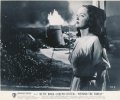
What unfolds on-screen is so ludicrous and trashy, yet at the same time grand and dramatic. Max Steiner's score, complete with an orchestral rendition of Chicago that becomes more and more maddening as the film progresses, is a highlight. You will never think of the song Chicago the same way again. Equally remarkable is the visually stylish production, as glossy and spectacular as Warner at its peak could provide, complete with sets including a great burning saw mill and the memorable ending where Rosa Moline (Bette Davis) approaches the train for the last time. To me its a Grand Finale for Bette Davis at Warner Brothers.
Fans of the overripe cinema of director King Vidor (Duel in the Sun, The Fountainhead, Ruby Gentry) and Edward Albee’s Who’s Afraid of Virginia Woolf? will recognize Beyond the Forest as the film whose title George is stumped to recall when Martha mimics Bette Davis and utters the oft-parodied line “What a dump!” But for that bit of theatrical immortality bestowed upon this hotly contested post-war melodrama that was plagued by censorship interference, it's a film Davis did only under protest and asked to be let out of her contract when the filming was done. Which is why, rather than simply escaping Loyalton on her own and paving an independent path for herself in the big city. As Rosa asks, "what as a telephone girl, a stenographer, a waitress?” Rosa sticks around, thumbing her nose at the low-rent aspirations of the townswomen ("You certainly go in for mass production", don't you?" she remarks to a local mom and her brood) and settling for a life of not-so-quiet desperation as a doctor’s wife in the town’s finest house (said aforementioned dump). Joining the ranks of the many discontented housewives of great literature: Ibsen’s Hedda Gabler, Flaubert’s Emma Bovary, Tolstoy’s Anna Karenina, Rosa Moline is a woman who longs for more out of life. Feeling constrained and stifled by marriage and the conventional morality of small town life, Rosa not only wants more, but feels she deserves more. Through a Loyalton native, Rosa has always clung to the idea that she is somehow “different” from the other women in town; a grade above the ordinary and therefore meant for better things.
But Rosa is a woman with a dream. Well, to be honest, more like a scheme. Not one to content herself with merely the best that Loyalton has to offer, Rosa sets her sights on wealthy Chicago businessman Neil Latimer (David Brian), the owner of a nearby hunting lodge overseen by family friend Moose Lawson (Minor Watson). After carrying on a torrid, year-long love affair with the bachelor industrialist practically under her husband’s (Joseph Cotton) saintly, overworked nose, Rosa plans on getting Neil to marry her and whisk her away with him to Chicago. Sure, she's already married, but what’s a little detail like that when she has it in her mind to fulfill her destiny. Like many film noirs, Beyond the Forest is a tale told in flashback. When we first meet Rosa she is on trial for shooting a man, the who and why melodramatically divulged once the film kicks into high gear and takes us back five months prior. Here, Rosa is revealed to be a crack shot with a lousy disposition (after using her rifle to take out a poor, defenseless porcupine minding its own business, her only explanation is "I don't like porkies...they irritate me."), the film conveniently supplies three likely targets for her trigger-happy temperament.
There's her goody-goody husband who is too nice to press his clients into paying their bills (those ankle-strap sandals aren't going to pay for themselves, y'know). Next, there's Moose, the town drunkard and Lewis' fishing buddy. Moose's only offense is he, like the character of Leroy in The Bad Seed (1956, Warner Brothers), is one of the few people in town who sees right through Rosa. Their mutual antipathy: Moose says to Rosa, "You're something for the birds," "Rosa". "Something for the birds." Rosa's response is, "You're something to make the corn grow tall!" I can't vouch for how 1949 audiences reacted to Beyond the Forest (we can all agree it wasn't particularly favorable), but I remember getting a huge kick out of watching Davis—Vampira wigged, with Edith Head designed low-neck peasant blouses, lumpy-figured, clomping about in Joan Crawford's ankle-strapped pumps and spitting out her campy dialogue in her best self-parodying, Bette Davis drag queen impersonation—while trying to guess which one of these male clay pigeons would irritate her to the point of having to mete out a little "porcupine justice." There’s no getting past the fact that Beyond the Forest’s single main attraction for me is the staggeringly miscast Bette Davis. Looking awkward, sullen and unable to get even a remotely credible foothold on the type of bad-to-the-bone vexed vixen Gloria Grahame could play in her sleep; Davis gives us a mannered (read: ludicrous) vamp posturing and broad-as-a-barn emoting. Beyond the Forest's allusions to adultery, abortion, miscarriage, sexual dissatisfaction and (gasp!) the lead character’s blatant disdain for all the things postwar women were supposed to want, must have been pretty heady stuff back in the late 1940's. Bette Davis supplies the film’s only spark of energy and interest, its Davis’ completely off the rails performance. it doesn't seem fair to lay all the blame at the actress' ankle-strapped feet.
For example, I'm not sure who came up with Davis' almost Vampria appearance here, but you'd have to look to Joan Crawford's garish getup in Strait-Jacket (1964, William Castle Production) to find a campier image of toxic sexuality. I don't happen to find Beyond the Forest to be particularly persuasive as drama, but as arch melodrama, it can't be beat. Director King Vidor ratchets up the excess to the point that everything about it feels satirical, even when the film is deadly earnest. The natural performances of the rest of the cast, Joseph Cotten especially, grounds the film just enough to provide Davis' over-the-moon emoting with a solid springboard from which to soar.
Rosa is an interesting character mostly because she isn't explained. This could be the film's strength -- explaining her would reveal her as a less complex character, and Rosa is one of the most complex the screen has encountered. Just hearing her name--Rosa Moline--and you know instantly what kind of woman she is. I guess that was enough.
What Rosa really wants is a life in the big city. She can't stand being married to her Doctor husband who is presented as good and well liked in town. All his patients owe him money (the script never really gives us any reasons to feel for him or think of him in any other way than how Rosa sees him--boring). Therefore, we find ourselves shamelessly rooting for Rosa--hoping she'll get out of her boring marriage, and out of the boring hick town but in her way are an amazing amount of obstacles.
What the film becomes, which surprised me, is an almost intelligent and (intended or not) humorous look at a woman stuck in a cow-town, surrounded by idiots, willing to do anything (including murder) to get out! The last scene, in which Rosa stares endearingly at the rain leaving for Chicago, is a stunner. It amazes me how a film as trashy as Beyond the Forest, bad script and all, can be such a brilliant film.
Beyond the Forest is the story of Madame Bovary by Flaubert, and so it is going to be over the top all the way, as is the novel. This film is much loved in Europe, especially France, and this is so because Bette Davis captures the the spirit of Emma Bovary when she thrashes out against men at every turn, beginning with her husband, who is a doctor as in the novel.
In this version Bette Davis is not lured by the opera or by fashions of Paris; she wants to go to Chicago and frequent cocktail lounges and slick bars, with her well-heeled tycoon lover, who likes passionate women, who kiss with gusto (their kisses are unbelievable), and who dresses up for sex. Bette does this, and with tremendous enthusiasm and great artistry. In this film; every move, gesture, outburst, tells us of her hot desires. Near the house where she lives are the saw mills with large phallic smoke stacks that bellow smoke and fire, like a hell for sex-driven dames. Beyond the Forest lies that great encounters with men, in Chicago or any place where the atmosphere suggests heat and dirt.
Hard as it is to believe, Bette Davis doesn't give Beyond The Forest's worst performance. That dubious honor goes to actress Dona Drake as . Admittedly it can't be easy doing anything under that dreadful fright wig and three pounds of Max Factor's Dark Egyptian #5, but as Rosa's just-not-into-it maid, Drake gives (to quote The New York Times): "A fine high-school performance." Well-groomed out-of-towner Ruth Roman pops up as a potential rival but ends up pretty much a red herring. Her main contribution: supplying the fur coat that just about blows the top off Rosa’s envy meter. Bette plays a mesmerizing scene with that coat. Forget Fred Astaire’s dance with a hat rack. Bette works that pelt. Eyeballing it, caressing it, trying it on as if she’s slowly dousing herself with hot fudge sauce. Davis rocks the room with so much full-tilt actress energy she practically animates the coat into a performance of its own. And it's a good one! Anyone who ever really lusted after luxury – and couldn’t quite put the feeling into words – can just point to this bit of film and say “Yeah, that’s how I felt.”
The lines from this film are famous all over the world (What a dump!", immortalized in Albee's "Who's Afraid of Virginia Woolf?", and the ending, as Davis hysterically tells her maid (Dona Drake), "Ever hear of Excitement" this is something that no version of Bovary could ever match. It's surreal, almost horrific, but you cheer for this woman, crawling to the railroad station to get out of town. It is extremely intense, almost Hitchkockian in its suspense. But then, King Vidor is directing, in that late 1940's style of his, showing raw passion outdoors on the ground, as in Duel In the Sun (see the ending to that one!) Bette Davis plays every key, if you will, to bring this version to your attention forever. She is never hampered by exaggerations, and so she uses them to great effect, and gives us a very feminist portrait of a woman on the verge of everything bad, who lets herself fall into the abyss (she literally jumps off a hill to induce an abortion). Who would want to live in Loyalton, Wisconsin? No body, after Bette Davis tells us about it. You'd have to be lobotomized to live in a dump like it.
Rosa Moline, Bette's character, wants everything, and in the big way; she has no class, no taste, because she has been denied access to the male treasure chests, and wants her share of the goodies.
This Emma Bovary goes understandably mad with frustrations and needs that must have plagued every woman in 1949 who had a brain. The conformity, the same clothes, the same roads, restaurants, nosy people, small town bigotry and violence, the sheer noise of it all. Bette fights against this Norman Rockwell psychosis with great conviction.
What unfolds on-screen is so ludicrous and trashy, yet at the same time grand and dramatic. Max Steiner's score, complete with an orchestral rendition of Chicago that becomes more and more maddening as the film progresses, is a highlight. You will never think of the song Chicago the same way again. Equally remarkable is the visually stylish production, as glossy and spectacular as Warner at its peak could provide, complete with sets including a great burning saw mill and the memorable ending where Rosa Moline (Bette Davis) approaches the train for the last time. To me its a Grand Finale for Bette Davis at Warner Brothers.
Attachments
-
 Beyond The Forest 1949 (2).jpg302.5 KB · Views: 40
 -
 Beyond The Forest 1949 (5).jpg321.3 KB · Views: 38
 -
 Beyond The Forest 1949 (4).jpg68.2 KB · Views: 50
 -
 Bette-Davis-Beyond-The-Forest-1949 (7).JPG100.5 KB · Views: 108
 -
 MV5BNGM5NzFhMzItZWZhMC00ZDkzLWFlZTItYWQ2N2U3Y2YxNGJiXkEyXkFqcGdeQXVyNjgwNjE2OTk@._V1_.jpg388.4 KB · Views: 50
 -
 69d077d992a19e6d0236b51d9e349b11.jpg327.8 KB · Views: 44