The Great British Sitcom: Fawlty Towers

Mel O'Drama

Admin
LV
16
 
Awards
44
Yikes - - has it really been over a year since I eased out of British sitcom land?! Time flies when you're stuck in the Mary Tyler Moore universe!

It's now coming up to a decade since I began my dive back into the world of British sitcoms. Since the starting point was The Galton and Simpson Playhouse, my latest sitcom brings me full circle since it's one of their most beloved projects...

iu


Hancock's Half Hour is one of those series that I've been aware of practically my whole life without ever truly watching it. I'm sure I've seen a clip or two, and some of the episodes, titles, scenarios and lines are simply impossible not to know - most of his stuttered name from the opening credits, plus The Blood Donor and his cry of "A pint?! That's very nearly an armful" - but until a few nights ago I had not watched an episode.

Needless to say, there was a bit of adjustment and settling in. We're going back the best part of seven decades here, to scratchy black and white, a slow pace and a verbose script. The latter, it turns out, is a strength. Once I'd eased into the series, it was very easy to sit back and enjoy Galton & Simpson's sharp dialogue, perfectly delivered by a great team. Last night, for instance, I watched the episode in which Tony had a nose job, and his description of another chap's nose ("...it was a Jimmy Durante with a Cyrano de Bergerac on the end of it") had me guffawing.

With no episodes from the first television series remaining, and only a handful from the second to fourth series, it's taken no time at all to whizz through to the latter part of series four. I understand the last three series are available in their entirety, so that will be a more substantial visit.

It's been a big surprise to me that the series is a true sitcom. I'd expected more of an anthology series, with him playing a slight variation on his screen persona in each episode, but there is a running thread with the scenes between Tony and Sid at 23 Railway Cuttings, and getting into a different scrape each week. It seems Tony Hancock and Sid James are the centre of the series, with other character actors popping up again and again in different roles. Kenneth Williams was along for a couple of earlier episodes, but hasn't been seen beyond those, so I'm assuming this was at the time Hancock was refusing to work with him (as he later would with Sid) due to perceiving his comedy style as cardboard-y and one-dimensional. Curiously, John Vere's speaking voice is uncannily like Kenny's, and he's playing the kinds of authority figures or pompous windbags that Kenneth did so well. I can't help feeling he's a direct replacement (though I could be wrong, since Kenneth mainly seemed to do his Snide character here, with his "Stop messin' about" catchphrase).

Speaking of similarities, I realise watching this how similar Hancock's sound, style and (to a lesser degree) look is very much like that of Terry Scott. Reinforcing this, we've even seen him interacting with June Whitfield.

For me, the most enjoyable aspect of the series is that one can tell it was transmitted completely live. The first three series and most of the fourth were all live, and it shows in the best possible way. There's a crackling energy, and it's always fun to see what the performers do when a line is fluffed - especially since Hancock invariably draws attention to it - and there have been a few little moments of corpsing or at the very least things pausing for an exchange of knowing little smiles. Plus a few little ad libs as well. These are all little treats for the audience, and the fact that the actors seem very aware of the studio audience at times makes it feel engaging and warm. These are the moments that would be edited out today, and seeing them here proves what a shame that is.

On the subject of breaking the fourth wall, it's also been interesting to see how meta the series is. Tony Hancock's character is "Anthony Hancock", while Sid James's character is "Sidney James". Hancock's character is also a performer/comedian. Ericson The Viking was the most meta episode so far, with Tony commenting that it's Boxing Day, and the first episode of his career-endingly terrible new series is due to be transmitted at 7:30 (I don't know about the time, but the new series did begin on Boxing Day). Needless to say it got big laughs.

I think my favourite episode so far is The Set That Failed. Perhaps I relate to it a little too much, telly addict that I am. In particular, I loved the scene where the TV-obsessed relatives were having conversations without looking away from the set (my partner commented that this was very much like The Royle Family, and I suspect it is). They even managed to coordinate setting the table and serving up a meal without looking away from the TV for a second. Hilarious.

I'm sure I'll have more to say, but so far it's living up to expectations.
 

Mel O'Drama

Admin
LV
16
 
Awards
44
I'm working my way merrily through Hancock's Half Hour. Having now completed Series Five (the first not to have numerous missing episodes) I've dipped into the first three episodes of Series Six.

While I find myself with surprisingly little to say, that's no reflection of my enjoyment. While not every episode is a great - some feel noticeably longer than others due to the pacing - each has been watchable enough.

Most episodes seem to either be about fixation of Tony's or a fad of the week, each one tapping into a monomaniacal obsession, and I suppose these have certainly become sitcom staples. In Hancock terms, these range from the wild sleuthing to find out whodunnit when the last page of his library murder-mystery book is missing (from what I've seen,I'd say The Missing Page is a top tier episode) to the determination to prove that someone famous once lived in his house to the sudden drive to emigrate. I love how accessible each situation feels. With this character, the almost surreal image of him barging into the Australian Embassy, stuffed bird under one arm, roll of carpet under the other and demanding a flight right away feels no stranger than him raising his voice in the library, and possibly less strange than him acting out in silent mime the plot of a murder-mystery (which he actually got across as clearly as he did comically).

This is the last series to feature Sid, and it's also quite surprising that a number of episodes for which the series seems best-remembered (The Blood Donor not least, but also The Radio Ham and The Bowmans) will not arrive until the final short , retooled series.

I've also watched Hancock's Face To Face interview broadcast on June 1960, shortly after Series Six ended. I stumbled upon it after reading about it in Wikipedia:

In early 1960, Hancock appeared on the BBC's Face To Face, a half-hour in-depth interview programme conducted by former Labour MP John Freeman. Freeman asked Hancock many soul-searching questions about his life and work. Hancock, who deeply admired his interviewer, often appeared uncomfortable with the questions, but answered them frankly and honestly. Hancock had always been highly self-critical, and it is often argued that this interview heightened this tendency, contributing to his later difficulties. According to Roger, his brother, "It was the biggest mistake he ever made. I think it all started from that really. ... Self-analysis – that was his killer."

Watching it with this context made for fascinating viewing. Certainly, his discomfiture can be seen, and the camera holds in close ups or profile shots which even to me as a viewer make Tony seem very exposed with nowhere to hide. There are some moments that, particularly with hindsight, are significant. He mentions regularly clearing out the rubbish and hints at changes that were on the horizon which appear to be allusions to his parting of the ways with Sid (and, eventually, Galton & Simpson themselves) and the retooling of the series. Given the times, it also feels somewhat brave for him to go on record as having lost his faith. There's another moment where he states matter-of-factly that he doesn't believe anyone is ever truly happy that feels tinged with sadness given his well-documented depression and his suicide later in the decade:


Mel O'Drama

Admin
LV
16
 
Awards
44
The later series of Hancock's Half Hour continued to be enjoyable. Not all of it is gold, but it's been a nice way to while away a little time of an evening.

Now, though, I'm halfway through the final short series. This retooled version, simply titled Hancock is one I was anticipating with mixed feelings. I knew that Sid would be gone and the format necessarily changed. But I also knew that the final series had some of the most oft-mentioned Hancock episodes.

Despite this, the changes are - in my eyes - to the detriment of the series. By his own choice, the series is now riding entirely on Tony's shoulders, and he appears to be buckling under the weight. Without the added support, his shortcomings are exposed and it's suddenly evident he is not actually that engaging.

The Bedsitter was practically a twenty five minute monologue and I found myself glazing over, which is a huge shame as I'm usually a fan of such lengthy, wordy, minimalist scenes.

The Bowmans was, I suppose, a kind of precursor to Acorn Antiques: a satirical pastiche of a contemporary serial. In this case it's The Archers. One gets the idea, of course, but I suspect it has lost much of its currency over the years due to its specificity. The fictional series within a fictional series is no doubt progressive for its time, and the idea of a poor actor who tries to sabotage his own character's on-screen demise is quite timeless. But it suffers from something that's been a running vein throughout each episode in this final series: Hancock himself is actually rather irritating.

Much of it rides on Hancock The Character being hapless and messing up when trying to carry out a straightforward action. But it was so overdone I quickly found it repetitive and tiresome.

This has been most evident in The Radio Ham. Compounding the frustration, Hancock The Actor seems overeager for the audience to like him. A good deal of time was spent looking at them and appearing to drink in the affection they were giving. Sadly, this in-house kind of connection has the opposite effect on the viewer at home.

It's almost needy, which is understandable given Hancock's personal struggles, and the fact that the series at this point hinges more than ever on one's enjoyment of his screen persona (and probably to a good extent on Hancock himself) . Truthfully, I'm not feeling this as much as I could. Those little moments with Sid where Tony would break character after one of them fluffed a line were indeed very endearing to watch. But with his fourth wall breaking involving the audience I felt less involved because I could only see one end of it. I started to feel that he was so busy getting his ego stoked that he dropped the ball with the actual performance. In other words, he was riding on his reputation while no longer giving a performance to warrant it.

I've read that Hancock started using teleprompters due to his car accident immediately after The Bowmans. If The Radio Ham was filmed after The Bowmans that would explain a lot of the fourth wall breaking. Given the way his eyes were moving round, it's safe to assume this was done using the teleprompters. Probably the kindest thing I can say is that I'm glad only a few episodes were filmed this way.

In my mind, The Blood Donor is THE Hancock episode. It's the only one I was really aware of ahead of time, and I've long wanted to watch it. Reading that it's considered by some to be one of his poorest performances, I'm trying to keep expectations low.
 

Mel O'Drama

Admin
LV
16
 
Awards
44
And that's that... I've now watched the entire series.

As far as the revamped Hancock series goes, I'm happy to say that The Lift and The Blood Donor were the two most enjoyable Sid-less episodes. How ironic that the best of these would come after Tony's performance became poorer through reliance on idiot boards, but then good writing will shine through and these two were well-written and with a great supporting cast.
 

Mel O'Drama

Admin
LV
16
 
Awards
44
I could definitely have done without the series' final line "We're pregnant". The "we", bizarrely, referred to Caroline and Charlie rather than Caroline and Jo (who took a simultaneous pregnancy test after a previous mix-up left Jo thinking she was pregnant). It seems an odd choice of phrasing as well as an inaccurate - and physically impossible - one.

About twenty/thirty years ago, young couples started saying "we" are pregnant. It's become pretty normal to refer to it that way now---frankly I'm kind of surprised you haven't heard this before.


This question came up on YouGov today, which made me think of our (three year old) conversation:

w9mX1p.jpg
 

Mel O'Drama

Admin
LV
16
 
Awards
44
I remember staying up late to watch The Gaffer - probably on a Tuesday - was something of a regular treat, even though I now remember almost nothing about it other than the theme song, the Rover P6 and a drab office set


It's time to see if this relatively short-lived - and presumably mostly-forgotten - little series from the early Eighties triggers any nostalgia in me. I won't have seen it since its first transmission.

71-6IvdtN5L._AC_SL1079_.jpg


I'd forgotten quite how catchy the theme song is. The way the characters name is sung always used to remind me of the Wonder Woman theme (it's even sung in a similar kind of rhythm). The guitar licks and the bassline pattern - especially over the end titles - remind me very much at times of 10cc's Dreadlock Holiday or (to a lesser extent) Pink Floyd's Another Brick In The Wall. And I enjoy the spoken lyrics over the end titles which create a sense of the title character's rebelliousness.


I was curious about the artists involved, so I just ran a search on their names. Nick Sherrif appears to have released a number of singles, none of which I can find online (though I can find lots of music from a similarly named younger performer with one "R" and two "F"s in his surname). Brian Wade had a history of stock music, with hundreds of Bruton Music tracks to his name. He was also a member of a group called The Echoes. He'd produced Elaine Paige's 1978 album Sitting Pretty on which he co-wrote most of the songs. He wrote further themes such as The Other 'Arf. Along with co-Gaffer-lyricist Maureen Darbyshire, he would go on to write the UK's 1987 Eurovision entry, Runner In The Night, which came seventh and sung by Ryder, a group featuring none other than Bill Maynard's son. Maureen, by the way, is the actress formerly of Rumpole Of The Bailey, so that's an interesting little career shift. She also has a few tracks under her belt, and I love that the single release of The Gaffer theme tune tops the list.

The clapped-out Rover P6 is present and correct. It's the first "character" we see at the start of the opening titles, and is also part of the mid-opening titles running gag in which title character Fred Moffat is teased about his vehicle of choice by tertiary character Ginger. I assume enough of these brief scenes for one series are recorded back-to-back at one time (for the second series Ginger has acquired a rather nice Eightieslicious jacket to replace his plain one).

While the series is mostly confined to the studio, the opening credits and several establishing scenes give the opportunity for some location spotting. Most have eluded me, but I have noticed that the first scene of the opening credits is shot in Leeds city centre, with The Majestic prominent in the background (meaning he's parked right outside the Queen's Hotel). I'm sure there's some retrospective irony to be found in an ITV sitcom character scoffing at a parking fine issued outside what is now the headquarters of Channel 4. After he crunches the car into gear, the car is magically transported to a more suburban setting from which he pulls away.

This series is the first thing that comes to mind when seeing Bill Maynard's name. I was too young to know Oh No It's Selwyn Froggitt (which I watched for the very first time a few pages back) and, while it's possible I might have seen one or two of his Carry Ons before discovering this series, I can't remember noticing him. If I had watched I'm sure he would have been overshadowed for me at the time by the regulars. As The Gaffer, though, he made an indelible impression on me. Certainly, his is the only character I can remember, even though I seem to recall finding his blunt gruffness and his heavy-set bearded appearance a little intimidating.

Bill does great work here. When it comes to dialogue, the scripts are surprisingly dense. There are pages and pages of dialogue for each scene, with pithy line after pithy line fired off. So much is there, in fact, that the audience has to follow along carefully or risk missing a gem. There's a lot of wordplay, and plenty of typically sardonic Yorkshire put-downs. Bill has most of the dialogue and certainly earns his stripes here.

It's said (on Wikipedia, at least) that writer/creator Graham White was unhappy that Maynard kept changing his dialogue, with the strained relationship meaning that a planned fourth series didn't happen. I can understand both positions. With so much dialogue to memorise, there are times when Maynard does seem to stumble a little and quickly recover with an apparent ad lib. I'd imagine there wasn't much time for retakes, so his ability to keep going as smoothly as possible - which I suspect comes from his background in rep - is an asset. I actually like these moments as the ense of watching something live and organic creates not only a naturalism, but an exciting energy which builds rapport. But I can also appreciate that some productions are more precious about saying dialogue verbatim, lest the actors become the writers. When there's a clash between these two philosophies, it creates a kind of irresistible force paradox.

Even having my memory jogged by rewatching, I don't remember any of the other characters. Perhaps this is a testament to Bill creating such a memorable central character. All the same, watching today I find myself thinking it's a great ensemble, mostly made up of faces I don't recognise from other projects.

Pat Ashton is most notable to me for being Barbara Windsor's double. There are some scenes in which I can't get over how much she looks like Babs from almost every angle (and she was indeed Barbara's understudy in 1970 for Ned Sherrin's Sing A Rude Song, taking the lead when Babs came down with laryngitis). If it wasn't for the voice, I'd be easily convinced she actually was Babs. I'm guessing this might not be Pat's usual voice anyway. Wiki says she's known for her "engaging cockney, blonde persona" but since the series is set up North she's giving us a more neutral accent closer to RP. She's very engaging to watch, with one frustrating exception: at the end of practically every scene, her character Betty laughs at something Fred does or says, invariably turning her head so that we get her right profile as she throws back her head and laughs (as seen in the thumbnail above). It always feels really fake and staged. I don't know if this is a choice of Pat or the director. I'd guess the latter since Russell Hunter has been seen doing something similar, albeit to a far lesser degree.

As shop steward Harry, Russell Hunter is also very watchable. He has a very flexible and mobile face when speaking, which he uses well to underscore the comedy while still being a very intense kind of character. His erstwhile brother in union is played by future Charlie Cotton from 'Enders (who is so mellow and Northern here, I initially mistook him for his brother, former Ernie Bishop from Corrie). Don Crann is very endearing indeed as helpful and naive labourer Charlie.

Familiar guests have included future Sir Frank Gordon Peter Cellier and Milton Johns, one of those character actors who seems to have been in everything - always playing the same grey-faced officious, funereal type - but who I don't instantly associate with any one role even though I feel I should (looking at his filmography, I suspect I'd have seen most of him in children's drama series Murphy's Mob - a series I'd completely forgotten about until I saw it listed just now).

Already I've watched half of the entire programme, so I don't think it will take me long to get through The Gaffer. How much I'll have to say about it remains to be seen, but I do know that I'm enjoying it.
 

Mel O'Drama

Admin
LV
16
 
Awards
44
The Gaffer drew to a close yesterday. As with so many sitcoms, there's little to say other than it worked and remained sharp to the end.

The ensemble of mostly unfamiliar (to me) faces grew to be one that I liked a lot. The actors playing Betty, Harry, Charlie and Ginger were all unknown to me, and each played their role well. The recurring players grew to be essential parts of this series' fabric as well, such as Wagstaff from the union and the kind but weary shopkeeper who provides Fred with a sympathetic ear. In later episodes there was also the addition of Charlie's shrewish fiancée and later wife, a bit in-your-face with her nastiness, but perfectly serviceable.

Despite the last episode being called Goodbye, I can see how it could have run for another couple of series. That said, I'm happy with what we got. Less is more and - certainly in terms of watching back-to-back episodes - it could be a little samey after a while.


future Charlie Cotton from 'Enders (who is so mellow and Northern here, I initially mistook him for his brother, former Ernie Bishop from Corrie)

And former Ernie Bishop also appeared in one of the later episodes, meaning both brothers were present and correct.
 

Mel O'Drama

Admin
LV
16
 
Awards
44
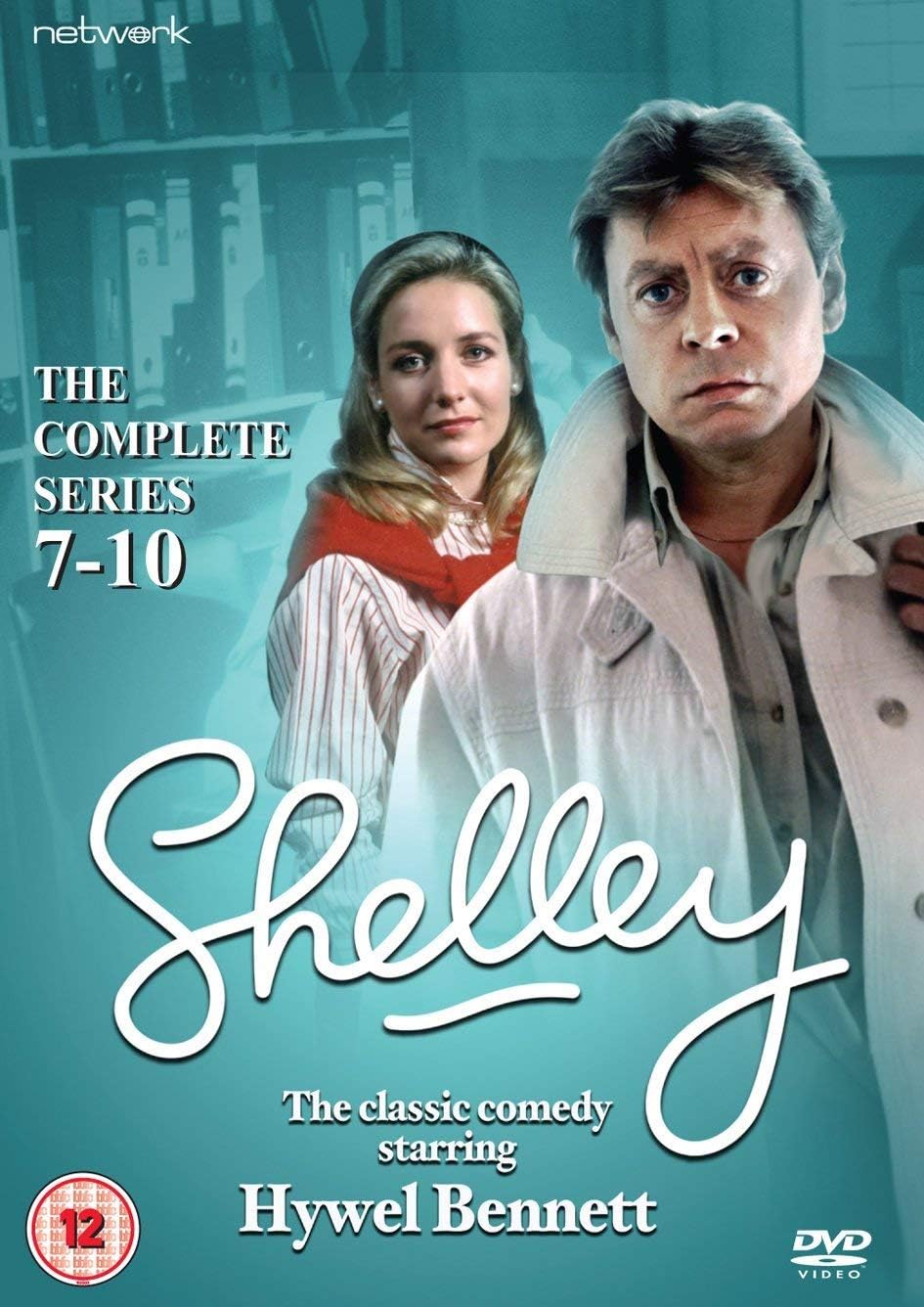
It Takes A Worried Man is new to me. I don't even recall it being advertised when I was young, while I have fond memories of the same creative team's Shelley which aired around the same time.

Six years after watching ITAWM, I'm cracking open the other PeterTilbury series:


71wlzsVXcVL._UF1000,1000_QL80_.jpg

When it comes to Shelley, my memories are fairly minimal. I remember Hywel Bennett and his hangdog face (I found him rather dishy when I was young, less so today). More vaguely I remember him working in advertising, and I think I'm misremembering him talking to a puppet of some kind (confusing it, I think with the bloke from Keep It In The Family who worked in the same field). I remember the title font and the way it wrote itself over the opening scene and ad breaks. Above all else I have never been able to shake Ron Grainer's* very whistleable earworm of a theme tune.

I remember watching this fairly regularly. I don't remember if I watched entire episodes, but I know it was part of the fabric of my childhood at times. At a guess it would be the later episodes of the first run, circa 1983-4. Perhaps even repeats after this time. Watching it now, there doesn't seem a great deal that would attract a primary school aged child (much like The Gaffer). But what do I know? It entertained me then, even though I'm sure I'm finding different layers.

As with It Takes A Worried Man..., the dialogue is naturalistic and sardonically witty. The lead character is a cynic and that's a good starting point. Once again the dialogue feels intelligent, articulate and grown-up. There was one almost surreal discussion between Shelley and his pot-growing mother where they practically talked about one another's lovers, with her adding that she was sure he was curious about what she got up to with his father. It's equal parts progressive and icky.

There's something very prosaic about the entire series. It's easy to see why I can't remember any specifics about situations or events. That's not what this series is about. In the best of ways, most episodes feel like just another day. That said, this just gives breathing room to the continuity. Over the course of the first series, Shelley's girlfriend, Fran became pregnant and the two decided to marry for practical reasons (not just to do with the baby, but also relating to financial breaks for married couples which nudged Shelley along with introducing the subject).

Hywel Bennett is terrific in the title role. The character is lazy and cocky (and up front about both), but always endearing. When I was young I had a bit of a crush on him. That's no longer the case, but I find myself fascinated that he looks like the lovechild of Geoffrey from Rainbow and George Roper.

I don't believe I know Belinda Sinclair from anything else (other than an episode of Lady Killers, which I've watched and have on DVD but can't remember). She has a lovely elegant presence: simultaneously classy and down-to-earth. In terms of energy she makes Fran a perfect match for Shelley, mostly allowing his dysfunction and unmanageability to wash over her... with the odd blow-up.

Josephine Tewson is the other key regular player. Best known to me - and most - as "Elizabeth dear" from Keeping Up Appearances, watching Ronnie Barker's body of work gave me newfound admiration for her versatility and professionalism. Here she's playing a bit of a harridan as the landlady who has no time for Shelley and his work-shy ways, whilst kind of pitying Fran for being stuck with him. The growing friendship between the two woman adds the perfect balance.

With dialogue being fast and dense, it's a treat to see it being delivered so effortlessly by all involved. The same goes for the guests and recurring characters.

Truthfully, before watching I had a feeling I might find the series a bit of a trudge. Turns out I'm enjoying it greatly.

I know this is a series of two halves - Series 1-6 from 1979-84 and Series 7-10 (AKA The Return Of Shelley) from 1988-92). At the moment I'm expecting the latter episodes to miss some of the spark of these early ones, but it would be great if I'm wrong.


* While I realise he also wrote themes for the likes of Doctor Who, Maigret and Steptoe and Son, my instant association with Ron's name is always Tales Of The Unexpected. What a body of work he has.
 

Mel O'Drama

Admin
LV
16
 
Awards
44
Series Two of Shelley has flowed gently to its end, with Shelley and Fran now married.

The wedding meant that characters who hadn't previously interacted were put together, adding new fascination. Fran's father's and his "housekeeper" dealing with Shelley's bohemian mother, for instance. Mrs H.'s wide-eyed shock at some of Isobel's statements was hilarious.

Recurring characters also make this series. Mrs Radcliffe from downstairs is a proper scene-stealer. Warren Clarke's character of Paul England - Shelley's old schoolfriend - has just arrived on the scene. I think it's from this that I'm most familiar with Warren.

Once again, the gentle continuity has been rewarding, and not just around the wedding and pregnancy. In one of the episodes around the wedding, Shelley commented told Paul about the girl upstairs who'd attempted suicide (his description of his own go at it was amusing enough. He'd taken six aspirin, and told the amused Paul that "the dose was two... and I didn't even have a headache!"). Even as I watched the overdose episode, I couldn't help thinking it was a fairly risky subject for comedy, but I like that there appear to be few taboos when it comes to subject matter. And it was funny, as well as showing a kind of support within the series' community.

I've watched a little beyond Series Two to the Christmas Special which is technically part of Series Three. It seems to be the only festive episode, so I made the most of it. And the absence of schmaltz was very appreciated. It was just a group of people trying to survive the tedium and social pressures of the season.
 

Mel O'Drama

Admin
LV
16
 
Awards
44
Three series down now, and I'm still loving Shelley.

Perhaps it could be described as the thinking man's sitcom, since it has logic and asks the kinds of questions people in the real world would (and sitcom characters rarely do). And it's present whether Shelley is spending half an episode explaining the Big Bang theory to an eccentric café patron, or he and Fran are discussing the mice in their bedroomwith Shelley worrying what will happen to the mouse they've tied inside a black bin bag.

The move out of the room at Mrs H's place to their own house has worked well enough, buffered by the continued presence of Mrs Hawkins herself, dropping in for cups of tea and to tut about Shelley's lack of employment.

Meanwhile, at the DHSS office, Kenneth Cope has been replaced by a double act which is slightly inferior but still watchable enough .

Series Three's other big news has been the arrival of baby Emma, which was done in a typically unsentimental manner. As previously mentioned, the lack of sentiment means these landmarks don't cloud what's really important in this series, which is the cynical wit (during a row, Fran even complains that she's "caught" this reflexive snark from Shelley).

Since Series Three is the last to be completely written by Peter Tilbury, I'm a little nervous that there may be a drop in writing quality after this point. But here's hoping.
 

Mel O'Drama

Admin
LV
16
 
Awards
44
Since Series Three is the last to be completely written by Peter Tilbury, I'm a little nervous that there may be a drop in writing quality after this point. But here's hoping.

Turns out Series Four was fine, with minimal impact from the change of writers. Even the move out of rented accommodation at Mrs H's place and into Shelley and Fran's own house felt perfectly comfortable, helped by Mrs H's inevitable daily visit for a baby fix, a chat with Fran and some verbal sparring with Shelley (and, of course, her bottomless cups of tea).

Series Five, on the other hand, is taking some time to settle with me. I was prepared for a change in tone with the revival series (which has become the Seventh Series), but this one took me by surprise. I'm only two episodes in, but with Shelley now separated from Fran and moving out of the marital home (all told to us in passing), there are no real familiar characters or settings.

In the Fifth Series' first episode itappeared Warren Clarke's returning character might now be a regular, but nope. He's only there for one final visit to pass on his flat to Shelley. Garfield Morgan as the building's officious and nosy warden is fine for the odd gag, but there's little to connect with (especially since very few people in Britain actually have a doorman of this kind).

There's a little promise with the workplace, but given Shelley's employment track record we know how temporary a situation this will probably be.

The next episode sees the brief returns of Fran and Mrs H, and I know I have to make the most of it since I believe it's Mrs H's final episode, and also the last time we see Fran until another appearance in the Sixth Series.
 

Mel O'Drama

Admin
LV
16
 
Awards
44
The next episode sees the brief returns of Fran and Mrs H, and I know I have to make the most of it since I believe it's Mrs H's final episode,

Sadly, Mrs H. came across as shrewish and controlling for much of her final episode. The fact that she's getting involved in others' business even to the point of butting in on a personal meeting between husband and wife isn't going to cast her in a flattering light. This could be blamed on the performance or the writing, but it's ultimately the truth of the situation. The only way to have Mrs H. at Shelley's flat is for her to arrive uninvited and play gooseberry. The only logical way around this would have been for Fran to want the meeting to take place in the neutrality of Mrs H's place, but perhaps there were practical considerations, such as rebuilding the set for one episode.

Fortunately Mrs H. redeemed herself in the final moments where she softened and it was apparent she cared about Shelley's wellbeing.

The Fifth and Sixth series did lose some of the charm of the earlier ones. The relationship with the warden was watchable, but not exactly peak Shelley. Still, there were some nice scenarios, and sometimes the more aimless ones suited the character better. An example of this is when Shelley bumped into his old short-lived colleague Malcolm and the two wandered round putting the world to rights with their navel gazing (a guest-appearance from Fulton Mackay as a homeless man was the icing on the cake here).

There appears to be some dispute about the episodes original transmission dates/order. IMDb and Wikipedia suggest the series opened with Dry Dreams, in which Shelley is reunited with Fran, and closed with Brief Encounter where he falls for the niece of his frenemy the warden. Network, and comments on the IMDb page dispute this and put Dry Dreams at the very end of the original run. This latter order is the one I chose to follow (easy enough since that's the DVD episode order), and it was far more gratifying since Brief Encounter wasn't the strongest of episodes (and I didn't think the girl playing opposite him was a particularly good actress). Dry Dreams included not only Fran but the return of Shelley's mother, which gave great sparring all round. Besides, it's a terrific episode title.

Out of deference to the number of years between this final episode and The Return Of Shelley, I'm aiming to take a break and come back for the revival series in a few weeks' time.
 

Mel O'Drama

Admin
LV
16
 
Awards
44
It's time to dive back in and revisit the later series of Shelley, or - as it was known for its initial series - The Return Of Shelley.

71R1sGPYAJL._AC_SL1336_.jpg

By the end of its initial run in 1984, it was easy to take the view that the series had run its natural course. The later series of that run - while good enough - weren't up to the high quality output of the earlier ones. With frequent changes to format and cast, there was a sense of aimlessness and that the writers didn't quite know what to do with the character.

The upside of this is that the overhaul for the revival series isn't particularly jarring and feels in many ways like a significant improvement on the mid-Eighties episodes. It helps that there's a time jump of almost five years (in both real and screen time) during which Shelley has been doing the TEFL thing in the Middle East. While that's an interesting concept in itself (shades of Mind Your Language), crucially it also helps create the sense that we haven't missed anything significant in his life in Britain. Even more than the audience, it's Shelley who is playing catch-up, returning to a gentrified world of wine bars and answering machines and Yuppie culture with its GTis, XR3s and filofaxes.

The culture shock is a really nice launching pad for the series. Shelley was already bewildered by the world around him, but being surrounded by Yuppies is compounding this and providing an embarrassment of riches when it comes to material. Carol and Graham are somewhat stereotypical (she the ambitious earner, he the "nice-but-dim" public school type who works in the stock market because it's the done thing but is so overwhelmed he's secretly covetous of Shelley's freedom of spirit).

Series Eight - the second series of the revival - has seen another addition to the cast in the shape of Stephen Hoye, best known to me as David Hunter's frisky son, Chris. He brings a similar energy here. There's a lot of manspreading and hip movement that exudes a sexual confidence, but the effect is sadly counteracted by his American accent (it's not bad, just a little distracting since I know what he usually sounds like. I wonder why the character had to be American? Perhaps it was intended for someone else). I'm making the most of him as Shelley's partner-in-crime since it looks like Stephen is only here for one series (plus one further episode in the next). Fortunately, Series Eight is by far the longest of any in the entire run, with thirteen instead of the usual six episodes.

Another soapy connection in Stephen's first episode was Sons and Daughters' Grant "Tony Parker" Piro in a fairly small part as one of Shelley's advertising colleagues. How interesting to see him in a British vehicle (and it looks as though he did a few around that time).
 

Mel O'Drama

Admin
LV
16
 
Awards
44
As Series Nine sees yet another reboot, I find myself wondering about the regular changes in format. Under most circumstances these would be red flags pointing towards problems behind-the-scenes, which could range from actors becoming unavailable to writers wanting to put their stamp on things to personality clashes.

With this series, though, the changes feel somewhat organic. It could be viewed that they're necessary to stay true to a free-spirited character who is defined by his unconventional outlook. Perhaps tying him down to one setting and cast of characters for too long would undermine this... certainly post Fran.

The final few episodes of Series Eight introduced a relatively small change to the status quo when Carol was dispensed with off-screen. We simply heard from Graham that she had left him, which led to the running gag of Graham being perpetually depressed (the resulting suicide gags harking back to the early days of the series). I am curious about the reasons for this sudden, mid-series change, but Caroline Langrishe's IMDb listing suggests her commitment to Chancer would be the most probable reason.

No sooner has this format established itself, though, than Series Nine rips up the floorboards again, moving Shelley into a completely new setup with a new ally. Now he has taken up digs in a condemned house owned by a grouchy old slob who refuses to sell up. And there's something about this back-to-(very)-basics premise that feels right for this series. It gives Shelley the opportunity to get his teeth into a cause (there's already a sense that he feels protective towards the man being harassed by developers - and to bond with someone who is equally cynical (albeit in a different way). Both of which allow the series to keep its edge.

It does also mean that both Graham and Phil are out. Neither is a particularly killing blow for the series. Both were decent enough, but more functional than essential (of the three supporting players Carol was the most fun). I also never saw the point of having an Brit playing an American here, since nationality never had any significant bearing on the role he played in the series, barring one or two observations of the "You Brits and your..." variety). It looks like Phil will return in one further episode, so hopefully there's some kind of closure or, at least a last hoorah for the character.

Since it looks like Ted Bishop appears in every one of the remaining episodes, I suppose the current format is also the last, and this is what we'll have for the final two series. Already I find myself wondering how the series will end.
 

Mel O'Drama

Admin
LV
16
 
Awards
44
With the final series underway, there are just four episodes of Shelley still ahead of me.

The current formula is working well, so I'm glad it's following on from the Ninth Series, as it'll be nice for things to end on a relative high.

Phil's one-off return was fine. There was the hoped-for ending for the character, as he fled back overseas on the morning of his wedding to avoid an awkward conversation with his bride, leaving reluctant best man Shelley to cop it in the neck. But it was done in an almost satisfying/unsatisfying way as his departure was off-screen and we didn't know he was going until he was gone. If anything, it proved that the setup that superseded his year as the sidekick is one that's a better fit. When all was said and done, Phil is a character who might have worked best as a recurring character over a longer period.

Series Nine closed with a New Year episode, appropriate on several levels: firstly (and only barely relevant) I watched it on the same day I randomly moved ABBA's Happy New Year into my Favourites playlist, deciding I wasn't obliged to wait until December to listen to bittersweet seasonal music. Secondly and most importantly, it's the perfect holiday for Shelley the pessimist. Complaining about the crappy year that's just passed and the even crappier one that probably lies ahead is so Shelley (truthfully, it's also quite me, and I usually do Shelley's trick of disappearing to bed at 9pm on New Year's Eve, hoping the whole thing will just go away).

Other scenarios have been Shelley Has A Run Of Luck On The Horses; Shelley Stuck In An Airport; Shelley Learns To Swim (notable for an anticipated visit from his daughter and a one-sided phone call with Fran) and even Shelley Sees A Shrink (which, as well as being suitable and inevitable, is also reminiscent of sibling series It Takes A Worried Man).

The closer I get to the end, the more I feel the final episode is going to simply be another episode. At least it means I'm managing expectations.
 

Mel O'Drama

Admin
LV
16
 
Awards
44
The closer I get to the end, the more I feel the final episode is going to simply be another episode.

It was. This one was simply Shelley Attends A Night School Class. Fortunately it wasn't a bad episode, but with the continuity in this series I just wanted more: some acknowledgement that this was goodbye. This being the era of the sitcom Christmas special, one of those would have been nice, just to wrap things up. As it was, it was just another Shelley episode. Never a bad thing, but far from satisfying as a final episode ever.
 

AndyB2008

Telly Talk Well-Known Member
LV
0
 
Awards
6
It was. This one was simply Shelley Attends A Night School Class. Fortunately it wasn't a bad episode, but with the continuity in this series I just wanted more: some acknowledgement that this was goodbye. This being the era of the sitcom Christmas special, one of those would have been nice, just to wrap things up. As it was, it was just another Shelley episode. Never a bad thing, but far from satisfying as a final episode ever.
The final series aired in 1992, which was around the time Thames, which made the show, lost their ITV franchise.
 

Mel O'Drama

Admin
LV
16
 
Awards
44
The final series aired in 1992, which was around the time Thames, which made the show, lost their ITV franchise.

Ah. Thanks for the context. The date hadn't registered with me, but that makes much more sense now. This series would have been just one of many that were dropped, then.
 

Mel O'Drama

Admin
LV
16
 
Awards
44
Here's a series I've never watched but have heard lots about (most of it critical). And its name has come up quite a few times in this thread already.

iu

It's quite difficult to separate Love Thy Neighbour from its reputation as a politically incorrect, unfunny relic of its era. This is a shame because I feel obliged to explore this and almost rationalise why I would choose to watch this in 2025, when really it's as simple as the fact that I enjoy daft Seventies sitcoms.

I was braced for the worst, but while there is some truth to be found in its reputation, I have to say that overall I'm finding the series quite accessible and, dare I say, enjoyable. Certainly the casual racism is cringeworthy and dated, though there is probably some intention behind that. The writing is very much skewed so that our sympathies are with the nice black couple and the long-suffering wife of the resident bigot with narrow-minded views. Arguably more offensive are the stereotypes that have found their way into most scenarios so far (I've watched the Pilot and the first three episodes of Series One). Limbo contests, mangoes and yams and other "exotic" food (it's amusing to think how relatively recently most British people did not know what a mango tasted like). I'd say these expose the writers' lack of cultural awareness far more than the regular utterances of "nig-nog" or "sambo", because these stereotypical ideas of what black people enjoy, eat, believe or excel at has pretensions of understanding whilst simultaneously placing people into a "comfortable" homogenous group. If anything, the writers are trying to be ambassadors, but you know what they say about good intentions.

In many ways this is Till Death Do Us Part Lite. It's not as clever or as challenging as that series, but nor does it really attempt to be. It's really no better and no worse than any of its Thames counterparts of this era, all of which reflect the times in which they were made and the audience towards which they're pitched. Think too deeply and they're all terrible and full of potential offensive material. Disengage brain and relax as prescribed and it's a far more positive experience. It may not be riotously funny, but it's mostly good silly fun.

Watching the Pilot and Episode One back-to-back was an interesting experience. It's fascinating to see the changes that are made before the series goes to air. This is one of those scenarios where the Pilot was not transmitted. But while the first episode tells the same story as the Pilot, it's not a word-for-word remake. Lots of scenes are the same, down to wording, but the episode that aired had more going on, with additional scenes and a denser script. Overall, I'd say I enjoyed the Pilot more. Perhaps in part it's because I watched it first, and many of the gags were less funny the second time round because at that point. But I also appreciated the extra breathing room in the Pilot, and example of this being Jack digging up his old neighbour's garden before the new neighbours moved in. In the remade episode he announced he was going to do this and it was taken as read, but in the Pilot we spent a few minutes watching him do this.

A notable change between these two episodes are the locations and sets. The Pilot was set in a pair of comfortable-looking pre-war semi-detached houses with bay windows and neat hedges around their tidy front gardens. The series moves things to modest mid-row terrace Victorian houses, yards away from an ugly gas works. The sets, too aren't as pretty or substantial (as befits the change of house). It possibly fits the characters better, but I did find the Pilot sets a nicer place to be (especially the Reynoldses' fairly tasteful living room, which is much louder in the remake). The Pilot made more use of location work as well, where the regular episodes move to more obvious sets for scenes set on the street outside and the back gardens.

The key casting change was Joan Booth, played in the Pilot by Gwendolyn Watts and in the series by Kate Williams. It was especially interesting seeing the different readings of the same lines between the Pilot and the remake. Gwendoyn's presence was much sweeter and softer, while Kate was instantly more fiery and forceful. It was jarring at first, and I'd just decided I preferred Gwen when Kate won me over. I think perhaps Jack needs someone who is going to challenge him more, and Kate's Joan does this. That said, I'd also have been perfectly happy to watch an entire series with Gwendolyn in the role. I'm curious why the recast happened. It's easy to always assume someone became unavailable, but it's always entirely possible that The Powers That Be wanted a change for other reasons.
 

Angela Channing

World Cup of Soaps Moderator
LV
19
 
Awards
52
Although Love Thy Neighbour is criticised these days for its racism, it was really very mild compared to some of stuff that was on TV during that era. The show was also quite popular amongst Black people because it was one of the few times Black people were featured regularly on a TV show.

I don't think I watched Love Thy Neighbour when it was originally broadcast (I think it went out on Mondays at 9pm which would have been past my bedtime) but I recall watching repeats which went out early evenings at around 7pm. My memory is that the Reynolds family (the Black family) were portrayed reasonably positively and generally won conflicts with white Eddie Booth and racist remarks were generally done is ridiculous way that it was difficult to take them seriously. Not that I'm defending the racism in the show, but I think outrage was exaggerated compared with the racism Black people often received in real life, which was generally downplayed.
 
Top