"Just one more thing...": Rewatching Columbo

Angela Channing

World Cup of Soaps Moderator
LV
19
 
Awards
52
I share your reservations about this episode. I've seen it a few times but I don't remember it as well as many of the others which is a sign that I didn't like it as much as many of the others. But it's not all bad, I like the casting of the character that made the bombs, he had a look of someone who could but unstable and dangerous and it's always good to see Jack Cassidy, even though he's far from being a favourite Columbo murderer of mine (I think he played his characters to be a bit too arrogant and glib).

You’d think not. All the same if this episode has an Achilles’ Heel it’s just that. It’s all very nuanced and multi-layered, and the plot doesn’t seem to follow a linear path. Instead, we garner fragments of information here and there. There’s a lot of information to take on board and work with and the episode demands more attention than I gave it.
You've identified what I think is the main problem with the episode: it's storyline is just a bit too complex to enjoy it on a very straightforward and simplistic level.
 

Mel O'Drama

Admin
LV
16
 
Awards
44
I share your reservations about this episode. I've seen it a few times but I don't remember it as well as many of the others which is a sign that I didn't like it as much as many of the others.
You've identified what I think is the main problem with the episode: it's storyline is just a bit too complex to enjoy it on a very straightforward and simplistic level.

That's good to know. Sometimes how much I enjoy something can be very much a subjective thing, depending on any number of factors. Because I watched when I was feeling very tired and not too focussed I thought perhaps the episode was more memorable than I was giving it credit for. But it sounds like we had similar viewing experiences with it, which suggests I wasn't too far off beam with my views.


But it's not all bad, I like the casting of the character that made the bombs, he had a look of someone who could but unstable and dangerous

Yes - he was great. The relationship between Kane and Greenleaf was interesting, because Kane was so unpredictable it always felt like Greenleaf's control over him was tenuous. There was a sense that at any moment Kane could snap and run rampage and wreck all the carefully-laid plans. Which is why Greenleaf killing him made such perfect sense.


it's always good to see Jack Cassidy, even though he's far from being a favourite Columbo murderer of mine (I think he played his characters to be a bit too arrogant and glib).

I know what you mean, and I'd say I agree. Murder By The Book is a favourite episode of mine, and I thought he was really good in that. But it also feels quite definitive as far as Cassidy's glib arrogant persona goes. Whereas I could watch Robert Culp over and over again and always remain fascinated.


Incidentally, I also never mentioned Paul Shenar who played Sergeant Young. Another actor whose performances fascinate me from the little I've seen.
 

Mel O'Drama

Admin
LV
16
 
Awards
44
Mind Over Mayhem


mayhem-2.jpg
v1.dDsyNjgyNjc7ajsxODgxMzsxMjAwOzYwMDs0NTA


Hmmm. Perhaps the terrific Double Exposure really is impossible to follow. First came an average episode. Now it’s a below average one. Have we peaked and crashed?

With this kind of situation I’m usually quick to add the caveat that even a below average Columbo is still good TV. I could probably still do that here, but it would have to be said in a whisper.

A good measure for an episode is that you could feel good about showing it to a friend who’s never seen the series and have it serve as their introduction to Columbo. Applying that here, this is one episode where I’d feel a little embarrassed doing so. Imagine any future conversations about it. “Columbo? Isn’t that the series with the giant robot, the genius kid assistant and the room with the bank of ancient computers with flashing lights?”

A large part of the reason this is a less watchable episode is that the technology aspect hasn’t dated at all well. Good writing can overcome this (à la Double Exposure’s CCTV) but several of the tech scenes felt a little like sci fi shows of the era. The giant helpful, handshaking robot walking round the huge computer room put me in mind of the third season of Wonder Woman when it was dumbed down and aimed firmly at a younger audience. Or perhaps 7 Zark 7 from Battle Of The Planets. Even episode victim Lew Ayres was last seen in O’Dramavision in The Bionic Woman.

As precocious kids go, Steve Spelberg was fairly tolerable and seemed to hold his own with Peter Falk. His name can only be Stephen Bochco’s a tongue-in-cheek reference to the director of Bochco’s first Columbo episode, Murder By The Book: a wunderkind whom Peter Falk had initially thought was too young but quickly realised he was working with a genius. Steven Spielberg (with an “i”) was now making a name as a director following Columbo with TV films including Duel, and was about to launch his silver screen career with his first theatrical feature, The Sugarland Express, hitting cinemas just six weeks after this episode aired.

As far as killers go, José Ferrer felt serviceable. He’s watchable enough, but there seemed to be no real chemistry between him and Peter Falk, and Ferrer’s presence is on the understated side. Consequently the overall tone of the entire episode was a little flat, static and lifeless.

The Gotcha, too, was very average. And arresting the son is another example of Columbo using very questionable methods to gain a confession. Surely this could be used to ensure it doesn’t stand up in court. I was reminded of Abby Ewing confessing to Peter Hollister's murder to save her daughter. And we know how that turned out.

It’s not all bad news. It’s always wonderful to see Jessica Walter. Dog made a return appearance (albeit recast, I think), with a lot of face-licking action.

Even technology became entertaining in Peter Falk’s hands, with some amusing dictaphone scenes now giving a new spin to his forgetfulness. There are scenes where he’s playing it back to jog his memory when questioning people, and we hear him on the tape scolding Dog. When he does play out the right prompt, he simply repeats it as though the person he’s with hasn’t just heard it and will think it’s a spontaneous thought. Very nice touches.

I’ve heard the word “sneaked” in a couple of Columbo episodes now which has made me wonder if “snuck” is either a newer Americanism or a word that’s still considered incorrect there. “Sneaked” is considered correct in the UK, of course, with “snuck” generally considered an Americanism used only by much younger Brits whose vocabulary comes from social media or American-dominated platforms like YouTube. I’ve heard “snuck” in so many American shows that I’d just assumed that was their standard word, so it’s interesting for me to hear “sneaked” used.
 

Angela Channing

World Cup of Soaps Moderator
LV
19
 
Awards
52
I wasn't a fan of this episode in fact it's one of the weakest episodes of the 1970s run of the series. However, there are worse episodes, in fact I prefer this one to Dagger of The Mind because at least it didn't suffer from overacting from main characters.

A large part of the reason this is a less watchable episode is that the technology aspect hasn’t dated at all well.
What were they thinking? Some of the technology looked old even for the 1970s, for example, Robby the Robot was a 1950s invention but they were making out it was cutting edge technology.

The cast was good but the material they had to work with wasn't great. Lew Ayers is a actor I've always liked since I saw him in the film Johnny Belinda with Jane Wyman but even a great cast couldn't elevate this episode into something better.

I was reminded of Abby Ewing confessing to Peter Hollister's murder to save her daughter.
Lew Ayers appeared in an episode of Knots Landing as a rich old man that liked Abby and she played along because she thought he would leave her his money when he died but she got nothing.
 

Mel O'Drama

Admin
LV
16
 
Awards
44
I wasn't a fan of this episode in fact it's one of the weakest episodes of the 1970s run of the series.

It's certainly a contender for my least favourite episode so far.


in fact I prefer this one to Dagger of The Mind because at least it didn't suffer from overacting from main characters.

I can appreciate that. I didn't mind Dagger, as I enjoyed the London scenery and the change of tone, but I can understand how it could be a challenge to watch for some.


What were they thinking? Some of the technology looked old even for the 1970s, for example, Robby the Robot was a 1950s invention but they were making out it was cutting edge technology.

Absolutely spot-on. It's all a bit awkward.


The cast was good but the material they had to work with wasn't great.

Agreed. Everyone in it was great, but it seemed to be a losing battle.


Lew Ayers appeared in an episode of Knots Landing as a rich old man that liked Abby and she played along because she thought he would leave her his money when he died but she got nothing.

Oh gosh. That was him in Silver Shadows? I hadn't made that association.
 

Mel O'Drama

Admin
LV
16
 
Awards
44
Swan Song


0054.jpg
swan-4.jpg


The big name singer as a guest-star can be a novelty for a TV series. The big name singer as a guest killer on Columbo, though, is quite another matter.

I must confess I was very sceptical about the idea of Johnny Cash as this episode’s murderer. This doubt wasn’t assuaged when we were treated to a full performance of one of his tracks. Was this too stave off the acting, I wondered.

As it turns out, Cash wasn’t a bad actor (it seems he has quite a respectable filmography). Admittedly, I went into this instalment with low expectations, but I thought his performance was good enough. He had presence and I thought he held his own in his scenes with Peter Falk. I wouldn’t say it’s the most nuanced performance, but he has a certain something that made me believe what I saw. As Tommy Brown, his smooth charm and laughter where others would have been angry or fearful put me in mind of JR Ewing (and then I found myself thinking Larry Hagman would have made a terrific Columbo killer).

I tend to expect a little more from the two hour episodes, and I’d say this one mostly delivered in terms of scope and scenery. From grand homes to airports to concert venues to military bases, the scenery was varied and fairly grand in scale.

The extended episode also allowed for a little more breathing space. While the cynic in me began thinking this could have been a standard-length episode if they’d cut out all the reprises of the song, and that some scenes may have been a little padded out, I also appreciated the room for character. Columbo’s introductory scene - getting in the way of the news cameras while inspecting the burnt out wreck of the crashed light aeroplane - was a lengthy one, running well over ten minutes without feeling cumbersome.

The twists and turns of the plot, too, played out at a pace that was at times a bit leisurely but allowed me to invest. We were given some nice titbits about Columbo, from his wife being a fan of Tommy’s to Columbo having served in the Korean War. Then there was his wide eyed interest at the differences between live and studio tracks.

As things drew to a close and Tommy disappeared to catch his plane, laughing all the way, this episode created a genuine sense that Columbo’s man was going to get away, which made the payoff feel quite satisfying. And Tommy, once caught in the act, was one of the most remorseful and human killers of the series, the guilt having eaten away at him.

Unintentional intrigue this episode. During one scene, I thought I’d spotted the debut of Columbo’s slightly revamped Peugeot with the lighter colour roof fabric. But then later in the episode it seemed to revert to the grey coloured one. I wonder if it has to do with the way the light catches it? I’ll keep my eyes peeled in the next episodes.

Anyway, all in all, while this is far from the best the series has to offer, it’s a watchable enough episode.
 

Angela Channing

World Cup of Soaps Moderator
LV
19
 
Awards
52
I kind of liked Swan Song. It's not Premier League but it's not Vauxhall Conference either, maybe mid-table in the Championship (UK football analogy). In more general terms, if I were to rank all the episodes of 1970s Columbo, it would be somewhere in the middle but overall in the bottom half of the list.

I think this was an episode that fans of Johnny Cash would love but as I know little about his music and although I appreciate the novelty of having a high profile musician play the murderer, it wasn't enough to make this episode one of the greats. Mr Cash was an adequate actor in this but he didn't exactly set the screen alight. Oh, and we had to endure that dreadful song over and over again in the episode, something about seeing a light and I kept think I wish you stayed in the dark and spared us from that song.

What I did like was a great murder plan and a good gotcha too. The gotcha reminded me a bit of the one in Any Old Port In A Storm but without the chemistry between Columbo and the murderer and the beguiling performance of Donald Pleasance.
 

Mel O'Drama

Admin
LV
16
 
Awards
44
It's not Premier League but it's not Vauxhall Conference either, maybe mid-table in the Championship (UK football analogy).

That explains why two thirds of that sentence went over my head. :D ;)


In more general terms, if I were to rank all the episodes of 1970s Columbo, it would be somewhere in the middle but overall in the bottom half of the list.

Yes - that's my feeling on it as well.


I think this was an episode that fans of Johnny Cash would love but as I know little about his music and although I appreciate the novelty of having a high profile musician play the murderer, it wasn't enough to make this episode one of the greats. Mr Cash was an adequate actor in this but he didn't exactly set the screen alight. Oh, and we had to endure that dreadful song over and over again in the episode, something about seeing a light and I kept think I wish you stayed in the dark and spared us from that song.

We're approaching it from the same place, I think. I have great respect for his musical career, though a lot of it has passed me by and I only own one of his albums. So my perspective on his performance is different from that of his fans.

I agree with your analysis of the performance and of that song.


What I did like was a great murder plan and a good gotcha too. The gotcha reminded me a bit of the one in Any Old Port In A Storm but without the chemistry between Columbo and the murderer and the beguiling performance of Donald Pleasance.

When I watched it, I was instantly reminded me of Blueprint For Murder, with Columbo lying in wait for the murderer to return to the scene of the crime at night after he thinks he's got away with it.

But yes, I can also see definite similarities to Any Old Port... especially with the two of them sharing a moment in the car.
 

Angela Channing

World Cup of Soaps Moderator
LV
19
 
Awards
52
When I watched it, I was instantly reminded me of Blueprint For Murder, with Columbo lying in wait for the murderer to return to the scene of the crime at night after he thinks he's got away with it.
I forgot that one. Yes, it has similarities to that one too. Well, if you hit on a winning idea, why not use it more than once?
 

Mel O'Drama

Admin
LV
16
 
Awards
44
I forgot that one. Yes, it has similarities to that one too.

Yes - it even has the car headlights being turned onto the killer at the key moment when they're skulking round in the dark.


Well, if you hit on a winning idea, why not use it more than once?

Absolutely. A good Gotcha is a good Gotcha (even when it's slightly recycled).
 

Angela Channing

World Cup of Soaps Moderator
LV
19
 
Awards
52
That explains why two thirds of that sentence went over my head.
I should have explained. The Premier League is where the elite English football clubs play, the league below is the Championship, followed by League 1 and League 2. Outside of the main football leagues is the Vauxhall Conference, so it like the 5th tier of English football leagues.

Try and Catch Me, Any Old Port In A Storm, Double Shock, A Stitch In Crime and Negative Reaction would be Premiere League whereas Dagger of The Mind would be Vauxhall Conference. Swan Song wouldn't be with the elites but in the second tier league (The Championship) because it's not a bad episode but far from being one of the greats.
 
Last edited:

Mel O'Drama

Admin
LV
16
 
Awards
44
I should have explained. The Premier League is where the elite English football clubs play, the league below is the Championship, followed by League 1 and League 2. Outside of the main football leagues is the Vauxhall Conference, so it like the 5th tier of English football leagues.

Try and Catch Me, Any Old Port In A Storm, Double Shock and Double Exposure would be Premiere League whereas Dagger of The Mind would be Vauxhall Conference. Swan Song wouldn't be with the elites but in the second tier league because it's not a bad episode but far from being one of the greats.

Thanks for the clarification. From your wording in your original comment I could get the gist of what you were saying with the analogy, so I was a little facetious in my reply about it going over my head. It's good to understand a little more of how the leagues are structured though.
 

Mel O'Drama

Admin
LV
16
 
Awards
44
A Friend In Deed


friend-8-e1523883036511.jpg
Peter_Falk_Richard_Kiley_Colombo_1974.JPG


^ AKA "The Only Episode For Which I Cannot Find A Colour Two-Shot Of Columbo And Killer"


In many ways this feels like the most rebellious episode so far. It strays from the Columbo formula left, right and centre. And it does so from its opening scene.

For starters, as the episode begins, the murder has already been committed. Janice Caldwell is notable not only for having been killed offscreen, but for being played by an uncredited actress. Twenty first century convention would be for us to then see things through flashback, whether it’s one or a series. But in 1974, if you arrive late then you’ve missed it.

As if this isn’t enough the killer, Hugh Caldwell, immediately ropes in a conspirator. Unlike most Columbo killers, he panics, confesses all and is prepared to turn himself in since it had happened in the heat of the moment. But the friend he seeks out convinces him it would be a bad idea and offers to help cover it up. Which brings in a new dynamic.

Despite not having planned, committed or even known about the murder until after the fact, Caldwell’s friend and neighbour Mark Halperin very quickly becomes something of a mastermind. And in it up to his neck. We know he’s bad news before we even meet him. Caldwell first phones Halperin’s wife, Margaret. She wearily informs him that this is the night he’s at the club. Which always follows the night he works late. She’s in bed. Alone. And it’s clear this is a situation to which she’s resigned.

Caldwell catches up with Halperin at said club, where he’s basically multitasking his sinful, hedonistic activities: drinking, smoking and cavorting with young women, while gambling with his wife’s money. And that’s before he turns his mind to the murder.

Now, I might have missed a reference to Halperin’s job earlier in the episode. For me, that was made clear to me when he phoned the police to pretend he’d seen a burglar leaving Caldwell’s home and announced himself as Deputy Police Commissioner Caldwell.

Now the stakes are high. Here’s a man who wields an enormous amount of power and influence not only over the general public, but over the police force itself the way it conducts its investigations and the way information is made available. And he has seniority over Columbo and his colleagues. If anyone is in a position to be untouchable, it’s Halperin.

One slight gripe I have with this story is why Halperin would request Columbo to attend, despite surely being aware of Columbo’s reputation as a bloodhound who always gets his man. Especially since he was reporting a burglary and not a murder. I found myself assuming it’s a combination of hubris and control. He’s called Columbo in because Halperin is convinced of his own genius and wants the satisfaction of beating a worthy adversary. And if he himself has requested Columbo then it’s a situation he’s created and can - to an extent - control.


continued...
 

Mel O'Drama

Admin
LV
16
 
Awards
44
A Friend In Deed

continued


As things unfolded and the investigation got underway, I found myself really questioning why Halperin would go to so much trouble. It seems almost wasteful on Halperin’s part since his neck is on the block and he has an awful lot to lose if the lie is discovered. It seems there’s very little in it for him.

I knew there had to be a reason, and I felt sure he would somehow call in the debt. All the same, Halperin suddenly drowning his wife in the bath in the middle of what was for them a fairly ordinary conversation took me by surprise. Here we are, perhaps halfway through the feature-length episode, and the episode’s key antagonist has only just committed their first murder. And then it’s time to call in Caldwell’s debt.

The quid pro quo arrangement with each helping the other cover up a murder evoked Hitchcock’s Strangers On A Train. Particularly with one being a sympathetic character almost forced into the situation by a calculating, dominant character who seems to enjoy the deception. The big difference here is that each character has committed their own murder rather than the other’s.

This is taken to yet another level with Halperin in a police chopper with a colleague claiming to see a burglar carrying his wife to their pool. The burglar, of course, being Caldwell. I did wonder if this was the point at which Halperin was going to frame Caldwell, but nope. Halperin was at least honourable enough to try to keep them both in the clear.


It’s a form of complicity we haven’t seen before. Far removed from the twins in Double Shock and worlds apart from the jolly husband/wife killers in Dagger Of The Mind. As well as Strangers On A Train, there are echoes of the power struggle in Hitchcock’s later Rope. But with Caldwell even more trapped by his complicity.


The cover up of laying the blame on a burglar who is known to have been stalking the Bel Air neighbourhood is a clever one - especially Halperin claiming in a press conference that his wife saw the burglar, laying the groundwork for his wife’s murder which he says is committed by the returning burglar to ensure she doesn’t identify him.

This introduces yet another angle to the story when we are introduced to the actual burglar, a man known to Columbo and who has never killed anyone. This is the kind of layer that a lesser story might skip over for brevity and simplicity. Not only is exploring it here satisfying for answering questions and adding nuance, Peter S. Fischer actually utilises this seemingly trivial detail for Columbo’s coup de grâce in the Gotcha.

The episode’s structure is in many ways so far removed from what I’ve come to expect it’s a huge risk. Had I read a brief synopsis of the plot before watching, I would probably have thought it would be an episode that I would grit my teeth and get through. But this episode is a clear example of a risk that bears fruit.

The end result is top tier Columbo. It’s surprising. It plays out the “howcatchem” in a unique and interesting way while still staying true to the series’ raison d’être. To borrow Angela's analogy, this is definitely Premier League!


continued...
 

Mel O'Drama

Admin
LV
16
 
Awards
44
A Friend In Deed

continued


Casting is great. With an abundance of police officers and several visits to a seedy dive of a bar there are character actors galore, right down to Eleanor Zee as Artie’s whiny lover Thelma. At the opposite end of the scale we see Columbo visit an upmarket jewellers where he balks at the price of a watch strap and is humoured by glamorous Arlene Martel in her third and final Columbo appearance.

There’s Rosemary Murphy as Margaret Halperin. There’s more than a touch of Mildred Roper in there, I think. I loved her character, who clearly knew something of her husband’s character and chose to live with it. There’s a sadness to her, balanced by the slightly snarky relationship she and her husband have. In retrospect her murder is inevitable, but because of its placement in the structure of the episode and the way in which it happened it proved to be one for the most surprising - and in turn satisfying - of the entire series.

Michael McGuire as Hugh Caldwell is just fascinating. His panic, guilt and remorse makes him a very endearing character, and the way he is coldly cornered and used by someone he considers a friend even more so. In many ways he is as much a victim of circumstances as anyone murdered on this series. Everything we learn about his circumstances evokes sympathy. His wife has made cheating with younger men an art form. Every route he tries to take out seems to take him deeper into some new misery. McGuire makes him one of the most vulnerable characters we’ve seen on the series and is very giving in his performance to ensure that his character is never the real threat. He’s always second in command.


McGuire looks very familiar to me. Like a previous actor I couldn't quite place he has Mack Mackenzie hair, but I don't think it's Kevin Dobson I'm thinking of. There's a bit of Alexander Armstrong in there as well. I have seen many of his one-off appearances in different shows, but I can't place which is the one for which I'd know him best. He's a very charismatic actor.


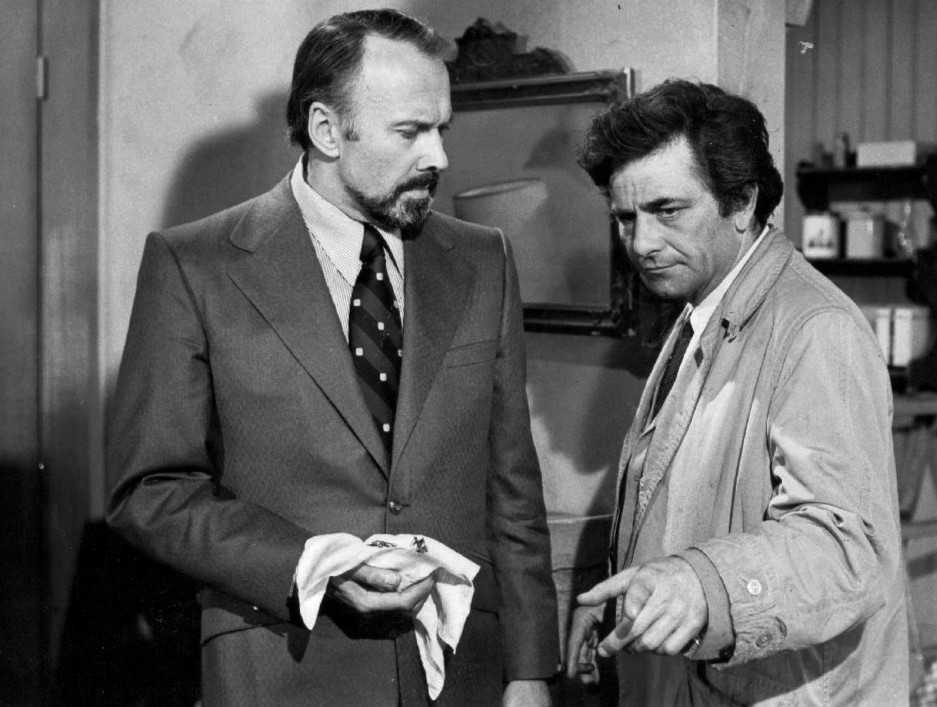
Richard Kiley isn’t an actor with whom I’m familiar, and that worked in this episode’s favour. Halperin’s neat beard and penchant for criminal masterminding put me in mind of The Master from Doctor Who. This is a man who has real presence. He may not be large in stature, but there’s something imposing about him. I completely buy him as someone who can command a force and go toe-to-toe with anyone without too much concern. That Halperin is a big time gambler almost makes sense. It serves to make him seen more dangerous.

The scenes between Kiley and Peter Falk are excellent. It’s interesting to see an established relationship, and one with the hierarchy weighted firmly in the favour of the killer. It all serves to reinforce Columbo’s commitment to justice at all costs. Even when it means taking down his boss and risking losing his job and all the benefits that come with that, there’s no sign of him flinching. In some ways it doesn’t even seem to register with him, any more than it does when other killers threaten to have him removed from the case. He doesn’t even seem to take it personally. He’s following the lines that have been drawn from victim to killer, and there’s nothing personal.


continued...
 
Top