- Awards
- 27
Hey! Don't flop my childhood memories.and notorious flop, Holiday Island.

Hey! Don't flop my childhood memories.and notorious flop, Holiday Island.
Lynn Bayonas and Brendon Lunney from those credits would later create and produce Chances, again for Nine.

Taurus Rising - 1982

After the gold standard of S&D and ACP, we return to car crash territory, as we profile the beginning of Nine's (to date) unbroken run of soap flops after it's Young Doctors / The Sullivans imperial phase. With the aforementioned wartime saga nearing it's end, Nine were on the lookout for something big and flashy to add to their schedule, in a similar vein to the US mega hits Dallas and Dynasty. Reg Watson and Grundy's were tasked with coming up with the goods and thus, Taurus Rising was born.
Like many sagas before and since, it was the tale of two wealthy families at war - the Brents and the Drysdales. Opening in the 1920's, young Isabella is jilted by Harry Brent and ends up married to the unloving James Drysdale. Jumping forward to the present day of 1982, the Brents and the Drysdales have become vicious business rivals in the intervening 60 years. Harry (Gordon Glenwright) is on his last legs, much to the delight of James and Isabella's (Georgie Sterling) businessman son Ben Drysdale (Alan Cassell). But Ben is in for a shock when his long lost love and Harry's long lost daughter Jennifer (Annette Andre) shows up at her father's deathbed, after 26 years away, with a son Mike (Andrew Clarke) in tow, that may or may not be Ben's secret son. Throw in a long suffering wife, a rich bitch daughter, a tennis playing wastrel son and a Damien from The Omen-esque child prodigy grandson, and you get the idea of the traumas that ensued.
Taurus Rising's promotion and production were marred with issues. For a start, the title confused many and cast members spent their time explaining in interviews that the show had nothing to do with the zodiac or astrology. When discussing the show at a press launch, one Nine executive cluelessly offered up the explanation of "Taurus rising from the ashes" (Taurus was actually the name of the tower that both families were battling to build in the story). In addition to this, the network were being purposely coy about the show prior to it airing, telling cast members not to discuss any details in interviews, leading Damon Herriman (Phil Drysdale) to wonder "how were people going to watch if they didn't know anything about it". Production wise, the show was facing big delays as a result of their poorly thought out choice of studio location. The Bijou Theatre in Sydney had been converted to accommodate the interior shoots. This decision didn't take into account the fact that it was under a flight path and filming had to be halted every time a plane flew overhead. They also had to stop when the nearby clock on Balmain Town Hall chimed every half hour.
Amid much hype, Taurus Rising premiered in a two hour special in July 1982. In true soap fashion, a sibling from the Grundy's stable had a hand in it's early demise, as it was scheduled against Prisoner, which was at the height of it's ratings powers on Ten at the time. On the other side, the final episodes of the ratings grabbing Brideshead Revisited were playing out. Unable to compete with either, Taurus Rising didn't stand a chance. Ratings started low and continued to fall, leading Nine to quickly pull it from it's primetime 8.30pm Tuesday slot and dump it in the 10pm slot on Fridays or Saturdays (depending on your city). Reruns of The Love Boat took it's vacated Tuesday slot, generating various headlines to the effect of Taurus Sinking / Flopping / Falling while Crawford's labelled their failing rival Pisces Plummeting. The schedule change gave the writers a clear message that their days were numbered, so they wrote a conclusion, tying up most of the series' loose ends before it was officially axed. Costing $2m to produce, it was an expensive failure for Grundy's (their most expensive at that time). In a bid to recoup some of their losses, they sold it as a 21 hour miniseries around the world, with it airing in the US, Germany and Turkey, where it became the number one show.
The same production company who produced the Restless Years with Grundy - Joop Van Den Ende, later Endemol, later produced two Dutch adaptations of British sitcoms - Vrienden Voor Het Leven (Friends for Life), a version of LWT sitcom The Two of Us, with Peter Lusse in the Nick Lyndhurst role, and Kees and Co, a adaptation of 2 point 4 children with Simone Kleinsma and Esther Roord in the Belinda Lang and Julia Hills roles. (The episodes are on YouTube).Regarding "The Restless Years": The show's concept was exported to Europe two decades later: In the Netherlands, "Goede Tijden, Slechte Tijden" debuted in 1990, and in Germany, "Gute Zeiten, Schlechte Zeiten" debuted in 1992. During their first year on the air, both shows used the same set of characters and storylines as "The Restless Years" with only minor alterations.
In the German adaption, the Archer family remained intact while in the original version, Louise and Clive were written out quite early in the show's run. The German pendants of Jeff and Carol Archer only had a few appearances whereas in the Dutch adaption, they became main characters. Also in the German version, the first incarnation of Heather Russell turned out to be an impostor when the actresses needed to be switched, which apparently didn't happen in the Australian nor the Dutch version.
Both the Dutch and the German adaption are still on the air as of today. GZSZ is the most successful show in Germany and has aired over 7.200 episodes.
Here's a comparison of the original characters ... I linked the German counterparts with character profiles (with English translations) so you can read what happened to these characters in the German adaption. The show was heavily retooled after the first 230 episodes with many of the original characters leaving and being replaced by newbies.
The Restless Years | Gute Zeiten, Schlechte Zeiten | Goede Tijden, Slechte Tijden
Peter Beckett – Peter Becker – Peter Kelder
Alan Archer – Heiko Richter – Arnie Alberts
Barry King – Patrick Graf – Rien Hogendoorn
Alison Clarke – Elke Opitz – Annette van Thijn
Penny Russell – Tina Ullrich – Linda Dekker
Raelene Geddes – Marina Geppert – Myriam van der Pol
Olivia Baxter– Julia Backhoff – Suzanne Balk
Elizabeth McKenzie – Elisabeth Meinhart – Helen Helmink
Bruce Russell – Frank Ullrich – Simon Dekker
Louise Archer – Vera Richter – Laura Alberts
Clive Archer – Clemens Richter – Robert Alberts
A.R. Jordan – A.R. Daniel – Daniël Daniël
Rita Merrick – Lilo Gottschick – Martine Hafkamp
Recurring characters and later additions during the first 230 episodes:
Jean Hutton Stafford – Claudia Wedemaier – Stephanie Kreeft
Unknown – Bertram Köhler – Jan van Ede
Unknown – Denise Köhler – Petra van Ede
Unknown – Oswald Löpelmann – Nico Stenders
Unknown – Jessica Naumann – Wil de Smet
Richard Dawson – Michael Döring – Marc de Waal
Unkown – Rüdiger Opitz – David van Tijn
Unknown – Richard Graf – Herman Hogendoorn
Heather Russell – Helga Ullrich – Jeanne Dekker
Unknown – Robert Linden – Rolf Huygens
Unknown – Alexandra Linden – Alexandra Huygens
Carol Archer – Carola Richter – Karin Alberts
Jeff Archer – Wilfried Richter – Jef Alberts
Shane Archer – Karsten Richter – John Alberts
David Harker – André Holm – David Harkema
Unknown – Holger Bachstein – Govert Harmsen
Unknown – Markus Born – Mickey Lammers
Maurice Brown – Armin Braun – Maurice de Bruin
Unknown – Sybille Vogler – Angela Nieuwkoop
Unknown – Jo Gerner – Frits van Houten
Unkown – Saskia Rother – Emma Driessen
Diane Archer – Diana Richter – Dian Alberts
Tim Watson – Tommy Walter – Tim Waterman
And here are detailed summaries of the German adaption's first year:
Episodes 1 to 100
Episodes 101 to 200
Episodes 201 to 300
I stumbled across what is possibly old news but Number 96 is now available on streaming (in Australia at least) via Brollie, the ad supported streaming service from Umbrella Entertainment. The collection includes the 19 black and white episodes from the series’ early years that weren’t wiped, followed by a bridging episode presented by Andrew Mercado (author of Super Aussie Soaps) that brings viewers up to date on the storylines from the missing episodes. They’ve then been dropping 5 episodes a week from the show’s colour era every Friday since May.Number 96 - 1972 to 1977We now enter into top tier Aussie soap territory with the saucy 70's classic Number 96. Following the lives of residents of a Sydney apartment block, it became synonymous with nudity and barmy plots during it's five and a half heady years on air and featured a horde of stars that would become familiar faces in soapland including Pat McDonald (Sons and &Daughters Fiona), Tom Oliver (Neighbours Lou) and Abigail. The show was born from Network Ten's need to compete against the higher rating Nine and Seven. Unable to afford big name US imports like the other networks, Ten decided to go for broke with a nightly adult serial in the vein of Coronation Street. Don Cash and Bill Harmon of Cash Harmon Productions pitched the idea of 96 with writer David Sale taking the reins. Sex and nudity would be the hook to pull viewers in. The show was scheduled to air five nights a week at 8.30pm with the infamous newspaper ad below heralding it's arrival. Some papers actually refused to print it, changing "virginity" to "innocence".

Straight out the gate, the show was attracting controversy as Rose (Vivienne Garrett) appeared topless in the feature length premiere (read, three episodes aired back to back), leading to enough viewer complaints that the scene was cut from broadcasts in other cities the next week. Actress Garrett was uncomfortable with the scene to begin with and butted heads further with producers over a gang rape scene that she and other actors refused to do, leading to her breaking contract and leaving the show after only five months. Regarding the nude scenes, a lot of actors signed a nudity clause at the start of the show thinking there wouldn't be nude scenes as it wasn't the done thing on Australian TV at the time but this later came back to bite them in the ass (pardon the pun) when producers pushed the boundaries of what they could show. Aside from the controversies, the show also broke ground by featuring the first interracial kiss on Australian TV and the first regular gay character on any soap anywhere in the world. Don Cash also pioneered the now common technique of shooting blocks of five episodes together by using one set to shoot a weeks worth of scenes out of sequence followed by another set and another before editing them all together at the end.
Abigail was one of the show's breakout stars but her tenure on the show wasn't without it's drama. The cast became jealous of her popularity and grew tired of her on set tardiness and she was written out briefly before returning and finally being fired over an incident where photos of her in "compromising positions" ended up in circulation after she left her handbag in a taxi (her character Bev was recast with actress Vicki Raymond). During her time on the show, Abigail did manage to appear in one of it's more controversial scenes involving a Black Mass in a church where a Satanic high priest and a number of topless characters recited the Lord's Prayer backwards. While the network had relaxed it's stance on nudity by this time, the Satanic element crossed a line for them.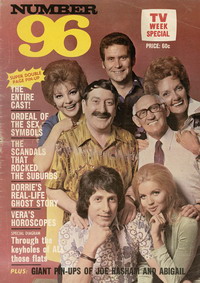
Ten's decision to go for broke paid off as their profits rose and the Number 96 cast became superstars, leading to a flurry of spinoff merchandise including the obligatory tie in novels (with names like The Grip of Evil and The Sins of Harry Collins), cast albums and a spinoff film (featuring a bedroom scene between Lou Carpenter and Jill Harper for those that are interested). One of the selling points of a spinoff film in those days was that fans could get to see their soap favourites in colour while the episodes were still going out in black and white. As the popularity grew, the show also moved away from the sex and nudity aspect and moved toward comedy characters and OTT plots and cliffhangers. However by 1975, ratings were dipping, so they wrote one of the storylines that the show is most remembered for - the bomb blast. Ten rather distastefully ran promos comparing it to real life bomb blasts in Belfast and London and while it's one of the more memorable plots, it only led to a brief ratings rise.
By 1976, the age old "schedule change" death knell was sounding as the show was reformatted into two hour long episodes a week. By 1977, the show was terminal and producers got desperate to keep it on air and decided to return to the nudity hook, this time full frontal, but the days of this grabbing ratings had passed. The move caused long time writer David Sale to quit in objection to the focus on nudity (there were scenes with characters just standing around naked) and violence and the show hurtled towards the chopping block. In a bid to salvage something from the wreckage and keep his production company afloat, Bill Harmon (Don Cash had died a number of years prior) tried a number of sitcom spinoff ideas to keep the show alive - Mummy & Me, where Reg and Edie go to work for an ad agency, Fair Game starring Vera and Bev as divorcees and another called Hope'll Help. There were also talks of spinning character Don off into a private eye drama called Law Unto Himself. None of these came to pass and Number 96 died after 1218 episodes in August 1977, taking the Cash Harmon Productions with it. The show's corpse did show a pulse a number of times after it went off air. Briefly in 1980 when it was remade by NBC in the US (it didn't last long) and again in 1990 when Ten talked about reviving it but it went no further than talks. While it's racy reputation hampered it's international sales potential (they tried unsuccessfully to sell it to European networks in Cannes using a topless model, with BBC and ITV being among those who said no) it is fondly remembered by Australian audiences today.

Number 96 is now available on streaming (in Australia at least) via Brollie, the ad supported streaming service from Umbrella Entertainment.
It would be a great DVD project for viavision although I'm not sure Umbrella would let them have it.

 tvtonight.com.au
Another chapter in Australian TV history ends, with the closure of Nunawading studios, home of soaps including Neighbours, Prisoner and Holiday Island, as well as countless other TV productions.
Punishment - 1981

With Prisoner a success internationally and it's original US broadcaster KTLA-5 willing to financially back more of the same, Grundy's started work on a male version of the show. Punishment followed the lives of the staff and inmates of Longridge Prison in New South Wales. Grundy's dream team Reg Watson and Alan Coleman would be responsible for creating and directing respectively, with $85,000 being spent on building elaborate double storey interior sets. Punishment was unusual at the time in that Grundy's were producing it first with an eye on international sales, with sales to Australian network coming second (Paradise Beach and Breakers would take similar approaches years later). As it happened, Prisoner's network Ten bought the Australian rights although the pilot did air first in the US on KTLA-5.
Much of the action was based (a bit too closely it would appear) on the original Prisoner format. Barry Crocker played straight laced Governor Alan Smith whose officers included sympathetic Mike Rogers (Ross Thompson) and bent screw Jack Hudson (Ken Wayne), who were basically the Meg and Vinegar Tits of Punishment. Fresh off his success in Mad Max, Mel Gibson added a bit of star quality to proceedings as prisoner Rick Munro. He departed after the pilot, leaving behind repeat escapee Robbo (the Doreen of the show, played by George Spartels), lifelong inmate Larry (the male Lizzie played by Mike Preston) and top dog Arthur (Jon Ewing) who was supposed to be the male Bea. Wanting to draw in the female Prisoner audience, a number of wives and girlfriends dropped in and out played by the likes of Kris McQuade, Anne Haddy and Cornelia Frances.
Bruce Best came onboard as producer after the pilot and realised that no clear plans had been made for storylines beyond the initial episode. Faced with writing for a bunch of Prisoner character clones and getting little or no feedback from Grundy's or Ten, Best decided to reinvent the show as a grittier drama in order to distance itself a bit from it's predecessor. He also threw soap convention out the window by filming with single cameras rather than the standard multi camera technique. Ten clearly weren't enamoured with the end result as they premiered the series in a Friday night death slot in February 1981 before puling it off the air after only 3 episodes. The final 23 episodes weren't aired until November during the non ratings period. Bruce Best has admitted in hindsight that the show may have been just too gritty while star Michael Smith pondered that maybe it didn't work "because the audience knew they were watching a clone". In addition to this, he raised a good question about the fact that Ten were airing three hours of prison drama a week "How many nights do you really want to sit at home watching people in prison?".
I would’ve considered this show to be “lost media” as such because there’d only ever been a few clips of it online but, two episodes (49 & 50) have surfaced in the You-sual place for anyone that’s interested. From the one episode that I have watched, it was a well produced drama, a bit on the gentler side compared to some of the others of the time. It’s worth a look to see what the last of the rural Aussie soaps looked like.Something In The Air - 2000 to 2001
In 1999, ABC's evening ratings were on the decline, so they set about commissioning a new soap to air Monday to Thursday at 6.30pm, as a lead in to their faltering 7pm news bulletin. Seven production companies were shortlisted and were then tasked with submitting scripts for four episodes. The victor to emerge from this process was production company Simpson LeMesurier (Halifax FP, Good Guys Bad Guys and Stingers) and the soap was Something in the Air. It would be the production company's first foray into soap opera and they looked back to ABC past soap success Bellbird (incidentally, SITA would be the first homegrown soap to air on ABC since Bellbird went off the air in 1977) for inspiration. "There hadn't been a rural soap since A Country Practice and there was no need for a city based show like Neighbours. We also knew at the time that the ABC was very sensitive about their regional viewers not being serviced" explained creator Roger Simpson. ABC's Sue Masters echoed his thoughts "In our hearts we felt a rural based serial would give us great freedom to create a new TV world audiences would warm to - and we liked the idea of tipping our hats to the ABC's rich tradition of long running country dramas. We have real hopes that Something in the Air will become the sort of show that families grow up with". Roger Simpson further explained the show's premise "The rural recession was a big problem at the time so we set it in a town which the railway didn't run to anymore and that became the metaphor for the show. The theme song referred to the line being closed but you can still hear the train - which harked back to the good times when the bush was profitable. The new guy to arrive from the city would become a pied piper in leading them all to a rebirth of their town. So there was as strong political agenda behind it, even though the first thing you do is bury that within the drama as that's not why people watch soaps".
The "new guy" was radio shock jock Tom Dooley (Colin Moody) who fled from the city to rural Emu Springs, a former gold mining town, after a radio stunt gone wrong threatened to land him in court. He started working at the local radio station 3ES and was soon riling up the locals with his controversial views. His new boss was ex-city banker Helen Virtue (Ulli Birve) who'd returned to her hometown with son Harry (Thomas Blackburne) following the death of her husband. Helen and Harry lived with her schoolteacher sister Sally (Danielle Carter) and her husband, farmer Joe Sabatini (Eric Bana). The local watering hole, Station Hotel, was run by ex-cop turned guidance counsellor, bookie and honorary sheriff Stuart McGregor (Frank Holden) whose teenage daughter Megan (Mariel McClorey) worked at 3ES and dreamed of a big break at a city radio station. Prisoner's Anne Phelan played Mon Taylor, who ran the general store with her husband Len (Ray Barrett) whose ailing health prompted son Wayne (Sullivan Stapleton) to return to town after being released from prison (although his parents had told everyone he'd gone off to join the army). Home and Away's Roger Oakley played cross dressing Senator Doug Rutherford, whose feminist wife Julia (Kate Fitzpatrick) had political aspirations of her own. Rounding out the cast were Dr. Eva Petrovska (Melita Jurisic), the local GP who travelled around the area on a motorised trolley via the disused railway line, Catholic priest Father Brian (Steve Adams) who played on the Emu Springs footy team alongside Ryan Cassidy (Jeremy Lindsay Taylor) who harboured dreams of working in the radio station.

Launching on 17th January 2000, Something in the Air was ABC's biggest ever first series commitment to local drama at a cost of $14.5 million (including $5 million from Simpson LeMesurier). ABC seemed either clueless or uncomfortable as to how to promote their hot new drama but ratings were good and the show started garnering a fanbase. However, behind the scenes, things were about to be turned upside down. Jonathon Shier was appointed new head of ABC, bringing with him Gail Jarvis as the new head of drama. Sue Masters, who'd championed the show, left ABC and moved to Ten. Roger Simpson recalls "We had our first meeting with the new guard and one said straight out 'I don't like the show'. It was the worst meeting in 30 years of television I've ever had, aggressive and unpleasant". When an explanation for their disdain for the show was requested, they stated they didn't like one of the actors. "It didn't seem to be based on any intimate knowledge of the series or it's aims. From that day on there was extreme disinterest from the ABC. Morale was appalling and the whole place became a mess".
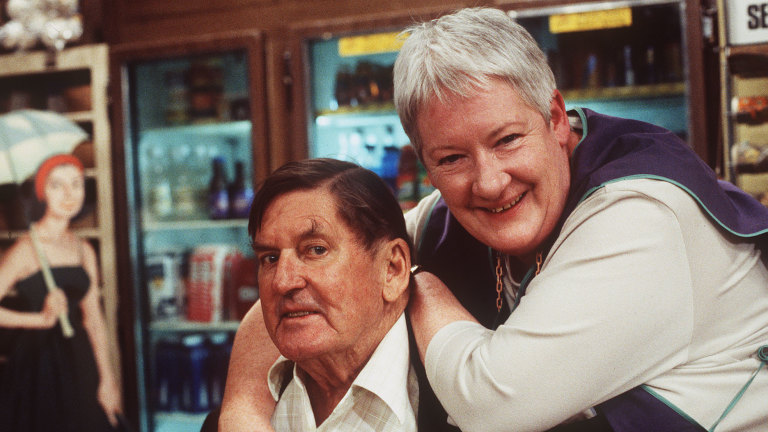
Things became messier when the ABC pulled the show from schedules to make way for two weeks of Paralympics coverage in October 2000 and then refused to put it back on until the production company agreed to reprogramming it for the second season. ABC also wanted the show to skew younger (despite ABC attracting an older audience) which meant older cast members had to go. "We didn't know who to write out and no actor volunteered to go. It was very difficult because we really loved all of the characters but in the end, we wrote out the doctor and the priest because they didn't have family". Dr Eva was replaced by Dr Annie (Nina Liu) while Father Brian disappeared after admitting he had feelings for Helen, making way for Mon's son Wayne to return as a regular. Something in the Air eventually returned to screens in March 2001, however it was now only airing two episodes a week, back to back from 7.30pm on Saturday nights (it's weekday slot had been given to a new lifestyle/current affairs show Dimensions that the new regime had commissioned). Disputes arose over the ABC asking for the end credits to be removed from the first Saturday episode and that the two episodes to be recut into one so it would run more seamlessly with Simpson LeMesurier pointing out that legally they couldn't do it because of different cast and crew working on different episodes "They ordered a serial and that's what we delivered". After poor ratings and complaints from viewers, the ABC eventually moved the show back to weekdays, albeit in the earlier slot of 6pm. "It was far too early" argued Anne Phelan, "but you have somebody in Sydney making these decisions, somebody who doesn't even bother to find out that in the country everyone watches their local news at 6pm. That's why it worked at 6.30pm. They would watch their local news at 6pm, us at 6.30 and the ABC news at 7pm". Eric Bana's departure from the show also caused issues with the ABC describing the decision to release him from his contract as "weak producing" whereas Simpson LeMesurier saying that they'd never stand in the way of somebody getting a break in Hollywood (Bana was leaving to star in Black Hawk Down).
The final months of the show played out under the cloud of the team knowing that they weren't going to be recommissioned, although the official decision wasn't announced until the show wrapped up. Producers also lamented holding back on international sales "We made a strategic mistake because we could have sold it to (UK broadcaster) ITV but they only wanted to buy a year's worth because they were making their own soap Night and Day (which would ironically end up airing briefly in the 6pm SITA timeslot on ABC). We thought long an hard about it and thought after a year we wouldn't be able to sell it to any other English broadcaster. Had we known that Night and Day was going to be a complete disaster, an ITV audience might have demanded more after watching the first series, but by then the news was out that we were doomed. The ABC had killed off any potential to sell it overseas, so it was a double disaster". The show concluded with various characters entangled in new romances and Ryan finally realising his dream of working at the radio station as he spoke the show's finally word's as he broadcast on 3ES "All is right with the world here in Emu Springs on another perfect day".
two episodes (49 & 50) have surfaced in the You-sual place for anyone that’s interested.
I think the episodes that we watched cover the fallout of the scandal. His wife made a reference to “that picture following him around”, which I’m assuming is the photo of him dressed as a woman.I was pleased that Roger Oakley featured heavily in these episodes, even if I was slightly disappointed not to see him cross-dressing
It’s a shame that the network dropped the ball with the show, because I’d say it could’ve run for a long time if they hadn’t messed about with its timeslot and format. I think a similar fate befell The Heights (on the same network). ABC seemed to have lost interest in it, somewhere between commissioning it and putting it on the air. If they were bad shows, I’d understand but both (based on the little I’ve seen of SITA) were good shows that were well written and well produced.It's nice to see that such a gentle series was still airing so late in the game.
I think the episodes that we watched cover the fallout of the scandal. His wife made a reference to “that picture following him around”, which I’m assuming is the photo of him dressed as a woman.
It’s a shame that the network dropped the ball with the show, because I’d say it could’ve run for a long time if they hadn’t messed about with its timeslot and format.
If they were bad shows, I’d understand but both (based on the little I’ve seen of SITA) were good shows that were well written and well produced.
I think the mention of Canberra was because the husband was already spending a lot of time there, through his work as a senator.It briefly threw me when his wife was talking about wanting to move to Canberra, because it felt like a soapy setup for her potentially discovering his double-life there, so for a time I wondered if she was still in the dark about it.
Yes, it was a proper multi-generational cast from what I can see but the new network regime’s decision to skew younger messed that up. Of the characters that we saw in those few episodes, the local GP was written out and replaced by a younger doctor and bar owner Len (husband of Anne Phelan’s character) was killed off.The way the Aussie TV industry works there seem to be so few good parts for actors - especially older, character actors - so a series like SITA must have seemed heaven sent. Shame it ended up being such a brief one.
I think the mention of Canberra was because the husband was already spending a lot of time there, through his work as a senator.
Of the characters that we saw in those few episodes, the local GP was written out and replaced by a younger doctor and bar owner Len (husband of Anne Phelan’s character) was killed off.
I’d need to look back at my posts or the Super Aussie Soap book but there was a Russian woman in the late 70’s / early 80’s who became a media celebrity in Australia after jumping off a ship into Sydney Harbour, in order to defect. I think she popped up in a couple of soaps around that time (possibly Holiday Island or Arcade). As she wasn’t a trained actor, I don’t know if these were regular roles or just cameos.Incidentally, the GP is possibly the first Russian character I've seen in an Aussie soap. I say possibly because it seems impossible there wasn't at least one in the thousands of hours of Aussie soap I've watched. I'm probably overlooking someone really obvious.