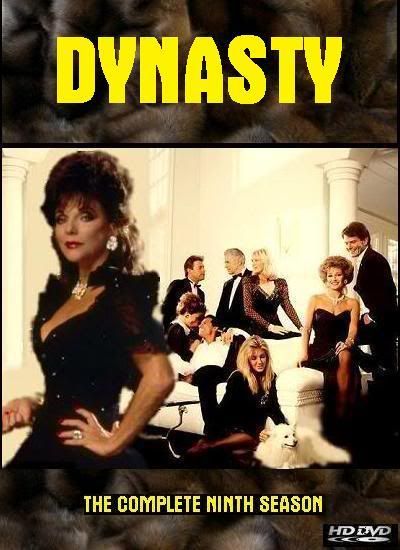
This review of Season 9 is from jacksonupperco.com and while I may not agree with all of it, I do with most of it:
DYNASTY: The ’80s Personified (Best of Season Nine)
Welcome to a new Wildcard Wednesday and the conclusion of my thoughts on
Dynasty (1981-1989, ABC), the gaudy primetime soap that I think defines ’80s television drama. When discussing both the first and second seasons, we saw how the series tried to define itself through the fantastical elements invoked by the Carringtons’ lavish lifestyle and the juicy antics of its characters, particularly the sensational Alexis, who burst onto the scene at the start of the second season and ushered in the “Golden Age” of
Dynasty. In the third and fourth seasons, we saw the show’s storytelling unravel, as style became more important than substance, while Season Five found the show at the peak of both its opulence and popularity. Then came Season Six, in which the show seemed crushed by its own weight (not to mention the spin-off it was attempting to birth), only to stage a miraculous turnaround in the last third of the season that picked up both the ratings and the quality. Unfortunately, this rejuvenation didn’t carry through to Seasons Seven or Eight, which found the series at its lowest.
Well, we’ve finally made it to the final season, which many viewers believe to represent an upsurge in quality — the kind unseen since the golden days of Year Two. I concur that this season stands as a marked difference from its predecessors, due primarily to the work of former
Dallas scribe David Paulsen (and the departure of De Blasio and the Pollocks), but I think there’s a tendency to overstate just how much of a turnaround the season is from those prior — at least with regard to narrative. In other words, the series’ penchant for ridiculous and only-occasionally character-driven stories is never deconstructed. This is still
Dynasty, and while that’s an easy comment to make — either in defense of the lower moments or as a knock to the higher ones — my point-of-view is that while the reactions the series seeks to elicit always border on the extreme, each season — and sometimes half-season — has its own unique set of strengths and weaknesses. Therefore, speaking specifically of quality, the fluctuations are only seldom as grand as our reactions would make us believe. In the case of Season Nine, the series is past the point of no return; if the writing has turned you off by now, you’re not going to come back here just because the scripts have notably, but not miraculously, improved. (It’s not the second coming of the Golden Age!) However, for those who have stuck with the series through the dark days of well, heck, Seasons Four through Eight, Season Nine
is a welcome change, and does represent the best stuff we’ve seen from the show since pre-Mark Jennings.
Speaking of Mark, Season Three is an excellent counterpoint for Season Nine, for while the former saw the series abandoning its original thesis of Krystle as the flawed fish-out-of-an-equally-flawed-water in favor of a more style-driven, less narratively concentrated (and at times, less comprehensive) modus vivendi, Season Nine restores focus. The show’s narratives can’t be improved — because the show no longer has any connection to its thesis (which is vital for the full appreciation of story) — but this season does improve the story
telling. And in some ways, that’s more satisfying. To wit: the prime strength of the final season is that every single plot is somehow connected to a single point. While the premiere has to handle the mess left by Season Eight’s staff, the opening installment concludes with the family searching for the missing Krystle (Linda Evans); in the process, they discover the body of Roger Grimes (the man with whom Alexis Carrington had an affair), whose death 25+ years before is subject to a season-long mystery, particularly as Alexis (Joan Collins) believes his murderer to have been Blake (John Forsythe). Connected to this story is the return of Sable Colby (Stephanie Beacham), who’s inadvertently responsible for the unearthing of Grimes’ body, and leads to the reveal that there’s an underground mine shaft (which had been operated by Blake’s dad, Jason Colby, and Dex’s dad on Carrington property) with stolen Nazi treasure — the storyline that also becomes a major part of the season, particularly as a corrupt cop seeks to capitalize on the discovery.
While the Nazi treasure angle is eyeroll-worthy, the Roger Grimes arc is more captivating, because it connects right into the show’s mythology, and in spite of some continuity issues, it allows the writers to refocus on the animosity that exists between Blake and Alexis, specifically the reason for her longstanding vendetta against him. This concentration is vital given the departure of Krystle, who misses the first two episodes of the year, and only appears in the next six before being carted away to Switzerland, where she’s stuck in a coma. (Another return to the series’ mythology — her medical condition is a result of falling off that horse.) Even though Krystle hadn’t been used as the series’ nucleus since Season Six, the loss of her character — when Evans’ contract ended and she decided not to renew — means that
Dynasty will never be able to fulfill its initial raison d’être. And that’s the only real detriment from the absence of her presence, because frankly, the series was having such trouble finding things for her to do that she had essentially become deadweight. In contrast, Alexis, who only appears in 13 of the 22 produced episodes due to sweeping budget cuts, remains vital to the audience’s enjoyment of the series — particularly with this back-to-basics storyline. And while we associate Collins as much with
Dynasty‘s ascent as its descent, she represents a major asset, evidenced here by the episodes in which she doesn’t appear; we miss her when she’s not around, and appreciate her more when she is. You’ll also notice that many of the best episodes are centered around her — she’s more an equal to Blake than ever (when she does appear, that is).
Pulling up the slack as the show’s resident cat is
The Colbys‘ most interesting character, Sable, who’s joined later in the season by daughter Monica (Tracy Scoggins). Now divorced from Jason, Sable’s back in town to ruin Alexis’ life for reasons that don’t become clear enough until late in the season (one of the few storytelling nitpicks here), which is easier than ever given the damage done by the late Sean Rowan. In stealing Alexis’ Natumbe oil tankers and secretly buying the hotel, Sable even goes so far as to snare Dex (Michael Nader), with whose child she becomes pregnant. At the same time, Sable shares an interesting dynamic with Blake, one in which we’re never quite sure of her true alliances and what her intentions are with him. (Will she eventually try to be his wife? Wouldn’t that be the ultimate affront to Alexis?) But her inclusion in the season bolsters its appeal stratospherically, especially when Sable is pitted directly against Alexis (and Gordon Thomson’s Adam, who’s back on his mom’s side after a rift with Blake over Krystle’s cousin Virginia — one of the season’s worst and most unrewarding stories). Many of the year’s best moments result from this conflict, and it’s clear that Paulsen knew that some sort of female rivalry was vital to
Dynasty‘s appeal — even in Krystle’s absence.
Meanwhile, among the finest and most lauded elements of the final season is the depiction of Fallon (Emma Samms), who opens the year seemingly having reverted to her original personality — you know, back when the character was portrayed by Pamela Sue Martin. Paulsen purposely decided to write the character as if Martin was still playing the role, and the results — in the beginning — are indeed electric. Although Season Eight saw her character moving slightly back to these origins (especially in the finale, when she falls back into the arms of John James’ Jeff), the damage that had been done to the character by the newly cast Samms’ having to play her with amnesia before being transplanted onto
The Colbys (with a crew who didn’t really have a grasp on how Fallon had always been presented), isn’t fully corrected until here in Season Nine, when Fallon’s portrayal is suddenly explosive again. If you close your eyes, it sounds like Martin is saying those words. Even if you squint, it looks like Martin is walking around. Unfortunately, this “Original Fallon” role only lasts for the first half of the year, as her relationship with the cop who’s trying to investigate the Grimes case, John Zorelli (Ray Abruzzo), puts Fallon back into Samms’ prior victim mode — a place she remains throughout the nevertheless brilliant reveal of Grimes’ true killer. Zorelli feels exactly like an ideal Fallon conquest (and reminds in some ways of Toscani), fitting beautifully into the season’s narrative and connecting her character to the main stories — even though this “Original Fallon” portrayal is a flash, and doesn’t have the longevity that many hope and presume.
Of the other stories worth mentioning, after the triangle between Fallon, Jeff, and Sammy Jo (Heather Locklear), the latter’s injuries sustained as a result of a crooked invesitagor hired (and then fired) by Sable — see how it’s all connected? — lead her into falling for a priest, played by Kevin Bernhardt. (Shades of
Soap…) Sammy Jo gets a fair amount to do here, but the character has been diluted so much since her debut under the laughable pretenses of growth, that sadly, she’s not as defined. The best parts of her arc this season involve the newfound friendship she develops with Fallon, which is good for both characters, and the intentional comedy that Paulsen injects in the scripts, most apparent in her scenes with Jeff. In fact,
this sense of humor, along with a self-awareness that this show has never had, is a crucial part of what distinguishes the season from its eight predecessors, and these traits are evident from the premiere to the finale, both of which are highlighted below. And speaking of the finale,
Dynasty‘s fate was all but sealed. The ratings were bad, and the final year’s move to Thursday night (opposite some of NBC Sitcom favorites) was a burial ground. With the budget trimmed significantly — you’ll notice that the series has traded in its trademark glamour for a more gritty and down-to-earth aesthetic —
Dynasty feels like it’s outlived its era.
The Reagan years are over; the ’80s are ending, and audiences no longer want material designed for a decade that’s fast concluding. They were looking to the ’90s, the future, and even though
Dynasty could attempt to keep up, the fact is: the ’80s were always a part of the show’s identity. And the series’ unspoken rejection of this larger-than-life style — a style partly corrosive to the show’s ability to tell solid stories — nevertheless represents a rejection of self.
Dynasty is the ’80s, a finite phenomenon made for an era now over, and the need for the show to continue — unresolved cliffhangers or not — is resistant to temporary spikes in quality; its time has come. Fortunately, Paulsen and company did help give the series a swan song worth recommending; it’s better than the peak of late Season Six — and again, probably represents a place of quality not seen since the early episodes of Season Three (just before Fallon’s personality began to change). So, for
Dynasty fans (or burgeoning fans), this atypical final season is a strong(er) one.
https://i0.wp.com/jacksonupperco.com/wp-content/uploads/2017/03/101609884.jpg?ssl=1

*For those interested in my thoughts on the two-part miniseries reunion that aired in 1991, I’ll tell you that it’s, of course, not very good, for it chooses to resolve the 1989 residue as quickly as possible and then resets the relationships back to 1984 (when the show was still immensely popular), essentially as a means of catering to the
memory of the show as opposed to the show itself. However, I’m also not as offended by it as most fans seem to be. I don’t think it’s an insult to the series’ storytelling; on the contrary, with the Pollocks, the Shapiros, and De Blasio at the helm, it feels
exactly like
Dynasty did. Did you expect it to be better than the series? No, if anything, it’s going to be — like
all TV reunions — cheap, schlocky, and unnecessary. And that’s precisely what this self-indulgent showcase is: typical. It’s typical for
Dynasty, and for reunions.
DYNASTY: The ’80s Personified (Best of Season Nine) | THAT'S ENTERTAINMENT! (jacksonupperco.com)