Grammarants

bmasters9

Telly Talk Mega Star
LV
5
 
Awards
11
In American English, the judgment is the accepted spelling in all circumstances.

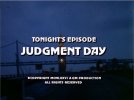
And here is one circumstance where that is used: the fourth-season episode of The Streets of San Francisco called "Judgment Day" (OAD Thursday, February 19, 1976 on ABC; from fourth go within all-in-one DVD of The Streets of San Francisco)...

streets4-2-2judgmentday.jpg

streets4-2-2menu.jpg
 

Angela Channing

Telly Talk Veteran
LV
19
 
Awards
52
This was a poster used in the UK to advertise the second Terminator film:

279313.jpg


I suppose it could be correct if you consider "Judgment Day" to be a pseudo-legal day of reckoning.
 

bmasters9

Telly Talk Mega Star
LV
5
 
Awards
11
I suppose it could be correct if you consider "Judgment Day" to be a pseudo-legal day of reckoning.

Which is, I believe, what this one and the title of that fourth-season Streets of San Francisco episode were both referring to.
 

Angela Channing

Telly Talk Veteran
LV
19
 
Awards
52
Which is, I believe, what this one and the title of that fourth-season Streets of San Francisco episode were both referring to.
However, the Streets of San Francisco (excellent series by the way) and Terminator 2 were both produced in the USA so the "e" in judgement wouldn't be required in that country in any circumstance.

I've fixed the UK poster.

279313.jpg
 

Angela Channing

Telly Talk Veteran
LV
19
 
Awards
52
Want a good laugh? Type "Judgement at Nuremberg" (the 1961 film) into Google. Both spellings are all over the page, sometimes within the same citation!
You're correct. However, as the Nuremberg trials were legal proceedings, "Judgment" (with only 1 e) should be the correct spelling in both UK and American English.

How do those unfortunate students learning English as a second language cope?
 

Daniel Avery

Admin
Top Poster Of Month
LV
9
 
Awards
24
If, like me you've had to grade the papers of American teenagers, you would recognize no coping mechanism whatsoever.
 

Angela Channing

Telly Talk Veteran
LV
19
 
Awards
52
This one isn't really about grammar and it's not really wrong but I'm finding it increasingly annoying.

I often watch a TV quiz show called Pointless and I've previously mentioned how irritating it is that so many contestants on the programme unnecessarily start sentences with the word "so". My latest bugbear is how many of them use the word "my" unnecessarily to describe things that aren't exclusively theirs. When asked what they like doing in their spare time they often say things like "I like my sport" or "I like my soap operas" or "I like my gardening". No, you like sport/soaps/gardening or you like certain types of sport/soaps/gardening but "my sport"? "My soaps?" "My gardening?" Really? Do people actually say that in real life? I've only ever heard people speak like that on TV. On a recent episode, much to my annoyance, of the 8 contestants, 6 of them (75%!) used that phraseology which would have had me pulling my hair out if I didn't have a shaven head. Maybe it's just me but I find it incredibly infuriating.
 

Mel O'Drama

Admin
LV
16
 
Awards
44
I often watch a TV quiz show called Pointless and I've previously mentioned how irritating it is that so many contestants on the programme unnecessarily start sentences with the word "so".

When asked what they like doing in their spare time they often say things like "I like my sport" or "I like my soap operas" or "I like my gardening". No, you like sport/soaps/gardening or you like certain types of sport/soaps/gardening but "my sport"? "My soaps?" "My gardening?" Really?

Well, this is a little embarrassing. I realised I, too, had mentioned the "so" thing and looked to see if it was in this thread that we'd discussed it. And I found this (warning, the first sentence might blow your mind, but it does neatly dovetail the two topics):

I love my Pointless, but the contestants on this series are the absolute worst for my other current gripe: the trend of beginning sentences with "so". Some days I just can't watch the first round when we're meeting the contestants.


:embarrassed:


The "my" thing relating to TV series reminds me of this scene:


I'm gonna miss my Sex And The City. But at least I've still got my Frasier and my Friends.


Do people actually say that in real life? I've only ever heard people speak like that on TV. On a recent episode, much to my annoyance, of the 8 contestants, 6 of them (75%!)

Actually, I don't think I would say that in real life, so I suppose I don't always write as I speak. I'm wondering if the "my" thing is a kind of shorthand for something someone has as a pastime, hobby or even interest, a way of claiming it as something that's part of their world on a regular basis.

As far as the latter part of the point you make, I do wonder if there's a kind of "monkey see, monkey do" kind of effect going on. One contestant says it and the next one picks up on the same language (probably without even realising) and by the third or fourth it almost seems mandatory. It would be interesting to know if it is a conscious thing as part of a desire to fit in or match what's going on around them.
 

Angela Channing

Telly Talk Veteran
LV
19
 
Awards
52
Well, this is a little embarrassing. I realised I, too, had mentioned the "so" thing and looked to see if it was in this thread that we'd discussed it. And I found this (warning, the first sentence might blow your mind, but it does neatly dovetail the two topics):
Maybe it's just me but my goodness I'm finding it really annoying and now that I've noticed it, I specifically listen out for it just to annoy myself!

I'm wondering if the "my" thing is a kind of shorthand for something someone has as a pastime, hobby or even interest, a way of claiming it as something that's part of their world on a regular basis.
I think you're right. It's a way that people can feel like something is special to them, almost like they own it even though they don't.

One contestant says it and the next one picks up on the same language (probably without even realising) and by the third or fourth it almost seems mandatory. It would be interesting to know if it is a conscious thing as part of a desire to fit in or match what's going on around them.
Yes, I suspect there was an element of groupthink going on in that episode but the fact that so many of them picked up on it to subconsciously use that phraseology could suggest that even they thought it stood out in a way that couldn't be ignored i.e., they also found it annoying. However, under the pressure of being in a TV studio their better judgment went and they just repeated it without thinking.
 

Daniel Avery

Admin
Top Poster Of Month
LV
9
 
Awards
24
Daytime soaps used to be much more important in the lives of people (especially housewives), so you often heard people refer to "my stories," a reference back to when they were on the radio that carried over when they transitioned to TV. Actually, I would say the reason they became known as "stories" rather than identified as "soaps" or "programs" early on was because radio soaps had only dialogue to rely upon, much like someone reading a story aloud rather than watching something being acted out. But the soaps became such an important emotional outlet and such a part of their day/routine that I can see why they'd say "my" stories. They were not watching/listening to those soaps with a group; they were typically alone at home with only the kids (if there were any), so they might say the soaps were "my" personal, daily event/experience.

 

Seaviewer

Telly Talk Warrior
LV
9
 
Awards
20
I don't say it myself but I've heard it, especially the "my sport'. Also, in the third person: "he loves his sport." It makes sense if it's a player, not so much for a spectator.
 

Seaviewer

Telly Talk Warrior
LV
9
 
Awards
20
Using a metaphor from one sport to describe another.
Here's a another good one I heard yesterday:
Australia's performance in world ten pin bowling rated as "punching above our weight."
In fact the phrase punching above our weight has become quite common in similar contexts but here it seemed especially striking (pun not intended).
 

DallasFanForever

Telly Talk Supreme
LV
5
 
Awards
17
Here's a another good one I heard yesterday:
Australia's performance in world ten pin bowling rated as "punching above our weight."
In fact the phrase punching above our weight has become quite common in similar contexts but here it seemed especially striking (pun not intended).
Your post got me to thinking about a sports related word I can’t stand: GOAT. For many, many years GOAT meant someone who cost their team the game, made a huge mistake, etc. Of course, now to call someone the GOAT means calling them the greatest of all time. Well, I still say it the long way because I refuse to call someone a GOAT. I’m sorry but it just doesn’t sound positive to me to look at someone and say he or she is the GOAT.
 

DallasFanForever

Telly Talk Supreme
LV
5
 
Awards
17
You're right. Charlie Brown was always afraid of trying to be the hero but ending up the goat.
It’s funny cause if you go back now and look up old interviews you will hear athletes and stars talking about NOT wanting to be the goat when they perform. This confuses my nephew who’s 18 cause obviously to him goat means an entirely different thing. Explaining the difference to him makes me feel old but that’s a story for a different thread I guess.
 

Angela Channing

Telly Talk Veteran
LV
19
 
Awards
52
Oxford commas are in the news because one of the priorities of our new health secretary, Therese Coffey, isn't to sort out long hopsital waiting lists but to stop her staff from using Oxford commas.


Personally, until now I've never used the term "Oxford commas" I previously thought they were called serial commas. I never use them myself but I can see how in some circumstances they are an acceptable option.

Oxford commas are the last comma in a list, for example:

The best TV shows of the 1980s were soaps operas, Dallas, Falcon Crest, Knots Landing, and The Thorn Birds.

The comma after Knots Landing and before the word "and" is a serial, or Oxford, comma.

Do you ever use for Oxford commas?
 

Willie Oleson

Telly Talk Schemer
LV
9
 
Awards
27
The best TV shows of the 1980s were soaps operas, Dallas, Falcon Crest, Knots Landing, and The Thorn Birds.
And how about the comma between soap operas and Dallas? Because now it reads like "soap operas and Dallas and Falcon Crest" etc.

I don't know what the Thorn Birds is doing in that list, or why Dynasty isn't in it.
 

Angela Channing

Telly Talk Veteran
LV
19
 
Awards
52
And how about the comma between soap operas and Dallas? Because now it reads like "soap operas and Dallas and Falcon Crest" etc.

I don't know what the Thorn Birds is doing in that list, or why Dynasty isn't in it.
I deliberately constructed the sentence that way to make my point how the absence or presence of the "Oxford comma" can change the meaning of the sentence and I included the comma you refer to in order to emphasise my point.

In the sentence the Oxford comma can been seen as being necessary because it indicates that everything before it is in a different category (soap operas) to everything after it. It can be read as the best show are soap operas and also The Thorn Birds. Without that Oxford comma, it's suggesting the Thorn Birds is a soap opera.

The best TV shows of the 1980s were soaps operas, Dallas, Falcon Crest, Knots Landing, and The Thorn Birds.

The first comma suggests that Dallas, Falcon Crest and Knots Landing are in a different category to soap operas.

I never really thought about this that much until I read an article about Oxford commas this week because I would normally construct my sentences in a way that wouldn't require me to use them but I now realise that in certain circumstances they are necessary
 
Top