A Vanity Fair article from a decade ago:
https://www.vanityfair.com/news/2008/01/dickinson200801
A Legend with Legs
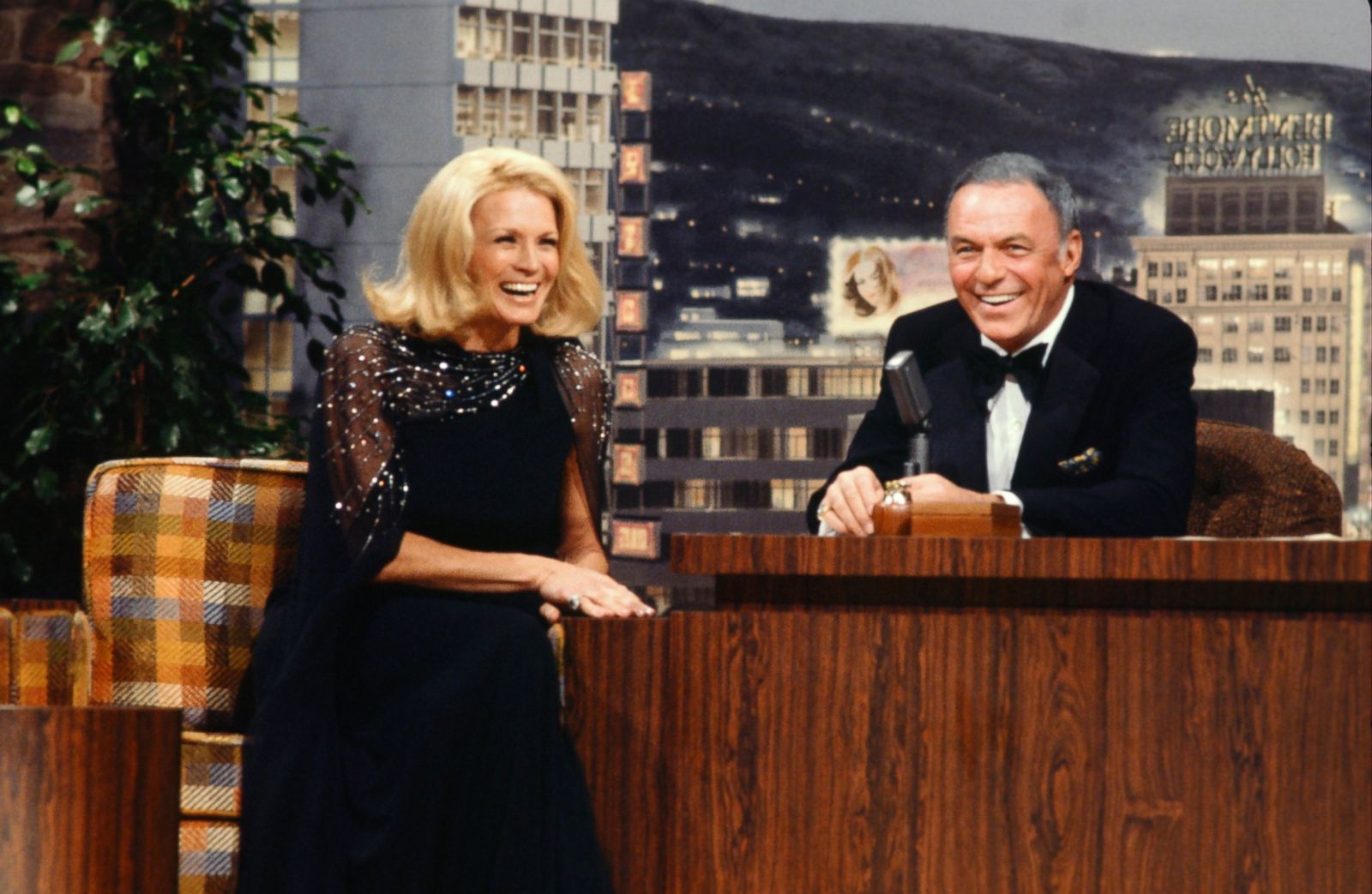
The secret crush of generations of male moviegoers, Angie Dickinson walked into Hollywood history as the Rat Pack’s gal pal, kicking off a 10-year affair with Frank Sinatra, playing his wife in the original
Ocean’s Eleven, and catching the eye (if not more) of J.F.K. Now 76, Dickinson talks about her marriage to Burt Bacharach, the tragedy of their daughter’s struggle with Asperger’s, and an erratic but memorable career—including the groundbreaking cop show
Police Woman and her classic reverse striptease in
Dressed to Kill.
'There’s a part of her that’s a phantom, and a part of her that’s very much alive.'
By Sam Kashner
Fourteen years ago, Angie Dickinson did the unthinkable: she walked off the television program
This Is Your Life, leaving its host, Ralph Edwards, and a collection of Dickinson’s family and celebrity and hometown friends stranded on the set.
Edwards had lured her with the pretense that she would be meeting with Brian De Palma, who directed her so magnificently in the 1980 thriller
Dressed to Kill, to talk about directors and actors. Instead, “they had assembled all these people,” Dickinson explains over dinner in West Hollywood, “my sister Janet, my daughter, Nikki, even an old high-school boyfriend. Bob Hope had left a dinner with President Ford and Colin Powell to be part of this, and of course they all had to go home.” That had never happened in the history of the show. When asked why she refused to allow the assembled crowd to honor her, she replies, “All these people are supposed to come around and rave about you. I think they should have organized it the other way around, so I could have talked about their importance.”
Her refusal to be part of that show is one of the many things that Los Angeles novelist and screenwriter Bruce Wagner—who wrote the 1993 mini-series
Wild Palms, in which Dickinson played Josie Ito, a sexy, villainous grandma—loves about the actress: “That was so ballsy and so antithetical to the culture,” he says. “Knowing Angie, you would think she’d have no trouble with that show; she’d think it was a hoot.” He compares Dickinson to British actress Jacqueline Bisset: “There’s a kind of easiness about the way they carry themselves in the world, a kind of devil-may-care, sexually charged quality. They’ve really seen it all and done it all and don’t give a damn—but in a really elegant way.”
That was not the only time Dickinson—born Angeline Brown in North Dakota in 1931—balked about revealing her personal life. In 1989 she returned a six-figure advance from a major publisher for her autobiography. What was it that she couldn’t bring herself to tell? Rumors had swirled around her for decades: about an affair with President Kennedy during the four-day inaugural celebration; about her on-again, off-again 10-year love affair with Frank Sinatra; and about the dissolution of her marriage to songwriter Burt Bacharach. Were there other secrets as well? And for an actress as good, as professional, and as beloved as Angie Dickinson, why were there so few major film roles?
“I was a leading lady,” she says, “but never the lead.”
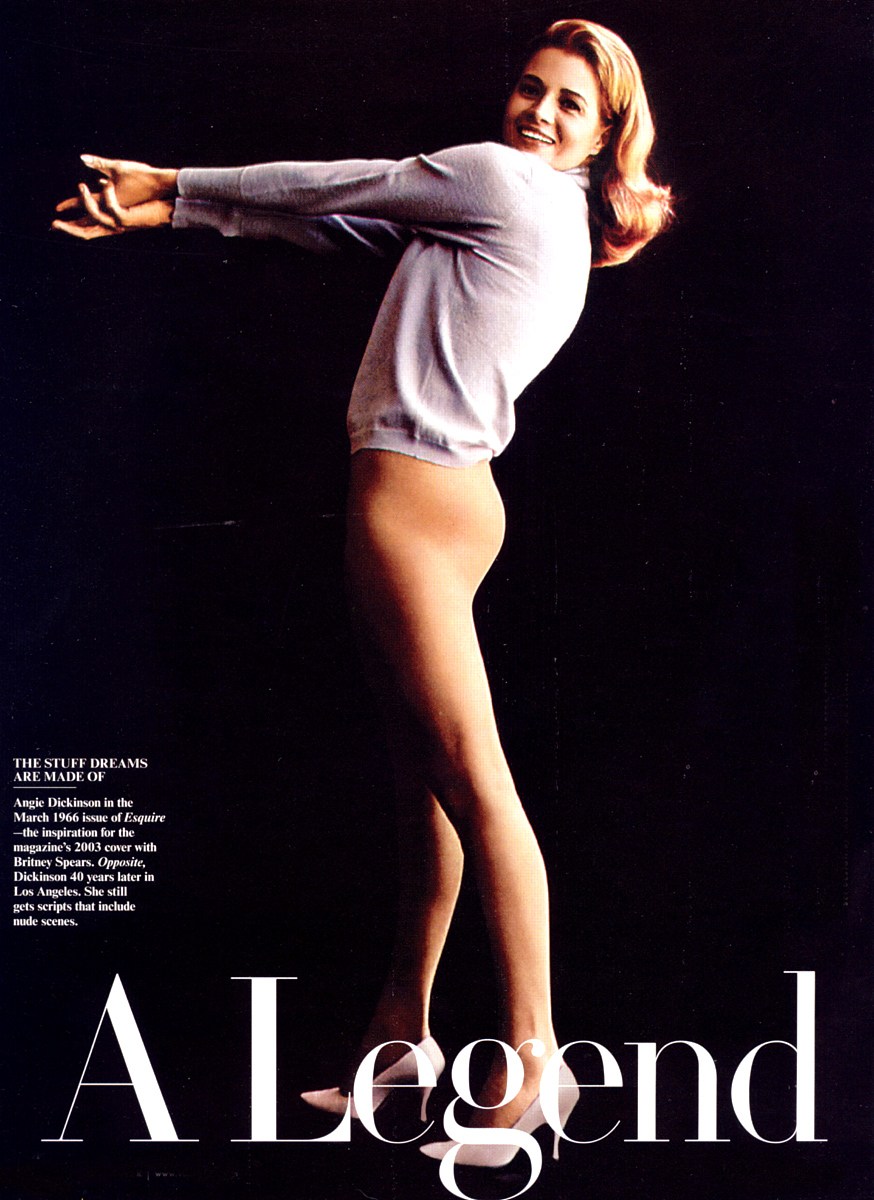
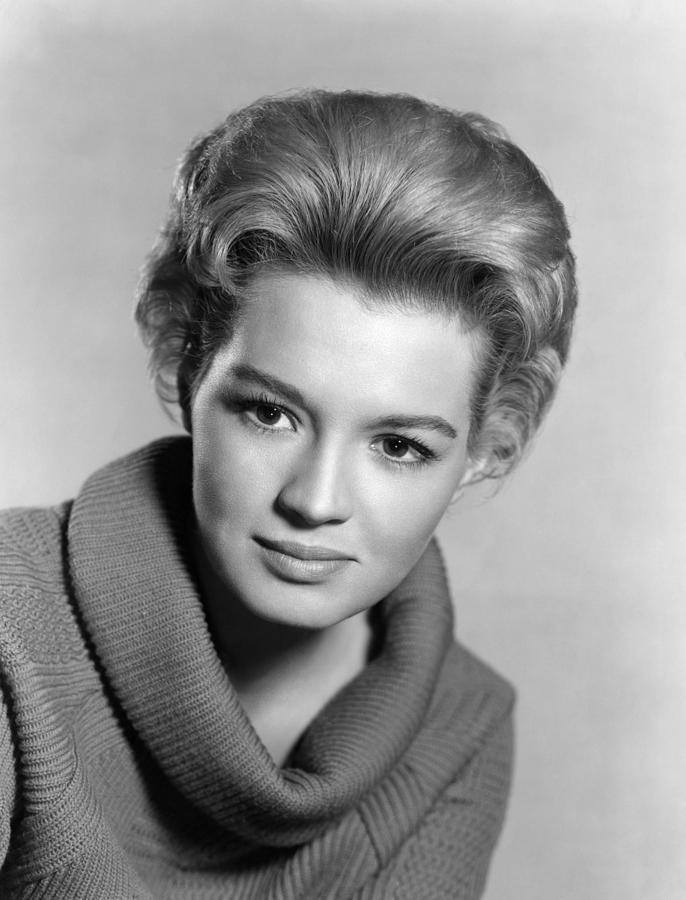
A veteran of more than 89 films and television movies and well over a hundred TV appearances, she still gets scripts that ask her to do nude scenes. “Don’t they know I’m an old lady?” she says, laughing. At 76, Dickinson still attracts admiring glances, though she apologizes for “not having the Angie Look” anymore. But she does: the champagne-colored hair, the warm, flirty eyes, the sensual mouth, the peach-melba voice—in short, the epitome of the game blonde with class and brains.
“You know my story. I’m pretty,” Dickinson says as Sheila Farr, the femme fatale nonpareil in Don Siegel’s thrilling 1964
noir film,
The Killers, in which she seduces a racecar driver, intensely played by John Cassavetes, and leads him to his doom. Dickinson’s Sheila is so seductive, so sympathetic, that when she finally shows her true, treacherous nature, you gasp. The most terrifying moment in the film is when Lee Marvin, playing a vicious hit man, dangles her by her ankles from a hotel window. She also gets slapped hard across the face by Ronald Reagan, in his last film role and his only one as a villain. For years after, he would apologize to her. “He was uncomfortable playing the villain,” Dickinson says, “and only did so to fulfill his contract.”
Film historian David Thomson claims that Dickinson is his favorite actress, “a woman you thought of as a pal, always effective, a reliable doll,” though he admits that “there was a moment when it looked as if she could do a great deal more than she did.” If she never won an Academy Award or achieved the superstar status of Marilyn Monroe or Elizabeth Taylor, she still remains the secret crush of generations of male moviegoers. Mention her name and eyes light up.
It’s not just Old Hollywood that remains entranced with Angie Dickinson. Younger, hip directors do too. Gus Van Sant cast her in
Only Cowgirls Get the Blues. Steven Soderbergh made sure she had a cameo in his remake of
Ocean’s Eleven. And when Brian De Palma cast her as the sensual, adulterous wife in
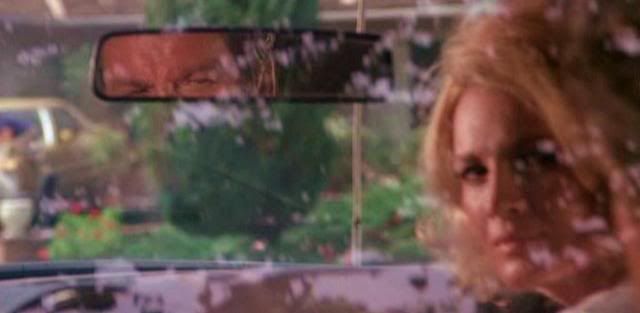
Dressed to Kill, it was because he needed someone who would immediately establish a sympathetic bond with the audience—someone we already knew and loved.
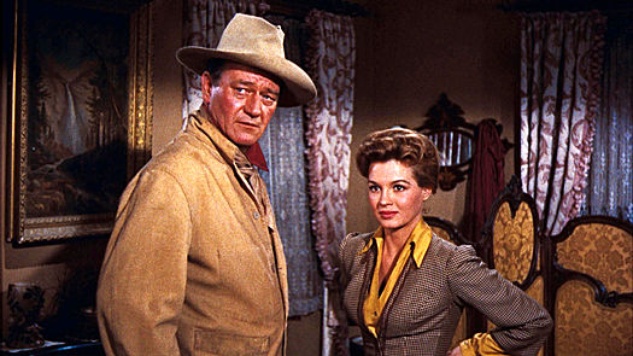
The character of “Feathers” (usually just called “The Girl”) in Howard Hawks’s 1959 Western,
Rio Bravo, put her on the map. Cast as a flirtatious saloon girl, she likes to please men, or, in this case, The Man (John Wayne, as Sheriff John “T for Trouble” Chance). But there’s never a weak or passive aspect to her performance. “I’m hard to get, John T.,” she says to the stoic Wayne. “You’re going to have to say you want me.” There’s a similar self-assurance in all the characters she has played—what one critic called “a quasi-liberated, pre–Women’s Liberation woman.”
Hawks, who also discovered Lauren Bacall, first noticed Dickinson in an episode of
Perry Mason, which he watched at the suggestion of his elegant wife, Slim Keith. But when he chose Dickinson, Slim remarked, “Really? I’m surprised.” And Hawks replied, “That’s what I wanted you to say.” Dickinson wasn’t exactly a newcomer: she had already appeared in seven films and had played the female lead, “Lucky Legs,” in Sam Fuller’s 1957 melodrama
China Gate. As a Eurasian good-time girl whose marriage to Gene Barry is derailed by the birth of her Chinese baby, Dickinson at 25 is stunning and her confidence borders on bravado.
She was born in the North Dakota prairie town of Kulm (pronounced “Kulum”), settled by Germans, and then moved to the even smaller town of Edgeley. “Some say that L. Frank Baum, who wrote
The Wizard of Oz, used Edgeley to describe the edge of the world,” Dickinson says, “and it wasn’t Kansas, it was North Dakota.” It was “smaller than small, and then again, it was the Depression.” Her parents published two newspapers when Angie and her two sisters, Janet and Mary Lou, were growing up: the
Kulm Messenger and the
Edgeley Mail. “My father, Leo Henry Brown, really was talented—he could write. He had a gift, and he had a great, sly humor. He was handsome, he was tall. He taught my mother how to run a Linotype, and they had that big roller—everybody working on that,” Dickinson recalls.
Like many of his generation, Angie’s father lied about his age to get into the navy at the outset of the First World War. “But his stepfather died, and he had to come home and take care of his mother I think his dreams were smashed. He’d wanted to play the saxophone, he’d wanted to be a veterinarian, so I think he was one of those sad people who didn’t get what he wanted in life.” Instead, he became an alcoholic. “It made it hard at home. You don’t know if that’s what gave you the drive to say I’m never going to be stuck like that. I loved him, but you can’t love the life—the life is horrible. Just remember this was Kulm, North Dakota, population 700, the end of the war, the Depression. It all adds up to what you are.”
Dickinson did what every other child with imagination and hope did during the Depression: she went to the movies. And she found herself identifying not with the leading ladies of the day—Marlene Dietrich, Betty Grable, and Lana Turner—but with the men. “I remember a Humphrey Bogart movie where he was a reporter, so I wanted to be a reporter, and then he was a parachutist and I wanted to be a parachutist,” she says. “Even a priest, when Gregory Peck was a priest in
Keys to the Kingdom, because the women didn’t do anything! They were just wives or old maids. I wanted to look like Dietrich or Grable or Lana Turner, but I wanted to do what the men did.”
After the war, her parents moved the family to California, where her mother worked as a proofreader for the
Burbank Review (“She could spell any word there was”) and her father “shuffled around from job to job, poor soul.” Angie attended Glendale College, and in 1952 she met and married Gene Dickinson—a big, good-looking football star with a passion for electronics. They divorced in 1960, and she went to work as a secretary at an airplane factory. She came in second at a local preliminary for the Miss America contest, and that got the attention of a casting agent, who landed her a spot as one of six long-stemmed showgirls on
The Jimmy Durante Show.
That’s where she met Frank Sinatra, who was a guest star on the television show. “It was my first show, my first step onto a professional stage. I had not even seen one before. I had come from work in a fill-in job, and I stepped on the stage, and there were Frank Sinatra and Jimmy Durante, working. I just walked in and thought, Oh my God, this is what I want to be a part of.”
That’s one reason she believes that “the most important man in my life was Frank. He was so important, because he was so powerful when I got to meet him.” In 1960, Dickinson played the estranged wife, Beatrice, of Sinatra’s Danny Ocean in the Las Vegas caper film
Ocean’s Eleven, and by that time she was the gal pal of the Rat Pack, the one woman they would let in the room, who could beat them at poker and tell a bawdy story. “The part of Bea Ocean is too small for a star, so I was lucky to get it,” she says. It is indeed a small role—she has only two scenes, both with Sinatra, but the chemistry between them is unmistakable. Watching the film today, Dickinson comments, “Look at that face!” She’s still entranced by him.
“Frank and I stayed friends for all those years, and it was just one of those great, comfortable things, where you always desire somebody, but you can live without them,” she says about their 10-year affair. Sinatra would park his Dual-Ghia behind her house, Dickinson recalls, and in the morning “the garbagemen would come and hang around the car,” she says with a husky laugh. “It was wonderful, it was kind of perfect,” she adds, “but I don’t think he ever had a great passion for me, which is why I think it lasted as long as it did. And I for him. There’s a difference between having to have something and wanting something.”

Another part of Sinatra’s life that Dickinson shared was his involvement with the Kennedys. “It was Frank who brought me in,” she says, recalling a big party given by J.F.K.’s sister Pat and her husband, Peter Lawford, at their beachfront home in Santa Monica, just before the 1960 Democratic convention, in Los Angeles. “The future president was there,” she says, “and Joe Kennedy, and Bobby and Eunice and Pat, of course—and Frank. We were feverish to work for him, which is why I got invited to the inauguration. It was an electrifying time.” Dickinson believes it was her role in
Ocean’s Eleven that made her so welcome with the Kennedy family. Sinatra, the film’s guiding spirit as well as its star, sent a copy of the movie before it was released to the Kennedy compound in Hyannis Port. “I was Frank’s wife in the movie, so I was already one of the boys!”
“We went barnstorming to seven states,” Dickinson recalls, “and we picked up athletes like [baseball stars] Stan Musial and Ernie Banks.” None of those seven states broke for Kennedy, but she felt they reduced the margin. Dickinson missed the inaugural parade because she had to spend the day getting her hair fixed for the ball later that night (“There were no hot curlers in those days!”). The night before, there was a gala put on by Sinatra at the National Guard Armory (with Jimmy Durante, Gene Kelly, Shirley MacLaine, Ella Fitzgerald, and many others), and then the president-elect went to Paul Young’s restaurant for a late-night dinner hosted by his father. Among the guests was Paul “Red” Fay Jr., a friend who’d served with J.F.K. in World War II, who would soon become undersecretary of the navy. In his 1966 memoir,
The Pleasure of His Company, Fay recalled that his assignment that night was to escort Dickinson, a date arranged by Ethel Kennedy. He recalled Angie “wrapped in fur, standing all alone,” and many have speculated that Fay was merely the “beard.”
That night Kennedy teased Fay and flirted with Dickinson. Since then the rumor of an affair with J.F.K. has clung to Dickinson like the fur coat she wore that cold January evening. It comes up again and again, and she’s quick to show her displeasure when asked about Fay’s book. “He shouldn’t have written it,” she says. “It was too personal.” The persistent rumor is “kind of like having a broken wrist,” Dickinson admits. “It’s an annoyance, but I have to live with it.” According to one source, her unwillingness to publish anything about her relationship with Kennedy is why she returned her advance to the publisher. She had completed more than 100 pages, with “all the details of her affair with the president intact.”
‘I thought better of it,” she says today. “I didn’t want to let it go out,” so she withdrew the manuscript. “They wouldn’t believe me if I said it never happened Anyway, it’s time for everybody to grow up about the Kennedys. It’s more important what we lost as a country.” It was during the making of
The Killers, with future president Ronald Reagan on the set, that she first heard the news that the president had been assassinated in Dallas. David Thomson assumes the rumor of a Kennedy affair is true, but lauds Dickinson because she has never once “talked about it publicly, taken advantage of it, tried to use it to boost her celebrity, or said one word to detract from the dignity of the presidency.” Or, more to the point, as Sinatra liked to say about Dickinson: “How wonderful it is to meet a lady who’s a gentleman.”
Indeed, when asked her opinion of the impeachment of President Clinton in 1998 over the Lewinsky scandal, she rises to his defense. “I think it was a terrible thing. He did so many great things for this country, and when they go after you, if they can’t find anything, that’s when they go after the genitals!”
She met President Clinton once, at a Democratic fund-raiser given by film mogul Lew Wasserman. “I was standing next to [actress] Suzanne Pleshette on the receiving line,” she recalls about the encounter, “and as he got closer, I said to her, ‘My God, I’m beginning to sweat!’ And then he was in front of me, bigger than life, and so great-looking. He said when he met me, ‘At last!’” He must have known of her long-standing connection to the Kennedys and her support for Democrats. In fact, she once famously joked, “I have never knowingly dated a Republican.”
In the 1960s, Dickinson played the female leads in a number of compelling films (
The Sins of Rachel Cade, Jessica, Cast a Giant Shadow), but that star-making role eluded her, and her parts—though good—did not give her a lot of screen time. After
The Killers, Dickinson accepted a small role as the sheriff’s wife in Arthur Penn’s 1966 film,
The Chase, because it gave her the chance to play opposite Marlon Brando. Lillian Hellman wrote the overheated screenplay, and the rest of the large cast—including James Fox, Robert Duvall, E. G. Marshall, Jane Fonda, and a wildly miscast Robert Redford—all seem to be acting in different movies. Only Brando and Dickinson are true and sure.
“The director, the screenwriter, and Brando all wanted different things,” Dickinson explains. “I was totally in awe to be working with Brando, who made me feel part of the group. He didn’t ad-lib just to smart off. He did it to add to the scene, and he wanted me to feel that comfortable. I watched him, and it was as if there wasn’t a camera in sight. He was so rich, he just exuded a greatness, and yet a comfortableness. We’d sit in his trailer and talk, and he’d tease me to death—it was all part of him making me feel less intimidated and able to work.” But, generally, away from the cameras, she notes, “he liked to make people squirm.”
In 1967, John Boorman directed Dickinson and Lee Marvin (who had played one of the relentless hit men in
The Killers) in the chilling
Point Blank, a
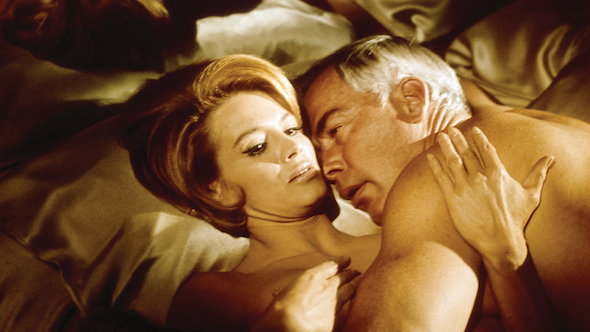
noir film about a double-crossed man who obsessively tries to recover a fortune stolen from him by the Mob. Dickinson has a steamy sex scene with the film’s villain, John Vernon, but what everyone remembers from the film is her pummeling of Lee Marvin, who refuses to give up his search for the stolen loot. She stands there and beats his chest with her fists, much longer than you expect her to, until she finally collapses on the floor. In the next moment she belts him with a pool cue, and actually opens a gash on his face.
“She was very enthusiastic about it,” Boorman recalls from his home in Ireland, “because I think she was taking revenge on Lee Marvin for holding her upside down out the window in
The Killers. She didn’t get on with Lee, really. She was afraid of him in a sense, uneasy with the character Lee was playing—a terrifying figure. When she got into that scene, she really went for it. She went beyond what was required. He stood there impassively, which was exactly that character, but the next day he was covered in bruises.” (Boorman did feel, however, that Dickinson eventually felt “an affection for Marvin.”)
Boorman adds, “I do think I photographed her well. We were shooting in February of ’66, I think, and I put her in the first miniskirt to hit America. They were already, you know, on the Kings Road in London, but she wore the first one seen in America. She had the legs for it.” Indeed, she was given the Golden Garter Award for “Hollywood’s Greatest Gams” in 1962 and voted the actress with “the most beautiful legs in Hollywood” by the L.A. County Podiatry Association in 1981. Boorman confesses that Dickinson “was very unhappy with me about forcing her to change her hair color. I had this maniacal idea that I wanted her hair to be the same color as her dress, and we went through three dyeing jobs to get there. The hairdresser at MGM said, ‘I can’t go any further, her hair’s starting to break off.’”
And then, for a while, the terrific roles stopped coming. It’s hard to know why. Bruce Wagner says, “You know, I think it’s just the luck of the draw, the throw of the die. Angie is completely iconic, and yet perhaps never got those roles—or passed them over—that would have made her a much bigger star than she is.” A slew of younger actresses—Jane Fonda, Mia Farrow, Julie Christie, Faye Dunaway—got the plums instead:
Klute, Rosemary’s Baby, Doctor Zhivago, Bonnie and Clyde. At this point in her career, Dickinson contemplated a move to Paris, where
The Killers and
Point Blank had given her star status. (There’s nothing the French love more than a good
noir.) She began studying French, but stayed in L.A.
By the time she met Burt Bacharach, in 1964, her career had cooled, just as his was reaching for the stratosphere. They were married on May 5, 1965, in the Silver Bell wedding chapel in Las Vegas. The ceremony was attended by Ricky Nelson’s older brother, David, and the producer and über-agent Charles K. Feldman.
Shortly after their marriage, Bacharach, a former accompanist for Marlene Dietrich’s Las Vegas show, was handed the opportunity to score his first film,
What’s New, Pussycat?, and the title song became a huge hit for Tom Jones. There was also a spate of hit songs performed by Dionne Warwick (“Walk On By” and “Do You Know the Way to San José”), Dusty Springfield (“The Look of Love”), and Jackie DeShannon (“What the World Needs Now”).
An Academy Award for best song, for “Raindrops Keep Fallin’ on My Head,” from
Butch Cassidy and the Sundance Kid, arrived in 1970. For a time, they were Hollywood’s most glamorous couple; with her pale blond hair and his gold records, they practically shimmered. “You couldn’t be a hotter couple than Angie and Burt in those days,” says Wagner. But, in fact, Dickinson noticed that the power equation in their relationship changed on the night of the Academy Awards, with 60 million people watching: “The audience loved ‘Raindrops Keep Fallin’ on My Head,’ and they loved the attractive man who wrote it,” she says. Photographers practically knocked her down in their rush to get pictures of Bacharach.
In 1966, their only child, a daughter named Lea Nikki, had been born three months prematurely and weighed not quite 29 ounces. “It was the nurses who named her,” Dickinson says, “because nobody thought she would live.” Mother and infant barely survived, and Nikki’s prematurity would have serious consequences down the road.
Dickinson continued to work in film, though in smallish roles in Westerns such as
Sam Whiskey, with Burt Reynolds, and
Young Billy Young, with Robert Mitchum. In l974 she made a rollicking, lightweight Roger Corman film,
Big Bad Mama, “basically a rip-off of
Bonnie and Clyde,” she says now, with Tom Skerritt and William Shatner. Again, she has a number of incredibly sexy love scenes with her two leading men, and her nudity, at 43, is breathtaking.
Her marriage to Bacharach lasted 15 years. Dickinson later felt that she had “held on too tight” in caring for her daughter. “I spoiled her. It obviously damaged the marriage, plus we had other problems. We really never should have married. We should have stayed in a romance, in love, and I should have walked away long before.” When Dickinson was offered a role in a new television cop show,
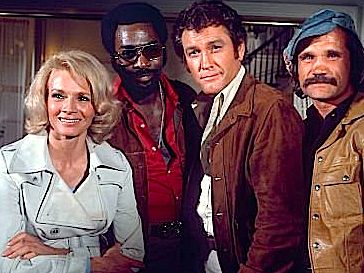
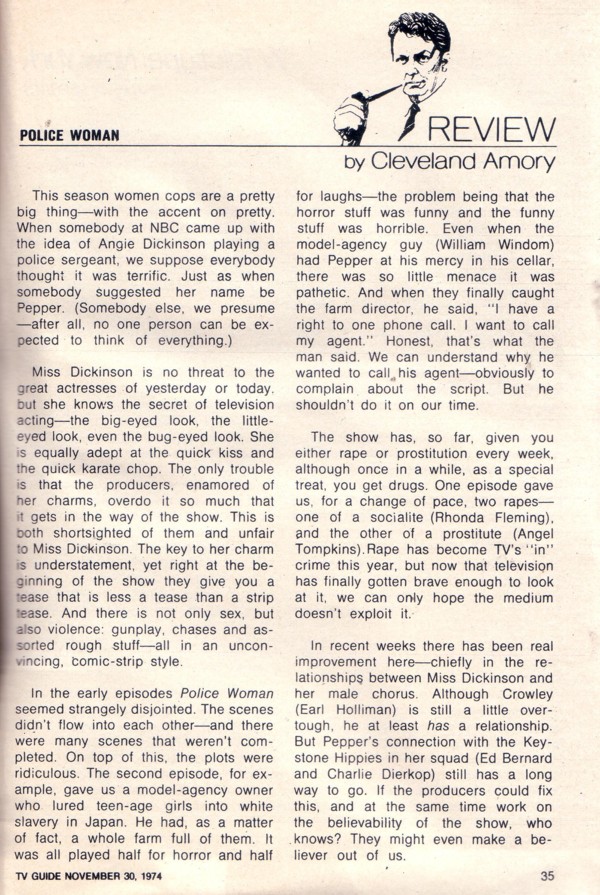
Police Woman, she asked Bacharach if she should do it, and he said yes. It became a smash hit, one of the first successful crime dramas in television history to feature a female lead.
“It was the cement block that landed on our marriage,” Dickinson now says. After the failure of
Lost Horizon in 1973, for which Bacharach composed the music, his career went into the wilderness, while Dickinson’s shifted into high gear. “It was hard,” she admits, and the grueling schedule was even harder—12-hour days on location six days a week. Her not coming home was difficult for Bacharach, she recalls, “and he’s a New Yorker, used to going out at night after working.” She was disappointed when he declined to write the theme music for
Police Woman, because, Dickinson says, “he didn’t think it was going to be a hit.” Bacharach did, however, compose a piece for his daughter, “Nikki’s Theme,” for an
ABC Movie of the Week.
“It was exciting when it was good—and it was great a lot of the time,” she now says about the marriage, but they separated in 1976 and divorced four years later.
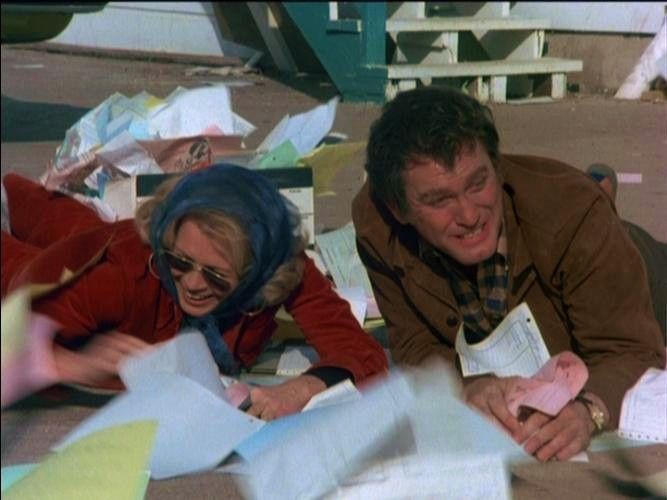
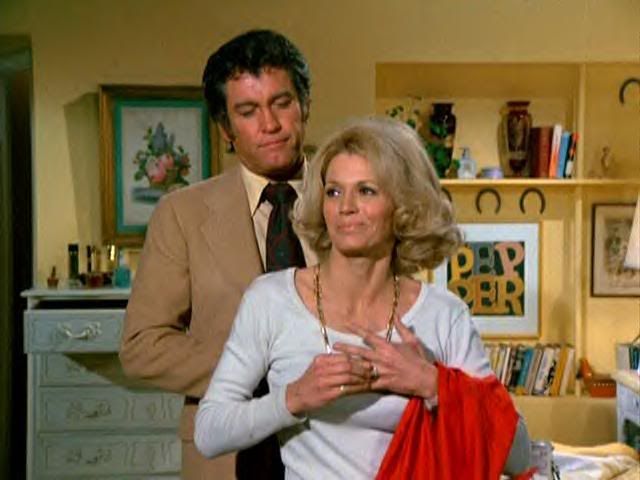
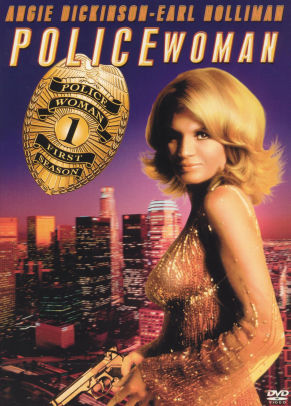
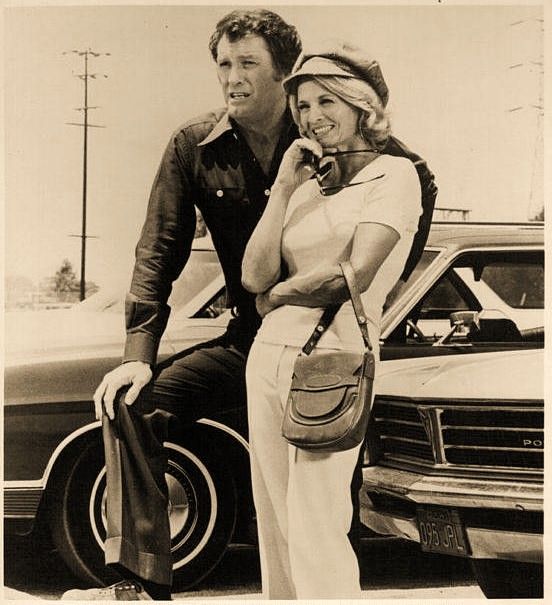
Police Woman—released in 2006 on DVD with Dickinson’s commentary—ran from 1974 to 1978 and earned Dickinson three Emmy nominations. Her Sergeant Suzanne “Pepper” Anderson was among the first of a new wave of tough, resourceful female action heroes who could hold their own in a man’s world. She was perfect for the role—that independent spirit coupled with a willingness to go undercover as a hooker or a moll, to be “eye candy”—and she was grateful to have the series. “A lot of actors tried television—Shirley MacLaine, even Anthony Quinn—but few were successful,” she says in a rare boast.
“I never really felt like a movie star until
Police Woman,” when she began to be recognized on the street, she says. Unfortunately, success on television seemed to signal the end of leading-lady film roles. Her next movie appearance would, indeed, be small, but it would make a tremendous impact.