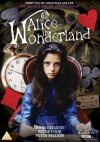
I've seen many versions of the classic ALICE story and I think I liked most of them. The child in me still enjoys the old fairy tales and that's how most of the AIW movies are presented, basically all remixes of the Disney version.
This TV version from 1966 has been on my radar for quite some time because (apparently) it was done in a different style.
But what makes this movie so unique and (imho) superb is that you can watch it as an Alice In Wonderland movie and as a movie that truly captures the art of movie making.
It's not exactly big news that human creativity peaked in the 1960s and 1970s but somehow it never stops surprising me, and speaking of surprises, apart from being haunting and atmospheric ALICE '66 is also the funniest version I've ever seen. I was still chuckling while I was doing the dishes.
The scripted dialogue, the actors, the effects created by filming technique and by the actors themselves, the otherworldly Indian folk soundtrack (a stroke of genius because it really shouldn't work with these images) - it just played with all my senses.
The Victorian period setting as opposed to the more fantastical fairy tale versions makes more sense from Alice's point of view. All those questions that can't be answered, the suffocating, conventional and bombastic self-imposed importance of the stiff-upper-lipped upper class who keeps its daughters hatted and buttoned up, I mean, if this is Alice's Wonderland then what was her
sister dreaming of?
The dream itself looks exactly like that, without any narrative manipulation. Like we are in our dreams, Alice is powerless and aimless, mildly pondering something that may or may not be important. She's not an active heroine and her half-hearted commentary here and there suggests that part of the intelligence that tries to be part of the subconscious (but usually fails) or, for example, when you're able to recognize danger and you try to run away but you're not making any progress because that part of your brain that's supposed to stimulate your physical strength is muted.
The Wonderland dialogue sounds like a mathematical language problem that moves in two opposite directions, to ridicule and sabotage sanity
and to make sense (one way or another) of something that has been ridiculous and insane from the outset. Which could refer to Alice's painfully Victorian oblivious state of mind, but with a rebellious undercurrent.
Most ALICEs I've seen "escaped" from the "terror" of Wonderland, in this case it felt a bit sad. I don't know what's going to happen to her and I don't know if she'll ever dream like this again.
It was Anne-Marie Mallik's first and last role and of course that adds to the oomph and obscurity of this movie.
10/10
Edit: don't be fooled by the DVD artwork, it's all in glorious black & white.