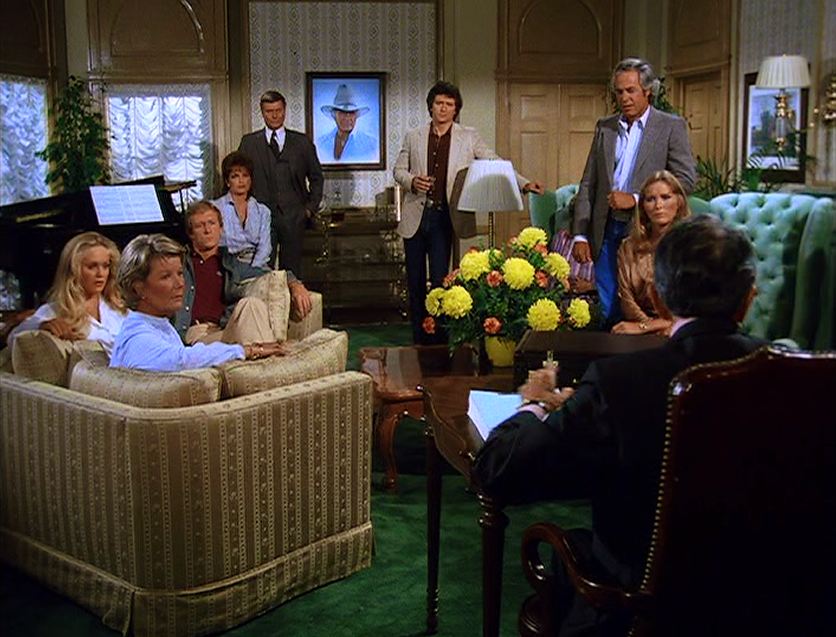
The contrast between KNOTS' perception of the Texas Ewings and DALLAS' version is interesting.
The miniseries in 1978, heavily-influenced by creator David Jacobs, gives us a smarmier, probably more-realistic bag of bastards who live at Southfork. You don't really see all that much overt devilment, even from JR, but there's a pervading feeling of nefariousness emitting from the family; unseen things -- probably vile and certainly illegal -- hidden just out of sight, an entitled smirk and a paranoid glance all we really glimpse of it.
Filming in the winter always seemed to help evoke this flavor of
skeletons-in-the-armoire, as it so often would even for TNT's nuDALLAS.
But you knew them Ewings
knew damn well who killed Kennedy. Even if they couldn't be directly implicated themselves.
Larry himself later said that even Miss "I-don't-care-if-it's-fair!" Ellie was a scoundrel in her own way during the short saturnine saga that was the first five episodes. Even Sue Ellen stammering to not-quite-offer her unappreciative mother-in-law a bedpan when Ellie was suffering a migraine managed to convey both Sue Ellen's lack of stature within the family and a franker tone than we would come to expect.
This was the morally-questionable cadre of mostly-offscreen in-laws that Gary and Valene seemed to conjure whenever reminiscing about their old lives in Texas, a clan of compromised characters in the backstory whose privilege was assumed and probably kind of dirty. One that seemed echoed in Donna Culver Krebbs' and Valene's various memoirs.
On DALLAS itself, of course, all sins soon drifted to JR, to a lesser-degree that pesky Cliff Barnes, with a revolving door of sisters-in-law with a revolver. It wasn't as dark, wasn't as ominous, and was less potentially off-putting to the audience of the time. Filming in the bright summer now made sense. Yes, you'd have the occasional foreboding moment with the family at night, gathered around the Southfork dining table or clustered together in the living room to hiss at each other, but mostly everybody was transformed into the lovely, upstanding citizens expected from series television, all righteously indignant over the most recent crimes, moral and otherwise, committed by JR and JR alone. He now embodied the program's entire sleaze-factor. (Although Sue Ellen appeared to like a little sip of somethin' here-and-there). Everybody else seemed to be living in a different ethical world, all flustered over how that wicked JR and his schemes managed to worm his way back into the house yet again.
I like to think both versions of the Texas Ewings are fundamentally true, just reflective of different subjective viewpoints.
But the interpretation that this oil-rich brood was
actually amorally apathetic to JR's numerous deals with The Devil, deals which permitted them all to lounge in smugly lazy luxury, rings the most true. And probably would have been right for a theatrical film, had there ever been one instead of a small-screen series.