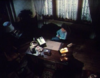
Flat-lighting is basically when a room is flooded with light such there are almost no shadows, and it causes the studio sets to look like studio sets. It prevents much in the way of mood or atmosphere, and it makes the contrivance of the melodrama more obvious.
Why did Katzman prefer flat-lighting? Maybe for the same reason Aaron Spelling did, too -- perhaps they just felt a straight-forward story was enough and that anything else was "pretentious" and gets in the way. (Spelling, of course, would overlight a series because he wants the audience to see every inch of the wardrobe).
I'm not sure Philip Capice would have done much better with the closing years of DALLAS, though it would have been different no doubt. Katzman was the
de facto show-runner even in the early, good years, but he always had conflicts with Capice (David Jacobs said both men "had the exact sane approach to television" and yet didn't get along).
The muddled year when Bobby was "dead," Katzman was also gone from the series (although he got a "creative consultant" credit), and Capice brought in Peter Dunne and his team of writers to replace Katzman. But while that season started out with promise and more creative experimentation, the new writers (who'd done excellent work on KNOTS LANDING) proved they didn't have a sense of what DALLAS was about, and so the show turned smugly PC and with the much-ballyhooed strengthening of the women comic strip and bogus. So Larry got mad and pulled rank, pushing Capice and Dunne out the door. (Plus, although Capice got along well with the actresses, he had a reputation of being a bit of a high-handed bitch, even firing the show's main composer, Jerrold Immel, because "I don't like guitar" after Immel used spanish guitar in Bobby's funeral episode).
Katzman came back with Patrick Duffy, as did Katzman's most inspired constructionist who gave DALLAS it most Shakespearean elements, David Paulsen.
So despite the dreadful "it was just a dream, Pam" opening to Bobby's first season back, it was otherwise one of the most entertaining years the show ever did, such was Katzman's and Paulsen's grasp of the program.
But a decision was soon made, apparently deliberately and consciously, to turn DALLAS toward overtly self-satirical campiness. And when Paulsen decided he wanted to leave in '88, Hagman made an oblique slam in the press saying that it was probably good that Paulsen was going because he supposedly didn't have "a sense of humor" (which seems to support the idea that an intentional comedic tone was planned for the next few seasons). So, proving that Paulsen indeed had a sense of humor, he went over to become the show-runner of deeply troubled DYNASTY and gave that show's Season 9 the best storylines it had had in 6 or 7 years.
But we all started wondering why Katzman was so intent on getting back control over DALLAS if he was going to eventually start dishing out worse crap than Capice/Dunne had ever delivered the year Bobby was dead. (And, proving Jacobs more-or-less correct, Katzman hired back Jerrold Immel and then fired him again),
Control for control's sake, one assumes.