First-run syndication

bmasters9

Telly Talk Mega Star
LV
5
 
Awards
11
But no, there wasn't much pressure on stations from the syndicator to air a show at any particular time unless maybe it was time-sensitive like Entertainment Tonight or tabloid garbage like Hard Copy.

So basically, game shows like Tic Tac Dough w/Wink Martindale or The Nighttime Price Is Right w/the late, great Tom Kennedy could air at any time on any station, because they weren't something that was important (TTD being on WPVI 6ABC in the 80s at 7 P.M., for instance), but if it was something like entertainment news (press about the latest films, shows, etc., which is what ET mostly was about then), the syndicator (Paramount Domestic Television) could make a station that ET aired on air it at a certain fixed time? That's how I'm understanding this.
 

Daniel Avery

Admin
LV
9
 
Awards
24
No, it was just "understood" among the station managers and program directors that ET was a good "palate cleanser" that bridged the gap between the evening news (important events affecting the world) and primetime television (entertainment). ET, with its frivolous celebrity interviews and shameless promotion of upcoming projects in the guise of a newscast, had a darkened set featuring a backdrop of the Hollywood hills at night. "Tonight" was even in the title, a suggestion of when they thought it best to air. Once a syndicator sells a show to a station, they likely could care less when the station airs it (the money is just as green), but when a show is geared toward a certain day part, most station managers will air it in the slot where they think it belongs (translation: where it gets the best ratings). ET likely was transmitted via satellite to its stations at 4pm or 5pm, so if a station opted to air it in the mornings, they'd have to have it air a "day late" (the morning after).

If you look at reruns of the daytime versions of Wheel of Fortune and Match Game that aired in the late 1970s and early 1980s, the lighting and tone of the two series overall "feels" like a daytime game show, whereas the early-evening versions that were produced simultaneously had a darker set and different feel. Even as both versions were obviously taped on the same set. The same could be said of the daytime/nighttime versions of The Price is Right.

I remember when Oprah aired in the mornings alongside all the other talk shows. She de-throned Phil Donahue and the others sort of shrunk away from trying to beat her. Certain stations decided she was such a phenomenon that they experimented with putting her on in early afternoon (that is, after soaps) slots like 4pm where there were even more potential viewers. It was such a success that by 1990 or so, she had basically taken over the "afternoon talk show" arena and was not airing in the mornings in many markets. Every market could choose where to air a show, but when one station sees a show prosper in a certain slot, they'll often try to copy that success at their own stations.

 

bmasters9

Telly Talk Mega Star
LV
5
 
Awards
11
No, it was just "understood" among the station managers and program directors that ET was a good "palate cleanser" that bridged the gap between the evening news (important events affecting the world) and primetime television (entertainment). ET, with its frivolous celebrity interviews and shameless promotion of upcoming projects in the guise of a newscast, had a darkened set featuring a backdrop of the Hollywood hills at night. "Tonight" was even in the title, a suggestion of when they thought it best to air.

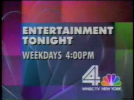
That's true-- however, one NBC O&O, WNBC of NYC, had ET going at 4 in the afternoon in 1989 or 1990 (despite the name); that intrigued me that something that was evidently made to air in the evenings (as I understand what you said there) could go in an afternoon slot.

wnbcetpromo198990.png
 

bmasters9

Telly Talk Mega Star
LV
5
 
Awards
11
The same could be said of the daytime/nighttime versions of The Price is Right.

So, IOW, Bob Barker and Tom Kennedy in the 80s were in two different worlds when it comes to TPIR, I take it.
 

AndyB2008

Telly Talk Well-Known Member
LV
0
 
Awards
6
No, it was just "understood" among the station managers and program directors that ET was a good "palate cleanser" that bridged the gap between the evening news (important events affecting the world) and primetime television (entertainment). ET, with its frivolous celebrity interviews and shameless promotion of upcoming projects in the guise of a newscast, had a darkened set featuring a backdrop of the Hollywood hills at night. "Tonight" was even in the title, a suggestion of when they thought it best to air. Once a syndicator sells a show to a station, they likely could care less when the station airs it (the money is just as green), but when a show is geared toward a certain day part, most station managers will air it in the slot where they think it belongs (translation: where it gets the best ratings). ET likely was transmitted via satellite to its stations at 4pm or 5pm, so if a station opted to air it in the mornings, they'd have to have it air a "day late" (the morning after).

If you look at reruns of the daytime versions of Wheel of Fortune and Match Game that aired in the late 1970s and early 1980s, the lighting and tone of the two series overall "feels" like a daytime game show, whereas the early-evening versions that were produced simultaneously had a darker set and different feel. Even as both versions were obviously taped on the same set. The same could be said of the daytime/nighttime versions of The Price is Right.

I remember when Oprah aired in the mornings alongside all the other talk shows. She de-throned Phil Donahue and the others sort of shrunk away from trying to beat her. Certain stations decided she was such a phenomenon that they experimented with putting her on in early afternoon (that is, after soaps) slots like 4pm where there were even more potential viewers. It was such a success that by 1990 or so, she had basically taken over the "afternoon talk show" arena and was not airing in the mornings in many markets. Every market could choose where to air a show, but when one station sees a show prosper in a certain slot, they'll often try to copy that success at their own stations.
Ref Oprah, she insisted that WLS in Chicago, Illinois, keep the show at 9am as it was the success in that slot that enabled her show to go national.

This is why WLS never aired Live with Regis etc like the other ABC O&O stations until after Oprah ended. Live as a result was seen on other stations in Chicago.

Ref Oprah in the afternoon, when Paradise Beach aired in America, one station in Los Angeles chose to air it against her show. A major no-no.
 

Daniel Avery

Admin
LV
9
 
Awards
24
Yes, because Paradise Beach was TERRIBLE. It should not have aired anywhere at any time. [/tangent]

I believe they tried to force prisoners in North Korean gulags to watch it, but even Kim Jong Un had to intervene to tell them that was too harsh.
 

AndyB2008

Telly Talk Well-Known Member
LV
0
 
Awards
6
No, it was just "understood" among the station managers and program directors that ET was a good "palate cleanser" that bridged the gap between the evening news (important events affecting the world) and primetime television (entertainment). ET, with its frivolous celebrity interviews and shameless promotion of upcoming projects in the guise of a newscast, had a darkened set featuring a backdrop of the Hollywood hills at night. "Tonight" was even in the title, a suggestion of when they thought it best to air. Once a syndicator sells a show to a station, they likely could care less when the station airs it (the money is just as green), but when a show is geared toward a certain day part, most station managers will air it in the slot where they think it belongs (translation: where it gets the best ratings). ET likely was transmitted via satellite to its stations at 4pm or 5pm, so if a station opted to air it in the mornings, they'd have to have it air a "day late" (the morning after).

If you look at reruns of the daytime versions of Wheel of Fortune and Match Game that aired in the late 1970s and early 1980s, the lighting and tone of the two series overall "feels" like a daytime game show, whereas the early-evening versions that were produced simultaneously had a darker set and different feel. Even as both versions were obviously taped on the same set. The same could be said of the daytime/nighttime versions of The Price is Right.

I remember when Oprah aired in the mornings alongside all the other talk shows. She de-throned Phil Donahue and the others sort of shrunk away from trying to beat her. Certain stations decided she was such a phenomenon that they experimented with putting her on in early afternoon (that is, after soaps) slots like 4pm where there were even more potential viewers. It was such a success that by 1990 or so, she had basically taken over the "afternoon talk show" arena and was not airing in the mornings in many markets. Every market could choose where to air a show, but when one station sees a show prosper in a certain slot, they'll often try to copy that success at their own stations.

When Ricki Lake became successful too just as Oprah, others tried to copy her.

I believe Carnie Wilson, Danny Bonaduce and Gabrielle Carteris got talk shows in the hope their fame would translate to ratings.

None of their shows lasted long and barely lasted a few months - wonder where they were scheduled by affiliates?
 
Last edited:

AndyB2008

Telly Talk Well-Known Member
LV
0
 
Awards
6
Yes, because Paradise Beach was TERRIBLE. It should not have aired anywhere at any time. [/tangent]

I believe they tried to force prisoners in North Korean gulags to watch it, but even Kim Jong Un had to intervene to tell them that was too harsh.
There were reports the station in LA which carried Paradise Beach (either KCOP or KTLA) were originally going to air PB at 7.30pm before it was decided to dump it against Oprah.

Oprah aired on KABC as a lead in to the 4pm newscast.
 
Last edited:

tommie

Telly Talk Hero
LV
3
 
Awards
9
A recent article about the issues with syndication:

TL;DR, production companies have started rolling back their syndicated shows and putting things on their own streaming platforms, leading to holes in schedules and everything can't just be news casts.
 

ClassyCo

Telly Talk Warrior
LV
5
 
Awards
11
The Fame TV series was originally axed by NBC after 2 seasons due to low ratings, but MGM/UA Television (MGM/UA produced the original film hence their interest to keep the TV series going) cut a deal with TV syndication company LBS Communications.

Hence why Fame was revived in first run syndication and continued for 4 more seasons.
I recall my dad talking about FAME when discussing TV shows from the '80s once.
 

Jock Ewing Fan

Telly Talk Star
LV
0
 
Awards
8
I don't have the link, but I read somewhere that there are discussions to bring back Baywatch.

Syndicated or not, I wish someone would bring back Blakes 7
 
Last edited:
Top