
Grande Dame Guignol

ClassyCo

Telly Talk Warrior
LV
5
 
Awards
11
I finally had the time to watch THE NIGHT WALKER on my laptop last night. I had downloaded it from You-Know-Where a few weeks ago.

I'll get right into discussing the film itself.

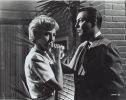
Directed by William Castle (the B-movie maestro behind films like THE TINGLER and HOMICIDAL), the story concerns the fate of Irene Trent (Barbara Stanwyck) as she deals with her blind husband Howard (Hayden Rorke), a millionaire. Howard is possessed with the notion that Irene is having an affair with his attorney Barry (Robert Taylor) because of the dreams he overheard as she sleeps. In reality, Irene is having a dream where she's visited by a handsome young suitor (Lloyd Bochner), who romances her. When Howard dies in an explosion, the mayhem ensues as Irene is either going crazy or being driven there.

That's enough of the plot.

THE NIGHT WALKER is basically an extended TWILIGHT ZONE episode. The music and cinematography both remind me of Rod Serling's anthology. Perhaps the strongest comparison between NIGHT WALKER and TWILIGHT ZONE is its opening prologue. It's a beautifully stylized opening narration that calls back to the TV series. Another comparison would be the use of creepy mannequins in the film.

Overall, I'd say I somewhat enjoyed NIGHT WALKER. I quite liked the B&W camera work (even if it did look a little bland in some spots) and Stanwyck's work in a rather thankless role as a wealthy widower apparently loosing her sanity. Taylor and Rorke also offer good performances (considering what the script requires). It was also interesting to see Stanwyck and Bochner (before their days as Constance and Cecil Colby, respectively) play lovers here.

I won't be as hard on NIGHT WALKER as some people might be. It wasn't totally bad, but not totally good. It's a fairly middling cheap mid-'60s follow-up to the high coat tails of better "hag horrors" such as BABY JANE and CHARLOTTE.

NIGHT WALKER quite simply isn't very memorable. It's definitely not one on my favorites of the Grande Dame Guignol sub-genre. It's a shame Stanwyck's only venture into these movies was this rather bland, drawn out psychological thriller.

Who knows, I might find myself watching NIGHT WALKER again one day, but it's safe to say, it won't be very soon.
1658586399440.png
 

Snarky Oracle!

Telly Talk Supreme
LV
7
 
Awards
19
THE NIGHT WALKER is basically an extended TWILIGHT ZONE episode. The music and cinematography both remind me of Rod Serling's anthology. Perhaps the strongest comparison between NIGHT WALKER and TWILIGHT ZONE is its opening prologue. It's a beautifully stylized opening narration that calls back to the TV series. Another comparison would be the use of creepy mannequins in the film.

Anything spooky and in B&W in the early-'60s is basically like a TWILIGHT ZONE episode. That's because the early-'60s was a twilight zone, one defined by THE TWILIGHT ZONE.

Directed by William Castle (the B-movie maestro behind films like THE TINGLER and HOMICIDAL),

HOMICIDAL and I SAW WHAT YOU DID look like Academy Award winning productions in comparison to the rest of William Castle's work. THE NIGHT WALKER has oodles of promise, but then so did that most disastrous of Castle films, his "masterpiece" STRAIT-JACKET.

tumblr_oeifqeJ3ec1thrhjso2_500.gifv
 

ClassyCo

Telly Talk Warrior
LV
5
 
Awards
11
THE NIGHT WALKER has oodles of promise
It does have a good cast, that's for sure, and a decent enough story. But it's all in the execution.


Anything spooky and in B&W in the early-'60s is basically like a TWILIGHT ZONE episode. That's because the early-'60s was a twilight zone, one defined by THE TWILIGHT ZONE.
You have a point. The early-'60s and its TWILIGHT ZONE vibes.
 

ClassyCo

Telly Talk Warrior
LV
5
 
Awards
11
Anything spooky and in B&W in the early-'60s is basically like a TWILIGHT ZONE episode. That's because the early-'60s was a twilight zone, one defined by THE TWILIGHT ZONE.

After watching NIGHT WALKER, I had this desire to watch TWILIGHT ZONE, but I couldn't get my DVDs to work on my laptop. I was disappointed to say the least.

HOMICIDAL

I've never seen this movie... Is it any good?
 

Snarky Oracle!

Telly Talk Supreme
LV
7
 
Awards
19
I've never seen this movie... Is it any good?

Well, it's not, technically, grande dame guignol, but it's one of William Castle's most polished films -- if only his other movies were this smoothly done and confident.

Which is not to say HOMICIDAL isn't sufficiently ridiculous. An obvious homage to PSYCHO (and released just a year later) HOMICIDAL gives us a comely bleach-blonde in a period hairdo who bears a bitchin' blade she bleeds the boys and babes who've displeased her with -- but all is not what it seems (she's played by Jean Arliss who is really Joan Marshall).

It's not quite as artful as PSYCHO but some find it a bit scarier.

R.ccd9350a02952d611007dad68c030a13
 

ClassyCo

Telly Talk Warrior
LV
5
 
Awards
11
Well, it's not, technically, grande dame guignol, but it's one of William Castle's most polished films -- if only his other movies were this smoothly done and confident.

I was aware that it didn't necessarily qualify as Grande Dame Guignol, but I've heard about HOMICIDAL being one of Castle's better films.
 

Crimson

Telly Talk Enthusiast
LV
1
 
Awards
8
I'm not sure if this is the right thread to post this in, but here goes WHAT EVER HAPPENED TO GOOD TASTE...?

I watched a good 90 minutes of this, but don't have much interest in some of the later films covered. Some interesting observations on the individual films, although there didn't seem to be a strong overarching thesis to connect these. And I really could have done without the lengthy plot recaps. I'm not sure why reviewers do this. Anyone who has seen the film doesn't need the info and anyone who hasn't seen the film probably doesn't want the storyline ruined.
 

ClassyCo

Telly Talk Warrior
LV
5
 
Awards
11
I just wish someone would give us a good documentary about the history of Grande Dame Guignol. I've seen little video essays out there and there's the AMC Backstory episode concerning the production of CHARLOTTE, but that's about all we got. While the genre isn't necessarily full of quality films, it was a defining sub-genre in the 1960s and into the 1970s. Many actresses "of a certain age" could only find work in such hagsploitation-type films. For instance, all of Crawford's post-BABY JANE work could be grouped as a mere attempt to duplicate the original's success.
 

Snarky Oracle!

Telly Talk Supreme
LV
7
 
Awards
19
I just wish someone would give us a good documentary about the history of Grande Dame Guignol. I've seen little video essays out there and there's the AMC Backstory episode concerning the production of CHARLOTTE, but that's about all we got. While the genre isn't necessarily full of quality films, it was a defining sub-genre in the 1960s and into the 1970s. Many actresses "of a certain age" could only find work in such hagsploitation-type films. For instance, all of Crawford's post-BABY JANE work could be grouped as a mere attempt to duplicate the original's success.

I agree with this. But it's funny how with aaalll the endless documentaries on certain, films, TV shows, genre and trends, there are zero docs done for some of the biggest things out there, including some of the biggest TV series. It's weird, actually, what gets passed over.

I guess "What Ever Happened to Good Taste?" is a stab at it for the grande dame guignol genre, but it's flawed for the reasons @Crimson states... I'd like a solid doc done on the subject, too, but especially in today's era, they'd focus waayyy too much on the objectification/dehumanization/demonization of women and aging women in movies and I just wouldn't have the stomach for that kind of predictable pseudo-analysis, which is likely the tone and angle of any such documentary.

I mean, a brief reference to that or analysis of that "misogyny" angle would be fine, but the piece would undoubtedly spend far too much time going down that road.

Never mind that the vast percentage of movie villains are men -- often ugly, haggard men. But if you have the rare female villain, then suddenly it's a manifestation of sexism. It's like the feminists' frequent complaint that while they loved the "strong women" of the golden age of Hollywood, they felt the one drawback was that these strong female characters had to "be punished" for their strength by the film's end -- when, in fact, these strong women were often criminals or even killers and, by all objective morality, should have been punished (as were all the male villains of the time, in keeping with the Breen/Hayes Code demands -- depending, of course, on how you viewed John Wayne's celluloid slaughter of Native Americans throughout his career). But while "strong men" were heroes doing heroic things (politics aside) "strong women" were usually villainous ladies who schemed to get away with those schemes, often deadly ones.

They pretend that it's chauvinism when e're you dare question the noble stature, collectively or individually, of criminal women -- like, say, Amber Heard today.

All of which is kind of fascinating, these oft-repeated narratives that are either untrue or highly selective at best.

But, yes, I'd like an over-arching grande dame guignol documentary, too, but one that appreciated the cinematic trend, considerable warts and all, without chiming on endlessly as they do about the "degradation of women" and how Hollywood discards women after a certain age or condemned them to the horror grist mill -- although much of the genre was indeed gristle.

nightmarebegins.jpg
 

Snarky Oracle!

Telly Talk Supreme
LV
7
 
Awards
19
Thematic analysis rarely interests me: it's looking at clouds. People see what they want to see or what is reflective of their already developed viewpoints. Such analysis are usually more revealing about the reviewer than the work of art.

Although a little thematic analysis is okay with me, as long as I agree with it. I think that's only fair.

R.7f8b265d0c4c227820f6167b1ac8d5d3
 

ClassyCo

Telly Talk Warrior
LV
5
 
Awards
11
BABY JANE colorized -- I'm against it on principle, but it's certainly better than the colorization of the '80s (until Bette steps into the light)...

I tried to share this colorization of BABY JANE earlier in the week, but my computer at work doesn't want to let me see this video. Every time that I click on it the image freezes and I can't watch it. I haven't tried viewing the video on my cellphone yet, but I do know I prefer BABY JANE in its ghostly B&W.
 

Crimson

Telly Talk Enthusiast
LV
1
 
Awards
8
I came across that colorized BABY JANE a few days ago. I was initially impressed with the (presumably) amateur work, but the further I got into the video the less impressed I was. The colors, particularly skin tones, were occasionally too garish and there's a muddling of color in some scenes. The work done by Pop Colorture is more technically impressive.

I like B&W, so colorized films have never done anything for me. This is doubly true of genres like horror and noir, where the B&W is essential to the mood; it's perhaps something else to colorize a musical or comedy that probably would have been filmed in color if not for budget limitations. Plus I think it was a deliberate choice to film BABY JANE in B&W; didn't Davis object to the use of color because of concern her makeup would look silly or something? (She was right.)
 

ClassyCo

Telly Talk Warrior
LV
5
 
Awards
11
Oh, I agree. I'm partial to old-school B&W movies. The B&W cinematography adds to the experience and atmosphere of the film, especially if we're talking about mysteries, horror films, or film noir. Colorizing something like BABY JANE is as useless as colorizing a classic like LAURA, a standout of the noir genre that depends heavily on its B&W cinematography to set the mood of the story.

I seem to recall hearing that Davis preferred BABY JANE to be shot in B&W because she didn't want her makeup (which she designed personally) to be too garish. I'm sure Crawford was also more or less insistent that the film not be done in color because, as I've read, she rebelled against being shot in color because she feared it would make her appear older than she wished. And for a image-cautious celebrity like Crawford, one can easily imaging such a story being true. Likewise, I'm sure Aldrich was more than okay with BABY JANE being shot in B&W, not only for budget restrictions, but also because he realized it fit the tone of the story.
 

Snarky Oracle!

Telly Talk Supreme
LV
7
 
Awards
19
Oh, I agree. I'm partial to old-school B&W movies. The B&W cinematography adds to the experience and atmosphere of the film, especially if we're talking about mysteries, horror films, or film noir. Colorizing something like BABY JANE is as useless as colorizing a classic like LAURA, a standout of the noir genre that depends heavily on its B&W cinematography to set the mood of the story.

I seem to recall hearing that Davis preferred BABY JANE to be shot in B&W because she didn't want her makeup (which she designed personally) to be too garish. I'm sure Crawford was also more or less insistent that the film not be done in color because, as I've read, she rebelled against being shot in color because she feared it would make her appear older than she wished. And for a image-cautious celebrity like Crawford, one can easily imaging such a story being true. Likewise, I'm sure Aldrich was more than okay with BABY JANE being shot in B&W, not only for budget restrictions, but also because he realized it fit the tone of the story.

In the '50s and early-'60s, movies were often shot in color due to genre, not cost. There were high-budget B&W films (like THE MISFITS) and fairly low-budget comedies filmed in color. (On TV, it was mostly a budget thing).

It was also believed that B&W was more complimentary to women's faces, making it easier to obscure imperfections in close-up. So Crawford would have been acutely aware of that.

Bette said CHARLOTTE couldn't be shot in color, because otherwise "it would look like GWTW."

There are just certain moods you can achieve in B&W that simply can't with even the most carefully shot color film... Perhaps it's the uniformity that B&W permits that color, by definition, can't (where all the objects on screen feel distinctly separate from one another which prevents a visual cohesion needed for the kind of focused atmosphere required for a film noir).

I'd hate to see the B&W noir films of the '40s in color (in all its silvery lush tones), or the creepy cold war dramas from the early-'60s in anything other than stark B&W.

R.8b6efbb7cc1b81d3acc8009c636c893d
houmashouseBW.jpg

But in the '50s, it's hard to tell if it matters...
R.0d767328252a97c2942896e05e2c0db9


John Huston once said the only film he ever regretted shooting in B&W was NIGHT OF THE IGUANA (1964) which is understandable if you ever saw the gorgeous color home movie/documentary footage they shot when they were down there.
 

Snarky Oracle!

Telly Talk Supreme
LV
7
 
Awards
19
Like "Eyes" with Crawford on NIGHT GALLERY, Norma Desmond herself appears in a TV episode, "Who is Jennifer?," of KRAFT SUSPENSE THEATRE (renamed "Crisis" for syndication) and filmed the same week Gloria Swanson's old lover lost his second-eldest son to an assassination. (The installment aired January 1964).

It's kinda-sorta grande dame guignol, isn't it? I like the atmosphere, lots of wind, and a mid-'60s color scheme which seems all ready for (or just finishing up from) Hallowe'en... The house, on Universal's back lot, will soon be occupied by The Munsters.

And why are they always named "Charlotte"?


Snarky Oracle!

Telly Talk Supreme
LV
7
 
Awards
19
As Autumn drifts in, it seems a good time to post THE GHOST OF SIERRA DE COBRE (1965) from Joseph Stefano late of PSYCHO-script fame. It started out as a pilot for a prospective series but was deemed "too scary" by executives, so it was expanded and distributed as a theatrical film, played for years in markets around the world but rarely-if-ever shown on American TV because it was deemed -- once again -- "too scary".

For decades it was the holy grail to classic horror buffs, and star Martin Landau was rumored to have the only copy in existence -- and, indeed, after he died the film suddenly emerged from the shadows and went to DVD in 2018.

Is it grande dame guignol? Well, Dame Judith Anderson has a significant role -- so, y'know, Scorpio Rising and whatever...

It may not be as terrifying as children may have understandably found it as it flickered across their TV sets in their darkened rooms in the mid-'60s, but it's chock full of period atmosphere and the expected creepiness...


I don't know why they're saying "1967" as it clearly isn't. (Apparently, that's when it was released in Japan).
 
Last edited by a moderator:

Snarky Oracle!

Telly Talk Supreme
LV
7
 
Awards
19
The plantation house used in HUSH... HUSH, SWEET CHARLOTTE:


A full house tour (wow!) of Houmas House -- there's even a Bette Davos room! (The host tells an apocryphal story that Davis & Crawford fought so badly that the police were called to break up the battle -- and one tour guest asserts that he "hates all movies.')

 
Last edited by a moderator:
Top