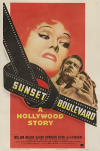
For a former silent-movie icon retreating in her decaying, Hollywood-Gothic mansion I think she's making a lot of noise - and rather monotonously theatrical at that.
On the other hand there's William Holden's character that tries to give this Hollywood-insider a cynical touch but to me it comes across as an unconvincingly naive woe-is-me story.
Surely even back then they must have realised that some people make it in the business while others don't, and that that could be a matter of talent, looks, nepotism or sheer randomness.
I do like the story itself and I think it would be a great read, but the relentless narration feels like someone reading the story out loud while showing pictures, or showing pictures and then describe what's in it (I'm not sure what's worse).
Ironically, it also makes the story look like second-hand information as opposed to the firsthand information as promised in the opening scene.
To create a satirical freakshow that's also meant to be a suspenseful drama was probably a little bit too ambitious even with all the talent involved.
Perhaps the character of Norma Desmond should never have been materialized on film; living in the shadows of her former glory the only exposure it requires is the sinister secret between the author and the reader which would increase the psychological mystery of "who's-using-who".
From a technical point of view I think the film looks very well made and it goes without saying that I love the interior of Norma's grotesque mansion (high ceilings
always do the trick) except for the tacky tiled floor in the hallway.
I don't think I could call it a
bad film, but personally I have experienced it as an overly exhibitionist drag that plods along towards its inevitable and not too exciting conclusion.
Having said that, I did kinda like Holden's narration in the final scene. "Funny how gentle people get with you once you're dead" probably being my favourite line of the entire movie.
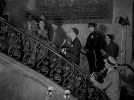
My favourite image isn't that of the iconic "ready for my close-up", but the moment she descends the stairs. Since the other characters on that very staircase are seemingly frozen in time it almost looks like a motion picture within a photograph.
Rating: 4/10
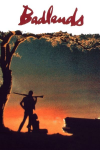
Here's another film that relies heavily on a character's narration, and not only does it describe the current situation but also what is
going to happen.
But in this case the matter-of-factly yet poetically soulful narration is mesmerizing, simultaneously devoid of emotional manipulation.
The story and characters are quite minimalistic and even the various killings are treated without a whiff of terror (although I feared that Kit would trash the rich man's beautiful home).
It's really only in the final act that their murder spree gets some gravity, oddly juxtaposed - or perhaps emphasized - by the way Kit is treated by the authorities.
Even though their romance and the consequences thereof are never glorified, the film is not entirely without issues.
Seeing how they lived they always look unrealistically clean.
The references to James Dean could make the viewer a little bit too forgiving, and Holly's motivaton to join Kit makes some sense at the beginning of the story, but not enough to stay in a situation that's getting worse and worse.
Well, eventually she decides that she doesn't want to anymore, and shortly after that Kit throws in the towel, too. Without Holly he no longer has a purpose, or so it seems. None of this is being spelled out though, and overall the story looks like it just
happens, and almost too realistic to be fictional. Apparently it was inspired by the The Starkweather–Fugate case.
BADLANDS is beautifully shot but I won't give them credit for the scenery because the plains and forests and mountains were already there, I'm pretty sure of that.
Despite being a late fifties period drama it's also very much a seventies production, but in this case I consider that two for the price of one.
The soundtrack is gorgeous.
Rating: 7/10