What was the last film you watched?

Mel O'Drama

Admin
LV
16
 
Awards
44
Mack & Rita (2022)

iu


Since I hadn't heard of this film until a few minutes before watching, there was very little expectation, other than that coming from seeing Diane Keaton on the poster, plus getting the sense from a line or two of the synopsis that this was a body switch comedy.

The plot is familiar... younger person wishes to be older. Magic happens. Wish is granted. Since this one involves two adults - a thirty year old woman becoming a seventy year old - it's not so much Big as Old.

This genre is invariably entertaining, but this mustn't be taken for granted. Sadly, I feel it was here. There's no real emotional stake here. The only jeopardy is based around very surface material things ("Oh no. I'm going to miss my best friend's wedding rehearsal"; "Does the man who lives in my apartment block like me?"; blah blah blah).

In terms of filming, I'm not sure which came first: Keaton's performance or that of the actress playing younger Keaton. Sadly, they're both quite annoying, and shrill with lots of squeaking excitedly or screaming with confusion/anger/frustration. Elizabeth Lail is more consistently annoying. Sadly, it's difficult to believe for a second that she's either an old soul or a fish out of water. A pair of glasses and affection for her dead grandmother doesn't not an interesting person make. She's just another blandly generic thirty year old woman trying rather too hard to be funny. Everything about her performance screams that she's "doing" comedy, as though she's imitating someone she grew up finding funny (ironically, this misfire truly makes her the square peg in the round hole the story tells us she is, but for all the wrong reasons). All of which would be forgivable, if she resembled a thirty year old Diana Keaton. Which she doesn't.

Then when Keaton arrives there's a whole lot of screaming and neurotic panic. Her performance feels wildly over the top, but not in a good way (for most of her early scenes, I found myself seeing Phoebe from Friends due to her using the same inflections and delivery). She does gradually tone down as the story (such as it is) goes along. She's a great actress, given thankless material here (perhaps enabled by herself since she's also a producer on this film).

Good actress, thankless material is actually the order of the day all round. Loretta Devine, Lois Smith and Wendie Malick are among the familiar faces who do nice work against the odds.

I'm not quite sure what the film's ultimate message is, beyond a rather vapid and obvious "you must be comfortable in your own skin".

Perhaps I'm just the wrong audience for this film and don't get it. Certainly, it's gynocentric. The only male characters are there to serve or screw up: the charlatan guru responsible for the body switch; the fawning groupie who works for the company and is the reason the lead character misses an important date; and the dog-sitting neighbour who is manipulated into loving the younger version once her older self has gleaned enough information about him to use (worse, we know she has "won" her prize at the end because of the possessive kiss she gives him before the assembled audience). So there you go. A romantic comedy that - unless one is of a certain type - is neither funny nor romantic.​
 

Mel O'Drama

Admin
LV
16
 
Awards
44
Monster-monkeys, rhinos....sharks!!

Oh, this did make me laugh. And then intrigued me enough to go and look this up.

Apparently the Romans did display rhinos and apes at the Colosseum but they never went up against soldiers. And the rhinos were the one-horned Asian variety rather than than two-horned indian rhino featured in the film.

The water battles did happen, but the boats didn't move at speed, and it's highly unlikely there were any sharks, which would have needed to be imported by water transport. Plus the Romans didn't even differentiate between sharks and other fish.

Also, there were neither cafes nor newspapers at the time.

It looks like a load of balls. And, having just watched a film made entirely by, for and about women, that sounds most refreshing.

iu


why stop there? Bring on the UFO!

Here you go:
 

Mel O'Drama

Admin
LV
16
 
Awards
44
Don't Look Back (2020)
A.K.A. Good Samaritan

iu


Usually I don't look up any information ahead of time, but I somehow ended up doing a quick search to get a sense of this one when I was narrowing down my choices. I'd read there was some Final Destination connection, and scrolled past many scathing reviews that said it was an el cheapo Final Destination knockoff in order to find out about the title as there seemed to be two.

Perhaps most weirdly of all, I saw Josh Bowman's name in the credits. Then as I watched the film I found myself thinking he hadn't changed that much since Revenge, and still had some of the same mannerisms. During the end credits, I tut-tutted that they'd got the character and actor credits in the wrong order for him. Only afterwards did I realise that, in actual fact, the character was named Josh Bowman, and was played by one Skyler Hart. I think I've just about caught up now.

As to the film itself, I enjoyed it. Yes, expectations were low, but even so I thought it was fine. It's written by Jeffrey Reddick who wrote and created Final Destination, and the similarities are there to be seen. Once again, a group of people is present when Something Horrible happens. Once again, they later begin to die, one by one. Once again, it's all about signs, omens and portents, and our protagonist begins to display something akin to precognition, putting herself at the scene of every death and making herself look sketchy in the process. Once again, authorities are dismissive, and the group begins to come together to try and beat the odds.

The familiar elements don't make this a bad story. Frankly, I'd probably rather watch this film than a number of the Final Destination sequels and scenes. Don't Look Back shifts the focus from prolonged death tableaus back to the characters' fears. The gore and kill porn is toned down, meaning the story has fewer places to hide. It might not be a great, clever or even original story, but there has been far thinner in the FD franchise.

The production values do occasionally let the film down. It's not a bad-looking film, but neither does it feel like an epic. This adds a degree of intimacy, which is a good thing, but the direction also lets it down at times - this was Reddick's directorial debut and, perhaps understandably, remains the only film he has directed - and there are schlocky jump scares in place of true suspense.

Where this film really has it is the casting and performances. In particular lead actress Kourtney Bell is terrific, which gives the film its substance. All the other characters are utilised well enough that all of them work. Unusually for me with a film in this genre, there aren't any performances that grate or irritate. Only on one occasion does an actor do that Chad Michael Murray thing of saying a sentence, waiting a beat and then saying the character's name like an afterthought (it's in the trailer). But then his character is beaten to death a few moments later so it never becomes problematic.

That death is the film's Something Horrible, and I found the idea of Evil Triumphing Because Good Men Do Nothing a fascinating concept for the film to centre around. Sadly, today, all too many people respond to an emergency or horror not by offering aid or summoning help, but by taking out their phones to film it. Watching this, I found myself wondering what I would do in a situation like this. Certainly, it takes a lot of bravery (some would even say stupidity) to intervene today. And then there's the trauma response of being immobile with horror. This is what we see in the film's protagonist, Caitlin, due to her being traumatised by a beating she herself received just months earlier (where she witnessed her own father's death. Even by Final Girl standards, this poor young woman has been through it).

When the film focusses on Caitlin's guilt and recovery and trying to reconcile things, it's great. And I can't say the mystery element was entirely predictable because I hadn't correctly guessed whodunnit (even though they were a fairly obvious choice, one of the red herrings just seemed far more suspicious to me, and I bought into that).

I can see why someone expecting Final Destination would find this dull or poor, so it's a shame that pushing this connection invites unfavourable comparisons. There's very little of the graphic stuff that one would expect in this kind of film. For my money, I think it would be improved with less attempted horror than what we got. Remove the cheap jump scares with visions of zombified bodies appearing next to people, brush up the anti-climactic ending and this is actually a decent and atmospheric little thriller.​
 

Seaviewer

Telly Talk Warrior
LV
9
 
Awards
20
Behind the Candelabra (2013)
Not so much a Liberace biopic as an account of the experience of his younger lover Scott Thorson, based on his book.
Michael Douglas's performance as "Lee" has been much lauded, but the Liberace mannerisms are so well known that it came across to me as dangerously close to caricature.
In hindsight its hard to fathom why he Liberace was so popular with women since he was never the picture of masculinity.
And I couldn't stop thinking of Chandell in Batman.
 

Toni

Maximum Member
LV
11
 
Awards
24
"Mermaids" with Cher. A perfect complement to "Tootsie", another feelgood dramedy with the diva surrounded by a young Winona Ryder and a still younger, debuting Christina Ricci. The movie leaves you with the same impression as the video for the famous song included in it... Bob Hoskins is quite good here, too.


Mel O'Drama

Admin
LV
16
 
Awards
44
Guess Who's Coming To Dinner? (1967)

iu


For a film that, by its nature, is intended to be forward-thinking, it seems appropriate that this should be a film of firsts for me. This marks not just my first, long-overdue, viewing of the film, but also I believe is the first vehicle in which I've seen most of the actors, including Spencer Tracy and Sidney Poitier. Technically I've watched Katharine Hepburn before as I viewed Suddenly, Last Summer many years ago (not that I remember it at all). In short, this one ticked a lot of things off my viewing bucket list.

While I knew the premise of this film, I had no idea where it would go, or what tone it would take. I felt strangely comforted by the breezy opening credits, accompanied by The Glory Of Love, and even more so upon seeing Stanley Kramer's name. The latter turned out to be a wrong association on my part: I'd confused his names with Stanley Ralph Ross and Doug Cramer, and so thought of numerous television vehicles watched throughout the Seventies and Eighties (from Columbo to Wonder Woman and Dynasty). Turns out that tonally I wasn't actually that far off base, since this was as charming and accessible as some of these shows were at times.

The performances are all marvellous. Katharine Hepburn's eyes seemed to be almost permanently glistening, intermittently breaking out into gorgeous photogenic tears. But her tough side, too, was able to come through in the fantastic scene where she smilingly dismissed her pushy and snobby assistant with lengthy and very clear directions for getting lost. Sidney Poitier was dashing and diplomatic and likeable, while being simultaneously strong and unapologetic. Hepburn's niece and namesake, Katharine Houghton is disarmingly bright-eyed, optimistic and forthright, giving her common ground with Cecil Kellaway's bumbling cleric. Roy Glenn and Beah Richards are both perfect as Poitier's character's parents, with Beah in particular giving a performance that's as understated as it is strong. It feels she says comparatively little, but every word she says has depth. Spencer Tracy stole the entire show with a lengthy monologue at film's end which was the icing on the cake after his various little vacillations between laid back acceptance and occasional outbursts throughout.

Special mention goes to Isabel Sanford for her character's no-frills (and usually unsolicited) observations throughout. There's a great scene where she marches up to an amused, shirtless Poitier and reads him the riot act for getting above his station. It's notable for the film's sole use of the N-bomb, which is diffused on the spot by coming in the middle of a diatribe (I wasn't even sure at first if I'd heard what I heard) and for the undercurrent of humour to the scene. What I loved about this scene was the direction, which held one shot, but went into a Dutch angle as she got into his face. As soon as she'd said her bit again, it immediately returned to horizontal, leaving the viewer feeling as amused, shocked and disorientated as Poitier's character.

There are lots of terrific little moments throughout that feel like ad-libs or throwaway background stuff, but that make this film so wonderful. The whole scene with Tracy's character fussing over ice cream flavours, for instance. My favourite little moment in the entire film was when Spencer grabbed a tie from a rail and, moments after he'd walked away, the entire row of ties began sliding to the floor, one by one, in the background.

The dialogue is all wonderful. It's full of quips and sideways observations and unexpected responses.

While it's a film of its time (which would be a good enough reason to watch anyway), there's also something timelessly universal about its messages. It's interesting that the girl in particular seems on some level to enjoy shocking people with the dramatic reveals (something that's highlighted by her husband-to-be in dialogue) while at the same time being horrified by those shocked reactions. Notwithstanding the race and age divisions, of course anyone would be very surprised by someone returning home with a fiancé she'd met only days before and whom she plans to marry within a couple of weeks, emigrating into the bargain. And, by the way, they need the parents' approval within a couple of hours of dropping it on them. All of which creates the perfect storm of conflict... because who wouldn't have reservations in those circumstances. It's all quite frothy and soapy.

Ultimately, it's a sweet little film that, in the best kind of way, feels very much like watching a stage play. I'd definitely be up for a rewatch.​
 

Snarky Oracle!

Telly Talk Supreme
LV
8
 
Awards
21
Guess Who's Coming To Dinner? (1967)

iu


For a film that, by its nature, is intended to be forward-thinking, it seems appropriate that this should be a film of firsts for me. This marks not just my first, long-overdue, viewing of the film, but also I believe is the first vehicle in which I've seen most of the actors, including Spencer Tracy and Sidney Poitier. Technically I've watched Katharine Hepburn before as I viewed Suddenly, Last Summer many years ago (not that I remember it at all). In short, this one ticked a lot of things off my viewing bucket list.

While I knew the premise of this film, I had no idea where it would go, or what tone it would take. I felt strangely comforted by the breezy opening credits, accompanied by The Glory Of Love, and even more so upon seeing Stanley Kramer's name. The latter turned out to be a wrong association on my part: I'd confused his names with Stanley Ralph Ross and Doug Cramer, and so thought of numerous television vehicles watched throughout the Seventies and Eighties (from Columbo to Wonder Woman and Dynasty). Turns out that tonally I wasn't actually that far off base, since this was as charming and accessible as some of these shows were at times.

The performances are all marvellous. Katharine Hepburn's eyes seemed to be almost permanently glistening, intermittently breaking out into gorgeous photogenic tears. But her tough side, too, was able to come through in the fantastic scene where she smilingly dismissed her pushy and snobby assistant with lengthy and very clear directions for getting lost. Sidney Poitier was dashing and diplomatic and likeable, while being simultaneously strong and unapologetic. Hepburn's niece and namesake, Katharine Houghton is disarmingly bright-eyed, optimistic and forthright, giving her common ground with Cecil Kellaway's bumbling cleric. Roy Glenn and Beah Richards are both perfect as Poitier's character's parents, with Beah in particular giving a performance that's as understated as it is strong. It feels she says comparatively little, but every word she says has depth. Spencer Tracy stole the entire show with a lengthy monologue at film's end which was the icing on the cake after his various little vacillations between laid back acceptance and occasional outbursts throughout.

Special mention goes to Isabel Sanford for her character's no-frills (and usually unsolicited) observations throughout. There's a great scene where she marches up to an amused, shirtless Poitier and reads him the riot act for getting above his station. It's notable for the film's sole use of the N-bomb, which is diffused on the spot by coming in the middle of a diatribe (I wasn't even sure at first if I'd heard what I heard) and for the undercurrent of humour to the scene. What I loved about this scene was the direction, which held one shot, but went into a Dutch angle as she got into his face. As soon as she'd said her bit again, it immediately returned to horizontal, leaving the viewer feeling as amused, shocked and disorientated as Poitier's character.

There are lots of terrific little moments throughout that feel like ad-libs or throwaway background stuff, but that make this film so wonderful. The whole scene with Tracy's character fussing over ice cream flavours, for instance. My favourite little moment in the entire film was when Spencer grabbed a tie from a rail and, moments after he'd walked away, the entire row of ties began sliding to the floor, one by one, in the background.

The dialogue is all wonderful. It's full of quips and sideways observations and unexpected responses.

While it's a film of its time (which would be a good enough reason to watch anyway), there's also something timelessly universal about its messages. It's interesting that the girl in particular seems on some level to enjoy shocking people with the dramatic reveals (something that's highlighted by her husband-to-be the dialogue) while at the same time being horrified by those shocked reactions. Notwithstanding the race and age divisions, of course anyone would be very surprised by someone returning home with a fiancé she'd met only days before and whom she plans to marry within a couple of weeks, emigrating into the bargain. And, by the way, they need the parents' approval within a couple of hours of dropping it on them. All of which works perfectly to create the perfect storm of conflict... because who wouldn't have reservations in those circumstances. It's all quite frothy and soapy.

Ultimately, it's a sweet little film that, in the best kind of way, feels very much like watching a stage play. I'd definitely be up for a rewatch.​

Oh, please don't confuse Stanley Kramer with Doug Cramer!

GWCTD was, obviously, very controversial back in 1967 -- some audiences were angry Kramer's film was "too safe" (which was on purpose) and many were angry that he made it all, given the subject matter (still then off-the-charts for some).

Some also feel the nepotistic casting of Houghton as Potier's fiancée is a bit 'off' and want a different actress.

Tracy died two weeks after delivering his finale speech, and Hepburn claimed she never saw the final film ("Can't watch it!")... She got her second Oscar (the first in ~35 years) for GWCTD, winning her third the very next year for LION IN WINTER, arguably her most deserved (and tying with Streisand), her fourth for that cabin-on-the-lake movie with the Fondas.

The ambiance to the film is classic late-60s cinema of the nostalgically sanitized kind (Kate walking onto the terrace and making almost-weepy at the sunset could only come off that effectively during that era). Sometimes I'll watch GWCTD on a double bill with the original NIGHT OF THE LIING DEAD for purposes of balance (and almost always on a Sunday night, for some weird reason).

Cecil Kellaway's inability to warble The Beatles -- or at least stay in tune -- is sweet.

And how about the moves on that groovy delivery boy?

 
Last edited:

Mel O'Drama

Admin
LV
16
 
Awards
44
Oh, please don't confuse Stanley Kramer with Doug Cramer!

I'd seen DC's name mentioned elsewhere this week, in less than flattering terms, so I had a feeling this might be a bit controversial to admit.


some audiences were angry Kramer's film was "too safe" (which was on purpose)

I can understand that, but I really like that it took a softer approach. Its gentle accessibility gives it a far wider audience for its message, many of whom would probably have avoided it if it were too heavy.


Some also feel the nepotistic casting of Houghton as Potier's fiancée is a bit 'off' and want a different actress.

My guess is that if I'd known about the relationship before watching I'd have found it off-putting. As it was I had no idea and, taking it on face value, I liked her and thought the chemistry was good.


Tracy died two weeks after delivering his finale speech,

Yes, I read this afterwards and it wowed me. Knowing this makes his speech even more impressive, and what a strong end to a long career.


Hepburn claimed she never saw the final film ("Can't watch it!")

Interesting. Did she ever expand on her reasons? Was it all due to Spencer's death, I wonder?


The ambiance to the film is classic late-60s cinema of the nostalgically sanitized kind (Kate walking onto the terrace and making almost-weepy at the sunset could only come off that effectively during that era).

I loved how pristine everything was. There were times where I couldn't tell if the view from that terrace was fake or just so picture perfect it looked a little unreal. And I like that I didn't quite know either way.


And how about the moves on that groovy delivery boy?

Oh, he was cute.
 

Snarky Oracle!

Telly Talk Supreme
LV
8
 
Awards
21
I'd seen DC's name mentioned elsewhere this week, in less than flattering terms, so I had a feeling this might be a bit controversial to admit.

He's a monster, that Cramer!

I can understand that, but I really like that it took a softer approach. Its gentle accessibility gives it a far wider audience for its message, many of whom would probably have avoided it if it were too heavy.

Yes, that was why Kramer did it that way -- to appeal to a mainstream audience for whom the basic subject matter was stunning.

If you only preach to the choir, only the choir hears you. I guess.

Interesting. Did she ever expand on her reasons? Was it all due to Spencer's death, I wonder?

It was his death. When she wound up on the set of LION IN WINTER months later, director Anthony Harvey described Kate as "very fragile" (not in keeping with her image).

I loved how pristine everything was. There were times where I couldn't tell if the view from that terrace was fake or just so picture perfect it looked a little unreal. And I like that I didn't quite know either way.

After the deeply funereal first half of the decade, the last-half took on a different kind of bigness which is sort of hard to explain (even when the film in question is squeaky-clean in its approach). A sense that history had turned.

Lame description, but that's all I've got at the moment.

But everybody feels it.

Oh, he was cute.

And so was she. But he had the jaw line.

Surely Kramer knew this attempt to be "mod" was ridiculous. But mesmerizing.
 

Mel O'Drama

Admin
LV
16
 
Awards
44
Yes, that was why Kramer did it that way -- to appeal to a mainstream audience for whom the basic subject matter was stunning.

If you only preach to the choir, only the choir hears you. I guess.

Exactly.

(Though I'd guess there were some people who would have avoided the film because of its premise, no matter what the tone).


It was his death. When she wound up on the set of LION IN WINTER months later, director Anthony Harvey described Kate as "very fragile" (not in keeping with her image).

Thanks for the clarification. It must have tinged the film's success. Out of interest, I watched her Academy Award win for the film and she wasn't present. George Cukor accepted on her behalf.


ridiculous. But mesmerizing.

Oh, this needs to be on a T-shirt.
 

Snarky Oracle!

Telly Talk Supreme
LV
8
 
Awards
21
Out of interest, I watched her Academy Award win for the film and she wasn't present. George Cukor accepted on her behalf.

Hepburn never attended the Oscar ceremony (she's won four, more than any actor in history; receiving the second-most nominations, 12, while Streep has the most nominations, 473 exactly) except to present the Irving Thalberg Award in 1974.

She makes no excuse for never appearing all the times she got a nomination, admitting she wouldn't know what to do with herself if she lost, asserting she doesn't completely approve of her own "cheap, second-rate" choices not to go.


Mel O'Drama

Admin
LV
16
 
Awards
44
She makes no excuse for never appearing all the times she got a nomination, admitting she wouldn't know what to do with herself if she lost, asserting she doesn't completely approve of her own "cheap, second-rate" choices not to go.

How refreshing. It's so much more endearing than all the supportive fakery in abundance at these ceremonies, or any kind of virtue signalling guff about being embarrassed to win.
 

Crimson

Telly Talk Enthusiast
LV
2
 
Awards
9
It's interesting that the girl in particular seems on some level to enjoy shocking people with the dramatic reveals (something that's highlighted by her husband-to-be in dialogue) while at the same time being horrified by those shocked reactions. Notwithstanding the race and age divisions, of course anyone would be very surprised by someone returning home with a fiancé she'd met only days before

A critic in the 80s said GWCTD is less about a bigoted society than a brain-damaged daughter. She could have brought Robert Redford home and her parents would still have been justified to be nonplussed at the abrupt engagement. I can't avoid feeling the film's well-intentioned messaging is undermined by presenting her as something of a flake.
 

Mel O'Drama

Admin
LV
16
 
Awards
44
All The President's Men (1976)

iu


This was an impulse watch yesterday. I was in the mood for a drama/thriller, ad-free and with a two hour running time and, looking at iPlayer, this fitted the bill perfectly (I dare say the choice to watch a film with this particular theme was influenced in large part by having watched a live stream of Friday's meeting at the White House).

There are probably many ways to approach this film. Mine was from the position of having only a passing knowledge of Watergate. I'd previously read a little on it, and picked up other snippets over the years (it's impossible not to have), but had no in-depth knowledge of how the names and various pieces of the puzzle interconnected. This put me in much the same position as the journalists whose investigation unfolds as the film goes along. I began watching not really fully knowing what was going on. and things were far from clear in my mind as the film ended, other than in general terms.

Still, I found it compelling in a people-watching kind of way. I didn't know all the facts and background, and very little was conveniently spoon-fed. Instead, I settled into observing people as they interacted, and finding that element almost made the story secondary. All I needed to know was that they were passionate about something and were going after it.

Robert Redford and Dustin Hoffman were an interesting pairing. Objectively, Redford felt more "leading man" and the film more often seemed to be seen from his POV, but it was the interactions between the two that gave the film a heart. Hoffman gave great sleaze and gave out a satyr-like energy - with lots of confident smirks and manspreading - as Bernstein swung between charm and chutzpah to gain entry and leverage. This meant he felt more like a scene-stealer (in the best way) and I found myself fascinated by his naturalistic acting style and what felt like frequent ad libs. In fact, I was a little distracted by it sometimes: there's one scene where he's questioning a nervous woman after pushing his way into her home. Halfway through the scene, he took a sip from a mug and commented that the coffee was cold. It felt so off the wall, I lost track of what was being said because I became more invested in the story of his cold coffee than the investigation.

They're very different actors in terms of physical stature, and I found myself noticing that most of their scenes were staged so they were on different levels - one of them sitting on a desk while the other either stood or sat on a lower chair; both walking up steps at different levels; etc. When they were seen standing or walking alongside on another in the same shot, it somehow felt significant.

The rest of the cast is a collection of well-known faces, padded out by some that are only known in certain circles. During one scene I was sure I'd recognised future Supergirl Helen Slater, only to realise this morning that I had, in fact, been watching future Knots schoolteacher/chanteuse Penny Peyser.

The film's aesthetics are its strong suit. Cinematographer Gordon Willis had previously worked on The Godfather films (and would later return for Part III), and this can be seen here. It looks sumptuous, often rich in shadows with mostly drab colour filters and occasional brighter pops (in diners, etc.). There's a gritty, almost uncomfortable edge that Seventies films did so well (think The Conversation or The French Connection). Meanwhile, the office is often shot from low angles, treating the audience to row upon row of headache-inducing overhead lighting on the polystyrene ceiling. Between this and the noisy hubbub from the open plan setup it seems to capture the truth of working in a large office during this era.

For much of the film, I found myself thinking how similar the film's look, tone, dynamics and energy were to David Fincher's Zodiac (it's the other way round, really, since Zodiac was made over three decades after this. But I first watched Zodiac almost two decades before this film so it was an established frame of reference for me). Doing a bit of reading, I've found that Fincher did indeed use All The President's Men as the template for his film. And he was certainly successful there.​
 

James from London

International Treasure
LV
6
 
Awards
18
All The President's Men (1976)

I (re)watched this not long ago as well, also on the iPlayer. I think visually this movie left its imprint on all sorts of subsequent films and TV series, not least the US prime-time soaps. The scenes of Ben and Mack knocking on doors during their stolen babies/Wesphall investigations on KNOTS always felt very influenced by it, while on DALLAS JR even had his own variation of the Deep Throat scene when he was lured to a darkly lit parking garage by an anonymous informant during the Justice Department investigation into Ewing Oil. And certainly FALCON CREST was no stranger to shady figures lurking in underground garages.

There's a very different, not-really-a-sequel-at-all from the mid-80s, Heartburn, in which Jack Nicholson plays a fictionalised and not very flattering version of Carl Bernstein, that focuses on his marriage to a fictionalised version of Nora Ephron, who just happened to wrote the movie, and is played by Meryl Streep. It's been years since I've seen it, but I really loved it at the time. It's very smart and funny and melancholic. Carly Simon's theme song 'Coming Around Again' really sums up the vibe of it.
 
Last edited:

Mel O'Drama

Admin
LV
16
 
Awards
44
The scenes of Ben and Mack knocking on doors during their stolen babies/Wesphall investigations on KNOTS always felt very influenced by it

Oh yes. There was one specific scene last night that vividly brought Mack and Ben to mind as I watched. It's already faded from memory too much for me to describe it well, but I'm pretty sure the two of them were in one of their homes, poring over papers and bouncing things off one another (metaphorically speaking). There were a number of late Season Six Knots scenes between Mack and Ben that echoed this, but the one that sprang to mind was when Ben remembered "We were... in the valley somewhere, talking to some woman".


on DALLAS JR even had his own variation of the Deep Throat scene when he was lured to a darkly lit parking garage by an anonymous informant during the Justice Department investigation into Ewing Oil. And certainly FALCON CREST was no stranger to shady figures lurking in underground garages.

Those Deep Throat scenes did feel quite familiar. I seem to remember Mack having a meeting of this kind during the Wolfbridge saga as well. I suppose shady exchanges in underground garages have become a bit of a standard.


There's a very different, not-really-a-sequel-at-all from the mid-80s, Heartburn, in which Jack Nicholson plays a fictionalised and not very flattering version of Carl Bernstein, that focuses on his marriage to a fictionalised version of Nora Ephron, who just happened to wrote the movie, and is played by Meryl Streep. It's been years since I've seen it, but I really loved it at the time.

That sounds interesting. I'll keep my eyes peeled for that one.


Carly Simon's theme song 'Coming Around Again' really sums up the vibe of it.

Coo. I knew the song, but hadn't realised this was where it came from.
 

Snarky Oracle!

Telly Talk Supreme
LV
8
 
Awards
21
There's a gritty, almost uncomfortable edge that Seventies films did so well

Yes, only in the '70s (especially early-to-mid). And that atmosphere was so organic and un-self-conscious then.

It's a great piece of politically-important cinema. But, as these things go, the actual story is even more hair-raising than the fictionalized version on screen.

Nixon's reputation is deserved. But there's always somebody meaner (and more powerful) in Foggy Bottom. (Woodward was CIA; The Post, pre-Bezos, was CIA; the break-in at the Watergate Hotel was deliberately-flubbed with an intention to get caught; several of the burglars were literally in Dealey Plaza nine years earlier, etc...)

As Deep Throat points out, it goes everywhere. And much further than even the movie would -- or could -- tell.

imrs.php
 
Last edited:

Mel O'Drama

Admin
LV
16
 
Awards
44
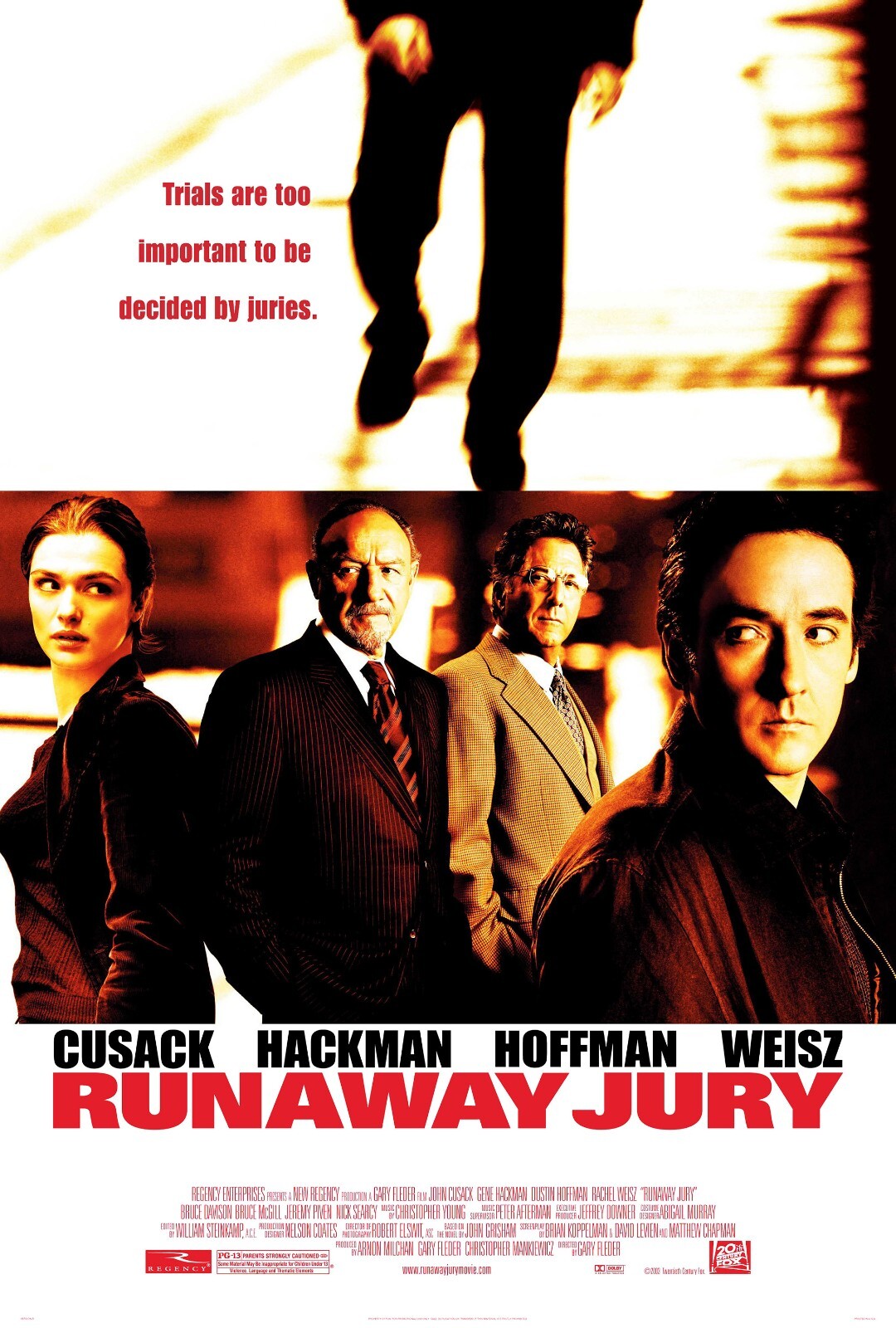
Runaway Jury (2003)

s-l1600.jpg

This is one of many legal thrillers that have passed me by. There are quite a number on my viewing bucket list, from To Kill A Mockingbird to The Accused and Mississippi Burning to other Grisham adaptions such as The Client and The Pelican Brief. Historically, I haven't been attracted to the genre. I don't know... perhaps I feared it could be a little dry. Or perhaps it simply wasn't my thing. Which means there's a whole world of potential discovery for me.

There were many good reasons to watch this particular one. Dustin Hoffman was in the last film I watched (and is probably how this one came to be suggested to me). The news of Gene Hackman's death also weighed in to my choice to watch one of his films. And when I watched 1408 back in October I made a note to keep an eye out for more of John Cusack's work.

I'm sure I must have seen John Cusack in other films, but I struggle to place them. I was impressed with his screen presence and his overall performance. Being in practically every scene, with a lot of emotional highs and lows and frequently monologuing the entire film hinges on his performance, and he carries it with flair. I'd go so far as to say his performance would be the key reason for a rewatch and I'd certainly be up for checking out more of his work.


It was quite surprising to see John get top billing, ahead of the two H-Men (Hoff and Hack). Even though his character is central, I don't think of him as a Hollywood heavyweight in quite the same way. But perhaps I've underestimated him again. Indeed, I had no idea how extensive his filmography was even before this film was made. And, once again, I really, really need to check out more of his films.

In pictures, John Cusack often resembles Edward Norton to me. In this film, though, I found myself deciding that if Kevin Spacey and Ryan Reynolds had a baby, he'd probably look just like JC. It's reassuring to know that I'm not the only one whose mind went along this track:
^ Oh -the embarrassment. And she's boasting about being a film student.

Now in this film, I didn't see the Spacey/Reynolds thing, but I did see the resemblance to Norton who, it turns out, was also in the running to play this part (along with violent diva Will Smith whom I'm glad wasn't cast as I'd have almost certainly have actively avoided it). Once again I found Cusack charismatic and watchable and he certainly helped sell the story.

Despite their billing, it has to be said that Hoff and Hack really do feel like the legends here. Even as the story is unfolding organically, there's an almost subliminally low key excitement to the way the two of them are kept apart for much of the film. Even when they're in the same space, they're kept apart, which makes their key scene together - which takes place in, of all places, a public convenience feel genuinely important. Both do their thing to perfection.

Reading up on the film afterwards it seems Hack and Hoff were former classmates... both voted "least likely to succeed". Meanwhile, John Cusack's own former school peer Jeremy Piven appears here. I know him best for his episode of Will & Grace, though according to Hollywood tattle both that episode and his friendship with Cusack seemed to end in acrimony. Anyway, he's fine here, and one of many familiar faces. Bruce Davison (best known to me as X-Men's Senator Kelly) again reliably channels authority. Leland Orser is one of those actors who for a time seemed to show up everywhere in supporting roles (something used to really good effect in The Bone Collector). He, too, is as reliable as ever here.

While I was expecting the story to focus on the case itself, this was sidelined by the film's very premise which was an engaging and effective way to surprise. On first glance, this could have taken place with any old trial on any subject matter. Upon reflection, though, it really had to be on a divisive topic where large numbers of people could come down on either side. The trial's subject needed to have grey areas and complexities in order for it to genuinely feel it could have gone either way and not just been about "good" and "bad" triumphing. The gun control issue is a perfect fit for this as questions of morality dovetail nicely with the very idea that justice can be bought. Likewise, the faceless corporation defending mirrors the idea of justice as a system, which exists as a concept that one cannot see or touch.


t's a great piece of politically-important cinema. But, as these things go, the actual story is even more hair-raising than the fictionalized version on screen.

Nixon's reputation is deserved. But there's always somebody meaner (and more powerful) in Foggy Bottom. (Woodward was CIA; The Post, pre-Bezos, was CIA; the break-in at the Watergate Hotel was deliberately-flubbed with an intention to get caught; several of the burglars were literally in Dealey Plaza nine years earlier, etc...)

As Deep Throat points out, it goes everywhere. And much further than even the movie would -- or could -- tell.

I'd certainly be up for watching some more films that focus on Watergate.

And I'd imagine it's only a matter of time before there's a Netflix series (if there's not one or two already there somewhere).
 

Soaplover

Telly Talk Fan
LV
0
 
Awards
3
No Way Out (1987)

1741600190012.png


I decided to do a rewatch recently given the recent passing of Gene Hackman. This movie is a neo noir mystery action thriller that takes place during the Cold War in Washington D.C. during the 1980s. This is the movie that launched Kevin Costner into A list status .. and starred Costner, the late Gene Hackman and Sean Young with Will Patton, George Dzundza, and Iman playing supporting rules in this forgotten gem of a movie.

The movie starts off with a political love triangle between Costner, Young, and Hackman that quickly shifts into an action thriller midway through with Costner knowing what really happened, but trying not to get harmed while exposing the truth. Everything seems resolved, or is it?

After watching this movie, one can see why Costner became an A-lister while Hackman turns in another compelling performance as the secretary of Defense that let his emotions cloud his judgement. Critics at the time said that Sean Young was the weak link and miscast, but I disagree with that assessment, because she's playing her own game with juggling both men and knowing more then she lets on. Some thought she was too cold and unlikable, but I think she infuses her character Susan with some vulnerability. Lastly, she and Costner have chemistry with one another and you spend time seeing their relationship develop in spite of the fact that she's also in an affair with his boss at the same time.

Some say Film Noir died with the arrival of color in films, but I think it evolved into the style we saw in thrillers/mysteries released during the 1970s and 1980s. This movie has everything a film noir would have... grey characters, a femme fatale character, the tragic best friends of the leads (played by Iman and Dzundza). I don't want to give too much away, but it's a great movie and one of Hackman's little talked about movies.
 
Top