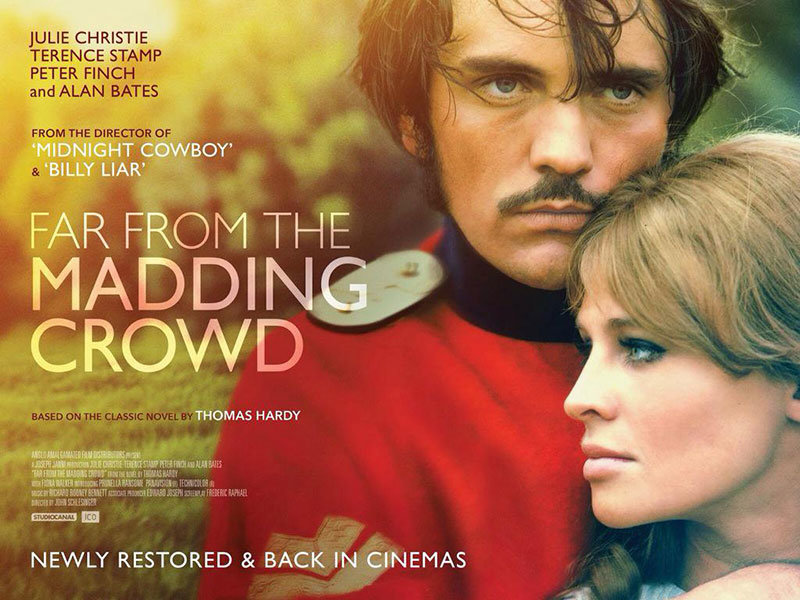
I watched both film adaptations of Thomas Hardy's
Far from the Madding Crowd over the weekend. Both depict a very potent world - a place of wild, wide-open spaces and dark forests with clifftops overlooking a raging ocean, yet it's also a place where the smallest things -- mishearing the name of a church, sending a Valentine card as a prank, an over-excitable sheepdog -- can have terrible, life-destroying consequences.
The 1967 version is directed by John Schlesinger (
Midnight Cowboy, Marathon Man) and stars Julie Christie, Terence Stamp (the same Terry and Julie who meet "every Friday night" in the Kinks song 'Waterloo Sunset'), Peter Finch and Alan Bates. It's about an hour longer than the more recent version (there's even an intermission!) and is filmed in a similarly sweeping, epic style to other big films of the period (
Dr Zhivago, Lawrence of Arabia, etc.) Yet there are also a few moments of wonderfully freaky camera work that feel quintessentially '60s (Terry and Julie's fantastically weird sword scene, for instance.) It's lush and romantic, but also dirty (dirty as in "muddy" rather than "naughty") in a way that the 2015 film isn't. You get more of a sense of the wider community as well.
The 2015 version (Carey Mulligan, Michael Sheen, two other fellas whose names I didn't recognise) is leaner, tauter, more concentrated on the main characters. I found myself rooting more for the characters in this version whereas I was happy to just let the "bigness" of the earlier film wash over me.
Story-wise, I think the biggest difference is the portrayal of the heroine, Bathsheba Evadine. Julie Christie makes Bathsheba's (initial) reluctance to be tied down to a man seem like the result of a kind of dreamy idealism ('60s idealism, perhaps?). There's also something of Julie Andrews in
The Sound of Music about her (she even runs up a hill, a big smile on her face, at one point.) The actions of Carey Mulligan's version of the character spring more from an innately independent, proto-feminist nature. She refuses to be defined by a man because -- well, why should she be? If that sounds like it's bolted on in order to appease a modern audience (the old "she was a woman ahead of her time" cliche), it doesn't feel that way. Her defiance is all in Hardy's original text apparently, and watching the newer version you can see why
The Hunger Games might have named its own tough heroine, Katniss Evadine, after her in a way than you don't when you watch the '67 one. A line from the novel that leaps out of the newer version, "
It is difficult for a woman to define her feelings in a language chiefly made by men to express theirs," doesn't appear at all in the earlier one.