What was the last film you watched?

Snarky Oracle!

Telly Talk Supreme
Out of interest, I watched her Academy Award win for the film and she wasn't present. George Cukor accepted on her behalf.

Hepburn never attended the Oscar ceremony (she's won four, more than any actor in history; receiving the second-most nominations, 12, while Streep has the most nominations, 473 exactly) except to present the Irving Thalberg Award in 1974.

She makes no excuse for never appearing all the times she got a nomination, admitting she wouldn't know what to do with herself if she lost, asserting she doesn't completely approve of her own "cheap, second-rate" choices not to go.

 
She makes no excuse for never appearing all the times she got a nomination, admitting she wouldn't know what to do with herself if she lost, asserting she doesn't completely approve of her own "cheap, second-rate" choices not to go.

How refreshing. It's so much more endearing than all the supportive fakery in abundance at these ceremonies, or any kind of virtue signalling guff about being embarrassed to win.
 

Crimson

Telly Talk Star
It's interesting that the girl in particular seems on some level to enjoy shocking people with the dramatic reveals (something that's highlighted by her husband-to-be in dialogue) while at the same time being horrified by those shocked reactions. Notwithstanding the race and age divisions, of course anyone would be very surprised by someone returning home with a fiancé she'd met only days before

A critic in the 80s said GWCTD is less about a bigoted society than a brain-damaged daughter. She could have brought Robert Redford home and her parents would still have been justified to be nonplussed at the abrupt engagement. I can't avoid feeling the film's well-intentioned messaging is undermined by presenting her as something of a flake.
 
All The President's Men (1976)

iu


This was an impulse watch yesterday. I was in the mood for a drama/thriller, ad-free and with a two hour running time and, looking at iPlayer, this fitted the bill perfectly (I dare say the choice to watch a film with this particular theme was influenced in large part by having watched a live stream of Friday's meeting at the White House).

There are probably many ways to approach this film. Mine was from the position of having only a passing knowledge of Watergate. I'd previously read a little on it, and picked up other snippets over the years (it's impossible not to have), but had no in-depth knowledge of how the names and various pieces of the puzzle interconnected. This put me in much the same position as the journalists whose investigation unfolds as the film goes along. I began watching not really fully knowing what was going on. and things were far from clear in my mind as the film ended, other than in general terms.

Still, I found it compelling in a people-watching kind of way. I didn't know all the facts and background, and very little was conveniently spoon-fed. Instead, I settled into observing people as they interacted, and finding that element almost made the story secondary. All I needed to know was that they were passionate about something and were going after it.

Robert Redford and Dustin Hoffman were an interesting pairing. Objectively, Redford felt more "leading man" and the film more often seemed to be seen from his POV, but it was the interactions between the two that gave the film a heart. Hoffman gave great sleaze and gave out a satyr-like energy - with lots of confident smirks and manspreading - as Bernstein swung between charm and chutzpah to gain entry and leverage. This meant he felt more like a scene-stealer (in the best way) and I found myself fascinated by his naturalistic acting style and what felt like frequent ad libs. In fact, I was a little distracted by it sometimes: there's one scene where he's questioning a nervous woman after pushing his way into her home. Halfway through the scene, he took a sip from a mug and commented that the coffee was cold. It felt so off the wall, I lost track of what was being said because I became more invested in the story of his cold coffee than the investigation.

They're very different actors in terms of physical stature, and I found myself noticing that most of their scenes were staged so they were on different levels - one of them sitting on a desk while the other either stood or sat on a lower chair; both walking up steps at different levels; etc. When they were seen standing or walking alongside on another in the same shot, it somehow felt significant.

The rest of the cast is a collection of well-known faces, padded out by some that are only known in certain circles. During one scene I was sure I'd recognised future Supergirl Helen Slater, only to realise this morning that I had, in fact, been watching future Knots schoolteacher/chanteuse Penny Peyser.

The film's aesthetics are its strong suit. Cinematographer Gordon Willis had previously worked on The Godfather films (and would later return for Part III), and this can be seen here. It looks sumptuous, often rich in shadows with mostly drab colour filters and occasional brighter pops (in diners, etc.). There's a gritty, almost uncomfortable edge that Seventies films did so well (think The Conversation or The French Connection). Meanwhile, the office is often shot from low angles, treating the audience to row upon row of headache-inducing overhead lighting on the polystyrene ceiling. Between this and the noisy hubbub from the open plan setup it seems to capture the truth of working in a large office during this era.

For much of the film, I found myself thinking how similar the film's look, tone, dynamics and energy were to David Fincher's Zodiac (it's the other way round, really, since Zodiac was made over three decades after this. But I first watched Zodiac almost two decades before this film so it was an established frame of reference for me). Doing a bit of reading, I've found that Fincher did indeed use All The President's Men as the template for his film. And he was certainly successful there.​
 

James from London

International Treasure
All The President's Men (1976)
​

I (re)watched this not long ago as well, also on the iPlayer. I think visually this movie left its imprint on all sorts of subsequent films and TV series, not least the US prime-time soaps. The scenes of Ben and Mack knocking on doors during their stolen babies/Wesphall investigations on KNOTS always felt very influenced by it, while on DALLAS JR even had his own variation of the Deep Throat scene when he was lured to a darkly lit parking garage by an anonymous informant during the Justice Department investigation into Ewing Oil. And certainly FALCON CREST was no stranger to shady figures lurking in underground garages.

There's a very different, not-really-a-sequel-at-all from the mid-80s, Heartburn, in which Jack Nicholson plays a fictionalised and not very flattering version of Carl Bernstein, that focuses on his marriage to a fictionalised version of Nora Ephron, who just happened to wrote the movie, and is played by Meryl Streep. It's been years since I've seen it, but I really loved it at the time. It's very smart and funny and melancholic. Carly Simon's theme song 'Coming Around Again' really sums up the vibe of it.
 
Last edited:
The scenes of Ben and Mack knocking on doors during their stolen babies/Wesphall investigations on KNOTS always felt very influenced by it

Oh yes. There was one specific scene last night that vividly brought Mack and Ben to mind as I watched. It's already faded from memory too much for me to describe it well, but I'm pretty sure the two of them were in one of their homes, poring over papers and bouncing things off one another (metaphorically speaking). There were a number of late Season Six Knots scenes between Mack and Ben that echoed this, but the one that sprang to mind was when Ben remembered "We were... in the valley somewhere, talking to some woman".


on DALLAS JR even had his own variation of the Deep Throat scene when he was lured to a darkly lit parking garage by an anonymous informant during the Justice Department investigation into Ewing Oil. And certainly FALCON CREST was no stranger to shady figures lurking in underground garages.

Those Deep Throat scenes did feel quite familiar. I seem to remember Mack having a meeting of this kind during the Wolfbridge saga as well. I suppose shady exchanges in underground garages have become a bit of a standard.


There's a very different, not-really-a-sequel-at-all from the mid-80s, Heartburn, in which Jack Nicholson plays a fictionalised and not very flattering version of Carl Bernstein, that focuses on his marriage to a fictionalised version of Nora Ephron, who just happened to wrote the movie, and is played by Meryl Streep. It's been years since I've seen it, but I really loved it at the time.

That sounds interesting. I'll keep my eyes peeled for that one.


Carly Simon's theme song 'Coming Around Again' really sums up the vibe of it.

Coo. I knew the song, but hadn't realised this was where it came from.
 

Snarky Oracle!

Telly Talk Supreme
There's a gritty, almost uncomfortable edge that Seventies films did so well

Yes, only in the '70s (especially early-to-mid). And that atmosphere was so organic and un-self-conscious then.

It's a great piece of politically-important cinema. But, as these things go, the actual story is even more hair-raising than the fictionalized version on screen.

Nixon's reputation is deserved. But there's always somebody meaner (and more powerful) in Foggy Bottom. (Woodward was CIA; The Post, pre-Bezos, was CIA; the break-in at the Watergate Hotel was deliberately-flubbed with an intention to get caught; several of the burglars were literally in Dealey Plaza nine years earlier, etc...)

As Deep Throat points out, it goes everywhere. And much further than even the movie would -- or could -- tell.

imrs.php
 
Last edited:
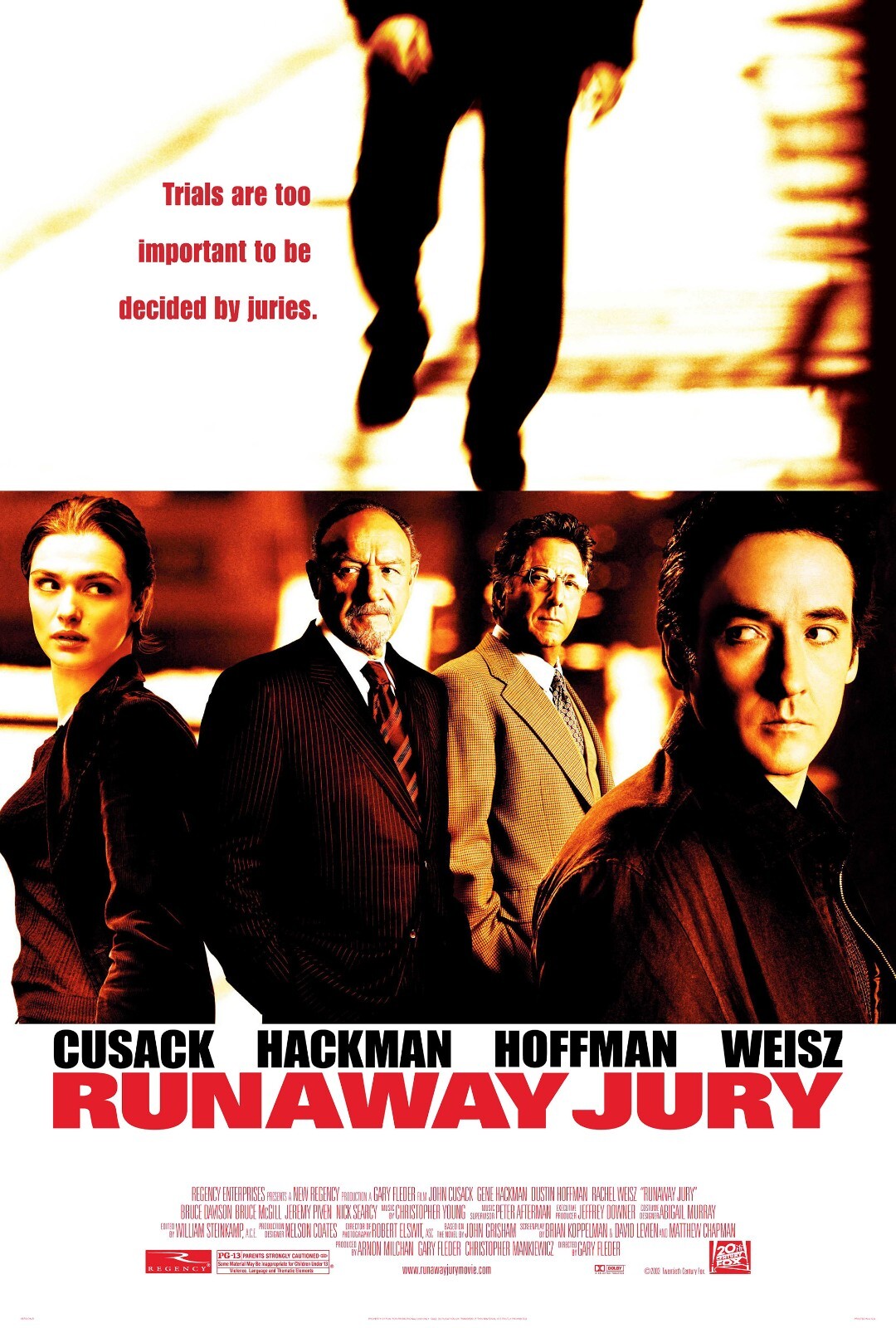
Runaway Jury (2003)

s-l1600.jpg

This is one of many legal thrillers that have passed me by. There are quite a number on my viewing bucket list, from To Kill A Mockingbird to The Accused and Mississippi Burning to other Grisham adaptions such as The Client and The Pelican Brief. Historically, I haven't been attracted to the genre. I don't know... perhaps I feared it could be a little dry. Or perhaps it simply wasn't my thing. Which means there's a whole world of potential discovery for me.

There were many good reasons to watch this particular one. Dustin Hoffman was in the last film I watched (and is probably how this one came to be suggested to me). The news of Gene Hackman's death also weighed in to my choice to watch one of his films. And when I watched 1408 back in October I made a note to keep an eye out for more of John Cusack's work.

I'm sure I must have seen John Cusack in other films, but I struggle to place them. I was impressed with his screen presence and his overall performance. Being in practically every scene, with a lot of emotional highs and lows and frequently monologuing the entire film hinges on his performance, and he carries it with flair. I'd go so far as to say his performance would be the key reason for a rewatch and I'd certainly be up for checking out more of his work.


It was quite surprising to see John get top billing, ahead of the two H-Men (Hoff and Hack). Even though his character is central, I don't think of him as a Hollywood heavyweight in quite the same way. But perhaps I've underestimated him again. Indeed, I had no idea how extensive his filmography was even before this film was made. And, once again, I really, really need to check out more of his films.

In pictures, John Cusack often resembles Edward Norton to me. In this film, though, I found myself deciding that if Kevin Spacey and Ryan Reynolds had a baby, he'd probably look just like JC. It's reassuring to know that I'm not the only one whose mind went along this track:
^ Oh -the embarrassment. And she's boasting about being a film student.

Now in this film, I didn't see the Spacey/Reynolds thing, but I did see the resemblance to Norton who, it turns out, was also in the running to play this part (along with violent diva Will Smith whom I'm glad wasn't cast as I'd have almost certainly have actively avoided it). Once again I found Cusack charismatic and watchable and he certainly helped sell the story.

Despite their billing, it has to be said that Hoff and Hack really do feel like the legends here. Even as the story is unfolding organically, there's an almost subliminally low key excitement to the way the two of them are kept apart for much of the film. Even when they're in the same space, they're kept apart, which makes their key scene together - which takes place in, of all places, a public convenience feel genuinely important. Both do their thing to perfection.

Reading up on the film afterwards it seems Hack and Hoff were former classmates... both voted "least likely to succeed". Meanwhile, John Cusack's own former school peer Jeremy Piven appears here. I know him best for his episode of Will & Grace, though according to Hollywood tattle both that episode and his friendship with Cusack seemed to end in acrimony. Anyway, he's fine here, and one of many familiar faces. Bruce Davison (best known to me as X-Men's Senator Kelly) again reliably channels authority. Leland Orser is one of those actors who for a time seemed to show up everywhere in supporting roles (something used to really good effect in The Bone Collector). He, too, is as reliable as ever here.

While I was expecting the story to focus on the case itself, this was sidelined by the film's very premise which was an engaging and effective way to surprise. On first glance, this could have taken place with any old trial on any subject matter. Upon reflection, though, it really had to be on a divisive topic where large numbers of people could come down on either side. The trial's subject needed to have grey areas and complexities in order for it to genuinely feel it could have gone either way and not just been about "good" and "bad" triumphing. The gun control issue is a perfect fit for this as questions of morality dovetail nicely with the very idea that justice can be bought. Likewise, the faceless corporation defending mirrors the idea of justice as a system, which exists as a concept that one cannot see or touch.


t's a great piece of politically-important cinema. But, as these things go, the actual story is even more hair-raising than the fictionalized version on screen.

Nixon's reputation is deserved. But there's always somebody meaner (and more powerful) in Foggy Bottom. (Woodward was CIA; The Post, pre-Bezos, was CIA; the break-in at the Watergate Hotel was deliberately-flubbed with an intention to get caught; several of the burglars were literally in Dealey Plaza nine years earlier, etc...)

As Deep Throat points out, it goes everywhere. And much further than even the movie would -- or could -- tell.

I'd certainly be up for watching some more films that focus on Watergate.

And I'd imagine it's only a matter of time before there's a Netflix series (if there's not one or two already there somewhere).
 

Soaplover

Telly Talk Fan
No Way Out (1987)

1741600190012.png


I decided to do a rewatch recently given the recent passing of Gene Hackman. This movie is a neo noir mystery action thriller that takes place during the Cold War in Washington D.C. during the 1980s. This is the movie that launched Kevin Costner into A list status .. and starred Costner, the late Gene Hackman and Sean Young with Will Patton, George Dzundza, and Iman playing supporting rules in this forgotten gem of a movie.

The movie starts off with a political love triangle between Costner, Young, and Hackman that quickly shifts into an action thriller midway through with Costner knowing what really happened, but trying not to get harmed while exposing the truth. Everything seems resolved, or is it?

After watching this movie, one can see why Costner became an A-lister while Hackman turns in another compelling performance as the secretary of Defense that let his emotions cloud his judgement. Critics at the time said that Sean Young was the weak link and miscast, but I disagree with that assessment, because she's playing her own game with juggling both men and knowing more then she lets on. Some thought she was too cold and unlikable, but I think she infuses her character Susan with some vulnerability. Lastly, she and Costner have chemistry with one another and you spend time seeing their relationship develop in spite of the fact that she's also in an affair with his boss at the same time.

Some say Film Noir died with the arrival of color in films, but I think it evolved into the style we saw in thrillers/mysteries released during the 1970s and 1980s. This movie has everything a film noir would have... grey characters, a femme fatale character, the tragic best friends of the leads (played by Iman and Dzundza). I don't want to give too much away, but it's a great movie and one of Hackman's little talked about movies.
 

ClassyCo

Telly Talk Warrior
I just watched the made-for-TV remake of A LETTER TO THREE WIVES (1985), starring Loni Anderson, Michele Lee, and Stephanie Zimbalist as the wives, with Ben Gazzara, Michael Gross, and Charles Frank as their husbands.

It's been a while since I've watched the 1949 original, which and been written and directed by Joseph L. Mankiewicz, but I recall loving that version of the story. Jeanne Crain, Linda Darnell, and Ann Sothern (who shows up as Loni's mom in this remake) are hard to beat. And the touch of Mankiewicz isn't so easily replicated.

With that, I found this 1985 small-screen adaptation to be enjoyable. It doesn't do anything new, but just simply rehashes the original story in a mid-80s setting.

1741983953529.jpeg
 

Toni

Maximum Member
I just watched the made-for-TV remake of A LETTER TO THREE WIVES (1985), starring Loni Anderson, Michele Lee, and Stephanie Zimbalist as the wives, with Ben Gazzara, Michael Gross, and Charles Frank as their husbands.

It's been a while since I've watched the 1949 original, which and been written and directed by Joseph L. Mankiewicz, but I recall loving that version of the story. Jeanne Crain, Linda Darnell, and Ann Sothern (who shows up as Loni's mom in this remake) are hard to beat. And the touch of Mankiewicz isn't so easily replicated.

With that, I found this 1985 small-screen adaptation to be enjoyable. It doesn't do anything new, but just simply rehashes the original story in a mid-80s setting.

View attachment 55722

I agree with you, it´s a very pleasant telemovie that doesn´t add anything to the story. My only but is that Ms. Lee looks like her Karen once again, when she should have done something with her hair to preventing the audience from thinking about her Knots character when she first shows up. Even one-faced Loni is ok here, and the guys are quite good. I remember fondly Zimbalist´s performance as the Remington Steele fan I am!


1742042473450.png
​
 

ClassyCo

Telly Talk Warrior
I agree with you, it´s a very pleasant telemovie that doesn´t add anything to the story. My only but is that Ms. Lee looks like her Karen once again, when she should have done something with her hair to preventing the audience from thinking about her Knots character when she first shows up. Even one-faced Loni is ok here, and the guys are quite good. I remember fondly Zimbalist´s performance as the Remington Steele fan I am!


Yes, it adds absolutely nothing to the table. It follows the same beats as the 1949 film, and doesn't improve in it in any way.

I agree with you about the cast. Michele Lee should've done something different with her hair to differentiate herself from Karen McKenzie over at Seaview Circle. I actually like Loni Anderson here, which I've enjoyed her performances as Jayne Mansfield and Thelma Todd, too. I was, by some measure, the least impressed with Stephanie Zimbalist and Charles Frank as the Bishops. They were least interesting and convincing to me.
 

Willie Oleson

Telly Talk Schemer
The Defiant Ones (1958)

1742165718547.png

It doesn't take long to figure out what the main premise is going to be, and for a moment I feared it would be one of those annoyingly forced-funny "buddy" stories.
But this film isn't from the 1980s or 1990s, it's from 1958 and back then they had a much better sense of humour.
In some ways this film reminds me of the no-nonsense attitude of Billy Wilder's Ace In The Hole - critical and cynical, with shades of absurd humour and unexpected moments of poignant drama.
It's precisely that kind of non-genre that makes these old films incredibly lively and entertaining.

The Defiant Ones features the issue of racism, and how could it not, but it really hits home when the story enters a moment of ease and the only significant female character assumes that she wouldn't have to feed the black man.
It's the ongoing action-reaction that allows the characters to learn a little bit more about themselves but not necessarily take advantage of it.

There are several laugh-out-loud funny moments in the simplicity of the chained characters tumbling down or beating each other up, in other moments it looks frustratingly tense.
The chase patrol delivers the quirkiness with the red tape decision making and the particular concern for the dogs.
Off the top of my head I can't think of any other movies that end with an exclamation, or certainly not as unique as "sewing machine!"

I haven't seen many films starring Tony Curtis or Sidney Poitier therefore it also felt like killing two birds with one stone. Also bought the film which is yet another funny DVD/Blu ray combo.
1742166231016.png
 

ClassyCo

Telly Talk Warrior
I just finished the TV movie remake of SORRY, WRONG NUMBER (1989), starring Loni Anderson, Patrick Macnee, and Hal Holbrook. It originally aired on the USA Network.

First, I'll say this right off the bat -- Loni is no Barbara Stanwyck, but I thought she did a decent job. Her rendition of the bed-ridden heroine is much more sympathetic than Stanwyck's version. There's even some good suspense towards the end.

It's a middling late-80s remake of a classic noir. It's available for free online, so you're not wasting anything but time to watch it.

1742316354907.jpeg
 

Willie Oleson

Telly Talk Schemer
NASHVILLE (1975)

1742433163520.png

For a film with so many characters and ongoing - sometimes overlapping - dialogue I find it surprisingly accessible, but I can't even begin to imagine what it looked like on paper.
I guess the trick here is Altman's incredible talent to make every detail pop without giving it too much attention, something I had previously witnessed in Gosford Park.
I struggle to categorise Nashville as a genre, even "drama" seems too generic in the context of this film.
Partially documentary, road movie, dark comedy, social commentary, satire counterbalanced by just enough optimism, and even shades of a psychological thriller. And music.

I'm not a hardcore country & western music fan but at least it taps into childhood nostalgia.
I thoroughly enjoyed most of the songs especially the ones by Ronee Blakley who comes across as a 1970s Julianne Moore.
At some point in the story it starts to hint at a possibly dramatic climax, I suspected the army guy who seemed like an obsessive fan.
Then later I figured he would prevent the assassination, just like his mother had saved Barbara Jean from the fire.

Quite cheekily, it even features a little bit of the "Eurotrash villain" trope in the narcissistic and intrusive BBC reporter brilliantly portrayed by Geraldine Chaplin.
Un deux trois quatre, testing.
The DVD also features an interview with Robert Altman, and the comment that stood out to me is that Karen Black was (at that time) considered the biggest name in this film.
The first time I saw Karen Black in a movie she had already followed in Adrienne Barbeau's footsteps and become a familiar face in B horror films.

It's a great addition to the precious movie collection even though it's a DVD-r (an alarming trend in R1 releases) so maybe I'll replace it with the OOP Criterion Collection release (I guess it won't be cheap in the market places).


BLEAK MOMENTS (1971)

1742434204245.png

The title kinda reads like a parody on the downbeat "kitchen sink" genre and although I don't know if this is intentional, the film itself certainly looks like it.
Not the conventional/popular parody with gags and references, but more like a bunch of long sketches aimlessly strung together.
In that regard I found it easy to lose track of whatever this film was trying to convey (a bleak existence, the lack of energy to escape it?) but at the same time it has an extraordinary spellbinding quality similar to, say, Jeanne Dielman.
It's impossible to look away because of "what else is not going to happen next?".
It is first and foremost a performance film - by actors I had never heard of before - and there isn't anything in it that could have been done better.

Bleak Moments takes shyness and the incapacity (or unwillingness) to communicate to the next level, and it's hard to imagine that a film that relies so heavily on body/facial language was based on a stage play.
It's the anti-My Dinner With Andre, and yes, it's often hilarious but not really at the expense of the characters (except for one, but I think we're supposed to hate her).

Mike Leigh is a familiar name to me but when I checked his filmography there wasn't anything on the list that rang a bell. However, some further reading informed me that he was the man behind the famous cringe classic Abigail's Party.
I will watch this again.


NOSFERATU (2024)

1742434800012.png

The story of a peculiar relationship between a stressed out goth chick and a vampire who sounds like Gru from Despicable Me.
It all looks painstakingly orchestrated but nothing ever comes to life, the many histrionics notwithstanding.
The only character that evokes something is Friedrich Harding, or maybe it's because he treats Ellen like the attention-seeking troublemaker that she is.
Naturally there weren't going to be any big surprises but the particular tone makes it beat-for-beat predictable and I was just waiting for it all to end.
The story takes place in Germany but it could have been anywhere, it could have been Harry Potter Land.
The Freudian undertone is in the story but I don't see it in the characters, it's way too sterile and precise to allow any of that moistly/suffocating atmosphere to creep in. And for the umpteenth time: that blue hue does not help at all. Please, stop it.

A boring costume drama without any thrills or suspense and it only made me think how much I enjoyed Dracula '92.
I wanted to like this because Robert Eggers seems like a cool person. Oh well, I'm sure he's going to make another film.

 

Willie Oleson

Telly Talk Schemer
Two rewatches (only because it was included with Prime)

MISERY (1990)

1742578209745.png

In some ways this looks like a step-up from the cheesy Stephen King adaptations from the 1980s and I certainly enjoyed it when I watched it for the first time.
The obsessive fan/friend/lover wasn't exactly a new theme in 1990 but it does predate the backlash of the fanbase who "knows better". Annie Wilkes is the future voice of our modern social media mob.
This isn't fair!
As a thriller/horror it hasn't aged very well and I think that has a lot to do with the filmmaker's crowd-pleasing approach, and it's ironic that a film called "misery" looks so cheerful.
The creation of Annie Wilkes' film version alternates between seriously psychopathic and knowingly "camp", and also between gullible and extremely clever and calculating.
In other words: the scenes aren't written for the character, the character is written for the scenes in order to achieve instant and maximum effect.
And while that kinda works (especially on a first-time watch) I think it diminishes the overall effect of the film.

In a somewhat comical way it works best as a story about a feud or one-upmanship.
A big part of the film is about prolonging the escape of Paul Sheldon, writer of pulpy period piece romance novels, and while these actions are inventive and sometimes suspenseful they're also too plot-driven to enjoy them all over again and I couldn't resist checking the remaining running time every now and then.
If anything, I found the investigation by the old sheriff's couple more entertaining.

As a phsychological thriller Misery is a bit rubbish, and perhaps its main asset is its charming familiarity and campy quotes.


THE SILENCE OF THE LAMBS (1991)

1742578405241.png

I'm not a big fan of the police procedural dramas, sometimes I find them enjoyable but never seriously good. Off the top of my head, Zodiac is the only other one that I really love (and True Detective, of course).

Most cleverly, Silence becomes a combination of two stories and they're both battling for being the most theatrical one, and that is very good for me.
There's the short buildup to the introduction of the (now) iconic Dr. Hannibal Lecter as we see Clarice enter the chamber of horrors.
Later there's Dr. Lecter's epic escape from his giant circus cage resulting in that jawdropping display of his victim: a not too realistic image that borders on Batmanism.
And we are so rooting for him.

The hunt for the killer plays out with a twist, it's not the most noble kind of trickery but if it works it works.
The killer himself isn't given much screen time to showcase his villainy but that makes sense since it's supposed to be a guessing game for the protagonist and we don't need to know much more than she does.
Additional credit goes to Brooke Smith who makes the very best of her role as the killer's last victim.

Apart from the two monsters it also has the a**hole character trope, the one who unintentionally obstructs or jeopardises the proceedings for superficial reasons such as vanity or laziness or just being a bitch for the heck of it.
In Die Hard it was Harry Ellis, in Silence it's Dr. Chilton which makes the open-ended but oh-so-suggestive finale all the more satsifying.

This was actually even better than I remembered.
(but how did Precious end up down in that hole? For a dog it could be a suicidal jump).
 

Willie Oleson

Telly Talk Schemer
THE WIZ (1978)

1742648723489.png

My first rewatch since....a very long time ago.
I'm not familiar with the Broadway musical but I will say that this was undoubtedly the most innovative way to revisit the classic story (which actually wasn't such a famous story in my neck of the woods).
There's a lot to love and a lot to admire in this film but I often find it a bit ponderous.
It's really not necessary to say the same thing in 10 different ways and then do it all over again with a song.

The ending (before Dorothy returns home) goes on and on until it peters out but thankfully it's saved by Diana's last song which is an absolute powerhouse performance.
Some of the lesser interesting songs could have been cut out because they don't say more than what's already in the story itself, and the Lion (my least favourite character) gets way too much screen time.

It's quite spooky and dark in some parts (but let's not forget the amazing tornado scene from the original Oz) and the "Brand New Day" part might be the best thing ever done in the history of movie musicals. It's simply ecstatic.
 
Hancock (1991)

iu

iu


This week I completed my very first viewing of the legendary Hancock's Half Hour series (later just Hancock), and I've also done some reading up one the troubled star of the series, Tony Hancock.

While the film's focus is mostly post-series, covering the last eight years of Hancock's life, it does open with a recreation of a scene from the series' most memorable episode, The Blood Donor ("A pint? That's very nearly an armful"), which came almost at the very end of the series' life. It's a single episode that came to define Hancock himself in the eyes of the public, and his resentment over this is one of the driving forces of the film (personally, I'd also like to have seen his slightly earlier Face To Face interview covered here, since it was said to have a profound affect on him (and not a positive one).

The film - part of the BBC's Screen One series - is essentially a portrait of self-destruction and on this level is almost painful to watch. His parting of the ways with his longtime comedy co-star Sid James is mentioned a few times (Hancock had simply decided he no longer wanted to share the screen with Sid and dropped him from the series without even discussing it with him), and we watch a similar thing play out with his writers, Galton & Simpson, though here they essentially sack him by refusing to jump, saying they think it's better if they stick to their little television series rather than his envisaged big screen career (IMDb tells me that Ray Galton would later punch screenwriter William Humble because he was so incensed at his portrayal in this film). We also watch a little of the filming of Hancock's charming little film The Punch & Judy Man.

Besides Hancock himself, John Le Mesurier is the best-known "character" to me. Malcolm Sinclair does a nice job with Le Mes's mannerisms and eccentricities, particularly the wan smile and the almost soporific delivery.

While I've seen Alfred Molina in many things, probably the role with which I most strongly associate him is that of Kenneth Halliwell in Prick Up Your Ears. This makes Hancock the second time in four years that Alfred would star in a biopic as a real-life celebrity whose life ended in failure, ignominy and ultimately suicide (though Halliwell's case, of course, was murder-suicide since he'd bludgeoned Joe Orton to death right before his fatal overdose). He has a bigger challenge in this film (for me, at least) since I'm familiar with Hancock as a screen personality, whereas I only ever read about Halliwell. Overall, he does a nice job. There are certain physical similarities between Hancock and Molina, but it's the performance that really does the work. I wouldn't go so far as to say it's uncannily like Hancock, but it's certainly compelling and tells the story well.

Much of Hancock's self-destruction is seen through the eyes of his publicist/mistress/eventual wife Freddie Ross. Frances Barber gives a wonderful performance as someone watching a loved one slowly sabotaging everything good in their life as Tony's drinking escalates even as his confidence diminishes. In the end credits I noticed one "Freddie Hancock" credited as production consultant, and this is no surprise since Freddie is the most sympathetic character here.

The end of Hancock's life has been fairly well documented, but the film focusses on the waste. In particular, it feels Hancock died over and over again through a series of disappointments and failures, primarily brought on by his depression, alcoholism, lack of worth which all adversely affected anything he attempted. It's sad to see him stumbling through endless retakes of a simple scene in Disney's The Adventures Of Bullwhip Griffin, eventually being sacked. Molina does a great naturalistic job with botched lines and frustration. Equally painful is the scene of his big comeback to a packed house where, unable to commit the new material to memory, he falls back on the same tired routines we watched him do near the beginning: bad impressions of Long John Silver and Captain Bligh, etc. With Freddie in the audience hoping against hope for him to succeed, and Galton & Simpson also present with a weary cynicism that nothing will have changed, it's quite unpleasant to watch someone dying on stage. As we watched this scene, my partner leaned over to me and commented that he couldn't understand how anyone found Tony Hancock funny and of course that is the point of the scene.

When Tony told the cabbie that he's going to Australia, I felt a few chills, because I knew how that ended.

There are a lot of little references that jump out for someone familiar with Tony's career. This made me wonder how this this would stand up in isolation (i.e. if someone who'd never head of Tony Hancock were to watch). I suspect it would work but would be a very different viewing experience. I suspect if I watched without knowing any background I'd be getting into a Wikipedia wormhole afterwards. And, I ended up doing this anyway.​
 
Top