- Awards
- 27
EYES WIDE SHUT (1999)
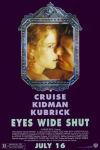
Not a rewatch but more like a second attempt to watch it. The first experience (as soon as it was available on rental video, I suppose) happened at a time in which I was much more into horror and blockbuster spectacle, and I've always considered the possibility that I watched it in the wrong frame of mind.
It's been on and off my to-rewatch list many times and as a result it never materialised - until today.
The film opens rather promising with the pretty and successful high society doctor's couple at the top of their game. It instantly raises the question "how long before this is going to fall apart" because that's the only way to go from there.
That happens when the doctor's wife (Nicole Kidman) confesses to her husband (Tom Cruise) that she's had adulterous sexual fantasies, and she does that to prove that women are in fact sexual individuals and not necessarily hopelessly devoted to their precious husbands.
It's the kind of conversation/argument that would have looked quite interesting in the 1940s or 1950s - and perhaps it has a whiff of BRIEF ENCOUNTER - but in 1999 it all sounds a bit forced.
Another point in this conversation that needs to be proven, with the wife's intent to checkmate her husband, is the difference between physical and mental faithfullness.
It's a "just because you don't do it doesn't mean you don't want to" rhetoric and I find it so utterly pointless because no matter how much you worship your spouse, you can't put a picket fence around your sexual impulses. That's why it's called an impulse, and being faithful is simply not giving in to those impulses.
From that point on we're supposed to believe the Tom Cruise's doctor is becoming obsessed with adultery and secrecy, courtesy of a "thought bubble" showing the wife's imaginary adultery as discussed before. The doctor himself never changes, he's the same polite, stone-faced character from start to finish which makes his lust for adventure hard to swallow.
This is especially visible during a conversation in which a friend of his tells him about a piano gig in a mysterious setting.
When I think of "embarking on an odyssey" - such a dear concept in film - it conjures up images of funny/bizarre/dramatic encounters (e.g. Midnight Cowboy), but this conversation painstakingly roadmaps Tom Cruise to the film's pièce de résistance, maybe the only reason this film was made.
Contrivance is an essential part of (script) writing but the trick is to make it look natural or accidental.
Stanley Kubrick proves once again that he gets the best images out of his film, and he's very generous in showing exactly that, but I don't find him a great storyteller.
Nothing significant happens, Tom Cruise is ordered to strip and that also doesn't happen because nude men don't exist in this erotic psychological world. After that he's ordered to leave the scene (some kind of high-end swingers society) and the rest of the film explains how big and important and serious it all is. But not so serious that it has any impact on the story or the characters. *sighs*
In a nutshell, Eyes Wide Shut looks like a remake of a Peter Greenaway film that has all of Greenaway's bite, humour and audacity stamped out of it.
On top of everything it moves slower than a daytime soap and I think it's telling when the main cast is constantly upstaged by the minor supporting characters.
This time I made it to the end credits, but there were many, many times when I was thinking of my upcoming dental appointment and how much more fun that is going to be.
It's easy for me to say "I hate this film" but I'd like to elaborate by saying that it made me feel awful having watched Eyes Wide Shut. Yes, ironically it does linger on, but with a frustrating and depressing aftertaste, and I wish there was a way to un-see it.
Not a rewatch but more like a second attempt to watch it. The first experience (as soon as it was available on rental video, I suppose) happened at a time in which I was much more into horror and blockbuster spectacle, and I've always considered the possibility that I watched it in the wrong frame of mind.
It's been on and off my to-rewatch list many times and as a result it never materialised - until today.
The film opens rather promising with the pretty and successful high society doctor's couple at the top of their game. It instantly raises the question "how long before this is going to fall apart" because that's the only way to go from there.
That happens when the doctor's wife (Nicole Kidman) confesses to her husband (Tom Cruise) that she's had adulterous sexual fantasies, and she does that to prove that women are in fact sexual individuals and not necessarily hopelessly devoted to their precious husbands.
It's the kind of conversation/argument that would have looked quite interesting in the 1940s or 1950s - and perhaps it has a whiff of BRIEF ENCOUNTER - but in 1999 it all sounds a bit forced.
Another point in this conversation that needs to be proven, with the wife's intent to checkmate her husband, is the difference between physical and mental faithfullness.
It's a "just because you don't do it doesn't mean you don't want to" rhetoric and I find it so utterly pointless because no matter how much you worship your spouse, you can't put a picket fence around your sexual impulses. That's why it's called an impulse, and being faithful is simply not giving in to those impulses.
From that point on we're supposed to believe the Tom Cruise's doctor is becoming obsessed with adultery and secrecy, courtesy of a "thought bubble" showing the wife's imaginary adultery as discussed before. The doctor himself never changes, he's the same polite, stone-faced character from start to finish which makes his lust for adventure hard to swallow.
This is especially visible during a conversation in which a friend of his tells him about a piano gig in a mysterious setting.
When I think of "embarking on an odyssey" - such a dear concept in film - it conjures up images of funny/bizarre/dramatic encounters (e.g. Midnight Cowboy), but this conversation painstakingly roadmaps Tom Cruise to the film's pièce de résistance, maybe the only reason this film was made.
Contrivance is an essential part of (script) writing but the trick is to make it look natural or accidental.
Stanley Kubrick proves once again that he gets the best images out of his film, and he's very generous in showing exactly that, but I don't find him a great storyteller.
Nothing significant happens, Tom Cruise is ordered to strip and that also doesn't happen because nude men don't exist in this erotic psychological world. After that he's ordered to leave the scene (some kind of high-end swingers society) and the rest of the film explains how big and important and serious it all is. But not so serious that it has any impact on the story or the characters. *sighs*
In a nutshell, Eyes Wide Shut looks like a remake of a Peter Greenaway film that has all of Greenaway's bite, humour and audacity stamped out of it.
On top of everything it moves slower than a daytime soap and I think it's telling when the main cast is constantly upstaged by the minor supporting characters.
This time I made it to the end credits, but there were many, many times when I was thinking of my upcoming dental appointment and how much more fun that is going to be.
It's easy for me to say "I hate this film" but I'd like to elaborate by saying that it made me feel awful having watched Eyes Wide Shut. Yes, ironically it does linger on, but with a frustrating and depressing aftertaste, and I wish there was a way to un-see it.