• The forum is about to undergo some crucial server updates

    There may be a little downtime, but we'll be back online as soon as possible.

    Watch this thread for updates

GUNSMOKE

Spooky Owl!

Telly Talk Supreme
So many of the half-hour episodes just border on The Stupid -- there's frequently almost no story. Somebody gets shot in the Long Branch in every episode, usually in the first scene, and Marshal Dillon gives a posing speech about morality & toughness (which usually contradict), with somebody else dying, and the closing credits roll.

Nobody quite knows why that week's shooters are mad. Just that they are. And Matt offers up a philosophical explanation that usually doesn't make much sense, a speech for which he'd probably get beaten up in real life.

Occasionally, the installment is better. But the earliest ones lean towards being narratively rather pathetic.

The very first episode ever filmed is "Hack Prine" and you can tell it -- the acting is as wooden as the livery stable, and the studio sets are different. In fact, the entry is so stiff and clunky its airing was delayed by six months in the 1955-'56 season. (The B&W noir camerawork is quite nice, however).

The problem with these early GUNSMOKE episodes probably comes from the fact that radio scripts (which began in 1952) were used for the television show. And that doesn't always translate. Radio was a more intimate medium back then, and the audience had to visualize the action. When that action has to be realized on camera, the same script and its holes may not hold together. And often doesn't.

On the upside, outside of Dodge, everyone lives in a decrepit hovel (which seems realistic). And there are a collection of hovels the viewer finds acceptable... But by the time the series turns to color in its final decade, all you see is that damned house with that damned barn to its right, and we're supposed to pretend it's a different place each week.


"He had the biggest gun in The West, Chester. And I'll never forget him..."
MV5BNzFmYTZjMGUtMjlkMi00ZmUzLThmZjQtN2Q1NDI0YTc1NmM3XkEyXkFqcGc@._V1_.jpg
 

Spooky Owl!

Telly Talk Supreme
I just saw a Season 1 episode with future super-producer Aaron Spelling (who started out as an actor) playing a mentally-challenged guitar-strumming fellow, Weed Pendle, who keeps getting roughed-up, his instrument smashed and his mule disrespected with paint, some of the menacing thugs trying to hang him for a murder in which he wasn't involved.

I guess for a late-'50s western, topics like mental retardation and the white man's decimation of "Indians" and recurrent treaty breaking -- were progressive in nature. Today, all that doesn't quite read... The early, half-hour GUNSMOKEs, the series at its ratings peak, just tend to come off as self-conscious and posing, almost like unfinished rough-cuts, the endings forced and arbitrary. Made more obvious by the scripts' attempts to make Marshal Dillon self-aware and introspective, Matt's brief, contemplative monologues something Jim Arness seemed to have some discomfort in playing.

In the '90s, the TVLAND cable network recurrently ran promos for GUNSMOKE referring to it as "the classic Aaron Spelling western" for years, although Spelling had nothing to do with the show other than his one episode appearance. And, apparently, no one ever told TVLAND of their error. Maybe I should have called somebody.

MV5BNDJlYmJkMTAtYzZkOS00MjEzLWE3ZmUtZDFhMDQyNGVmMTA5XkEyXkFqcGc@._V1_QL75_UX500_CR0,26,500,281_.jpg
 

Spooky Owl!

Telly Talk Supreme
Decades ago, I read an interview with Amanda Blake where she bemoaned the series' shift to focusing more on guest stars "like Jean Arthur" in the mid-'60s. I never knew who Jean Arthur was (she was predominantly a stage actress) and never found out.

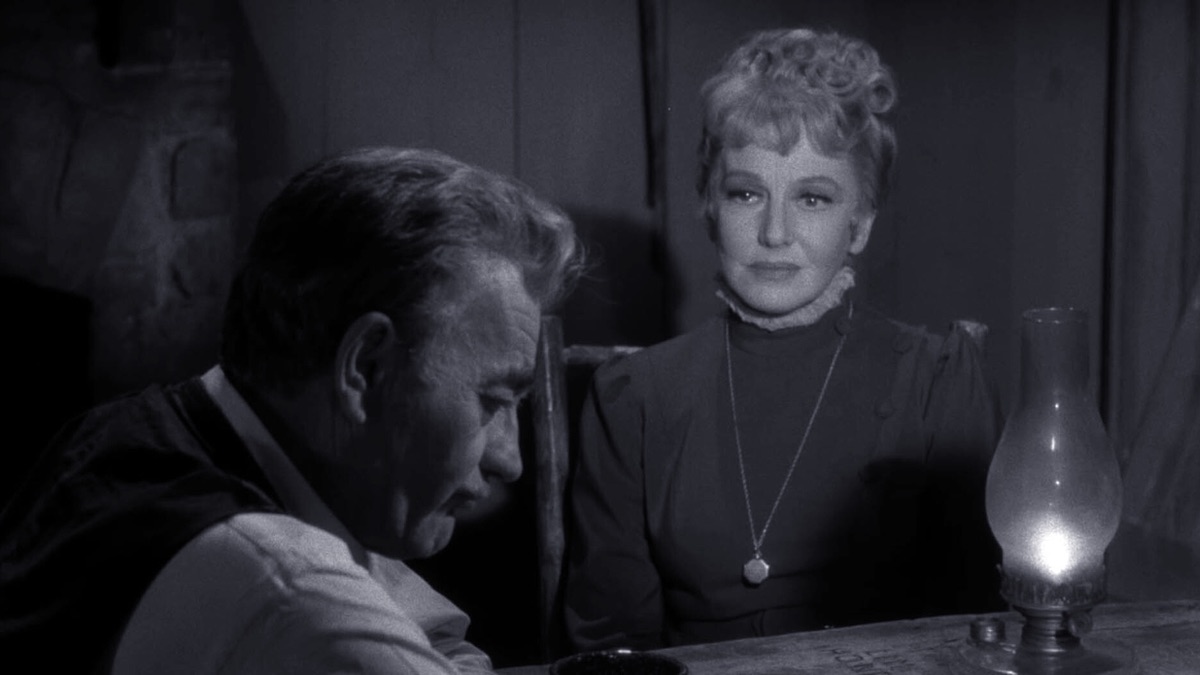
The other day, I was watching an old episode from Season 10 in 1965 with the sound down (there are 635 installments, forgodsake, and I can't be expected to listen to all of them) and in walked a woman into the Long Branch Saloon and, seeing the interaction between Miss Kitty and this guest actress, my first thought was: 'Amanda Blake, the actress and not Miss Kitty, doesn't like her --- I wonder if that's Jean Arthur....'

I waited for the closing credits. It was Jean Arthur.

Mystery solved. :lol:

So you've never seen Jean Arthur in the movies? She was a big star in the '30s and '40s, and was seriously considered for Scarlett O'Hara. Which, I guess it's not that surprising. Everyone hasn't seen every movie, or they aren't familiar with every actor or actress.

I'm not terribly familiar with Jean Arthur myself. I think I've only seen her in TOO MANY HUSBANDS (1940) (a gender-reversing of MY FAVORITE WIFE, that was released the same year), and pieces of YOU CAN'T TAKE IT WITH YOU (1938) and SHANE (1953), the latter which was her final film.

She was such a big box office draw by 1937-38 she was one of the four finalists in the running to play Scarlett, along with Joan Bennett, Paulette Goddard, and Vivien Leigh. You can see pieces of Arthur's screen tests in the MAKING OF A LEGEND documentary, which I'll link below.

As late as November 1938 -- just two months before Vivien Leigh was cast -- Jean Arthur was still in heavy consideration for the part.


I'm watching her 1965 GUNSMOKE episode again. I'm surprised I never discovered her (except for her name, and Amanda Blake's comments about her) especially since I now suspect she has a Scorpio Rising (although I can't find birthtime on her). She's both a good actress and a bad actress in a very Scorpio Rising kind of way.

And, last but not least, she's got Bette Davis eyes. Especially by her sixties.

I'll keep looking.

1200x675.jpg
 

ClassyCo

Telly Talk Warrior
I'm watching her 1965 GUNSMOKE episode again. I'm surprised I never discovered her (except for her name, and Amanda Blake's comments about her) especially since I now suspect she has a Scorpio Rising (although I can't find birthtime on her). She's both a good actress and a bad actress in a very Scorpio Rising kind of way.

And, last but not least, she's got Bette Davis eyes. Especially by her sixties.

I'll keep looking.
Do some searching on Jean Arthur, and maybe watch a couple of her films. You might've stumbled upon someone new you'll like.
 

Spooky Owl!

Telly Talk Supreme
Sometimes, GUNSMOKE has a problem with its episodic titles (but at least it didn't repeat those titles endlessly, as discombobulated DYNASTY did -- but even DALLAS used "The Sting" twice and GUNSMOKE used "Hostage" twice, so nobody's perfect ... DYNASTY used "The Testimony of The Man in the Vengeful Dinner Gown" seven times and no one ever noticed).

But, unlike DALLAS and DYNASTY, the episodic titles for GUNSMOKE appeared on screen (at least, after Season 12). GUNSMOKE's choices for those titles sometimes seemed a little strange; too many episodes are named after guest characters' names (in keeping, no doubt, with the series' increasing semi-anthology structure during the hour-long format). But many of the titles just don't describe the story dynamic of the episode.

I'm sure these are just personal quirks, but for all the high-and-mighty titles BIG VALLEY gives its episodes, I more-or-less don't have a problem with any of them (except, of course, for the series' title itself, given that BIG VALLEY feels largely interior and claustrophobic -- at least after the first few episodes -- despite the '60s decade being very much a valley). BONANZA had acceptably self-important episodic titles, too, even though the series itself is almost unwatchable today for any rational adult. (BONANZA was, in retrospect, really a sloppy kiddie show).

Today, I'm rewatching a Season 17 episode from 1971, the only GUNSMOKE three-parter ever, and filmed in California's Sonora Desert, entitled "The Bullet" (Parts 1, 2 and 3)..... Really? "The Bullet" ?? The story has Marshal Dillon, who was (as per Arness' contract with CBS) shot every second installment for twenty years, once again shot, in the back, in the opening scene. The delicate nature of his injury, a slug in his spine, necessitates all the cast accompanying Matt by train to Denver where the greatest medical experts known to 19th century Man can perform the procedure to save the lawman's life and ambulatory capacity. But, as it turns out, there is gold on the train. Gold which attracts bandits to that train. Thus, Dillon's identity and health status must be kept secret lest the larcenist thugs discover him and plug him with a few more -- y'know -- bullets.

The original script apparently bore the title "Gold Train". And that feels exactly right -- you've got gold, you've got a train, even the arid desert surrounding is golden... But, for some strange reason, the producers decided to change the name on-screen to "The Bullet" and it just sticks in my craw every time I've seen it... And it goes on for three hours.

Miss Kitty gets a nice soliloquy speech, though, about her seventeen-year non-permanent relationship with the marshal, and it stirs Matt back into consciousness. Which is sweet. But by the time this three-part episode concludes and the villains are subjugated, the train pulls off towards Denver and "the bullet" has been removed from Dillon's back by Doc Adams anyway. But science says successfully fighting crime is good for the immune system, so you know he's gonna be fine. To be shot again another day.

Then there's an episode from the previous season called "The Gun".... Okay, "gun" is already in the overall series' title. There are lots of guns in GUNSMOKE. That might even be why they called the series what they called it... Again, my eyelid starts to spasm involuntarily... The plot is that a young boy working in the freight office finds a gun used in a crime by a famous outlaw, and as the story progresses, the firearm changes hands multiple times and a trail of bloodshed predictably unfolds. Decent episode. But "The Revolver" seems a better metaphoric title; "The Gun" sounds artless, redundant, and bereft of any cleverness.

There are others.

1236946.jpg
 
Top