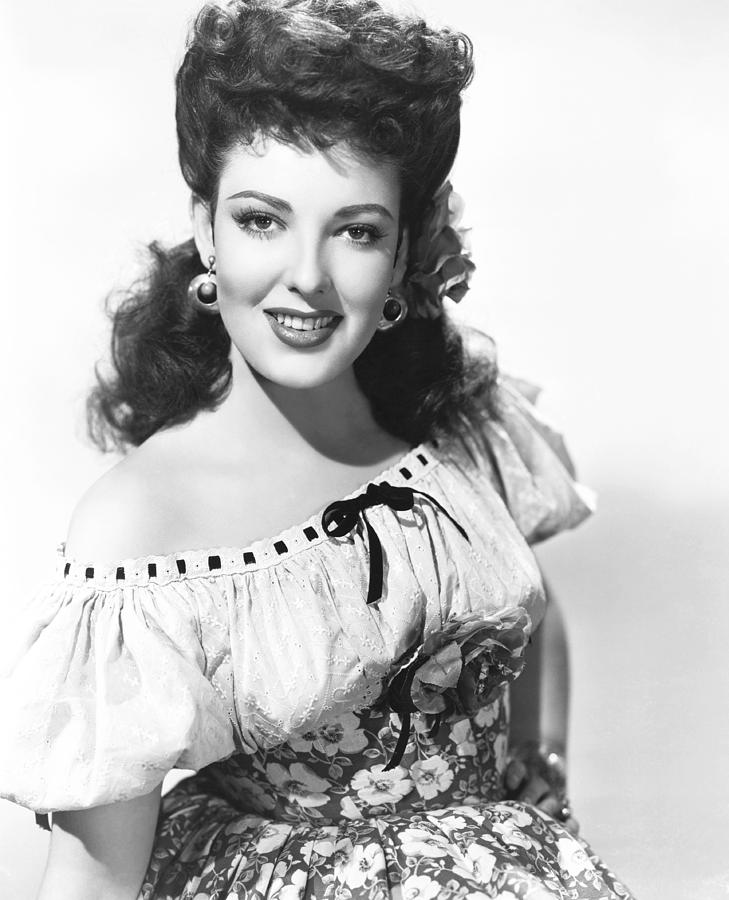
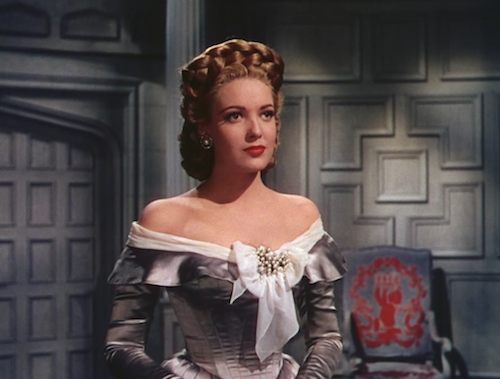
Funny you would post Linda today. I was literally pecking away at a write-up for her in this thread, but it's a rainy day and I took a nap rather than finishing.
I think Linda was one of the better of the 40s pin-up girls, but much less remembered today than many of her contemporaries -- Lana, Rita, Ava, Jane, etc. To my eyes, Linda looks like an amalgam of Vivien Leigh, Jane Russell and Dorothy Lamour which her seem emblematic of the era. Linda's acting was often reminiscent of Lana's -- both prone to that hoity-toity huffiness passing for fieriness -- but I think Linda was a smidge better.
Her career -- at least in the 40s -- was robust. A few heroine parts (THE MARK OF ZORRO, BLOOD & SAND) opposite Tyrone Power; a couple of great floosie roles (HANGOVER SQUARE, FALLEN ANGEL); and a classic western (MY DARLING CLEMENTINE). It was her misfortune that what should have been her greatest role -- FOREVER AMBER, touted as the next GWTW -- fizzled. She rebounded with two excellent performances in excellent films (Sturges' UNFAITHFULLY YOURS and Mankiewicz's A LETTER TO THREE WIVES). And then her career collapsed.
There seemed to be no discernible reason for this. She didn't have any huge box office flops or a string of bad notices; she wasn't black listed or the subject of a career ending scandal. Hollywood just ... lost interest. I once read the opinion that just at the point Darnell was capable of playing interesting characters, she stopped being offered them. (And it's amazing how many actresses that description could apply to.) She herself later lamented that while she knew her career wouldn't last forever, she hadn't expected to be washed up at 30.
View attachment 21572
Overall, I'm very partial to the 20th Century Fox stars of the 40s -- Linda, Tyrone Power, Gene Tierney, Laird Cregar -- and their films.
Linda Darnell was a terribly beautiful woman in her heyday. Dark hair, eyes, lips. It all mixed together perfectly, and she photographed exceptionally well in black-and-white and in Technicolor.
She was a star in her first movie,
Elsa Maxwell's Hotel for Women, which was immediately followed by the romantic comedy
Day-Time Wife, co-starring the handsome Tyrone Power. Her earliest days at 20th Century-Fox were spent playing second fiddle to Tyrone Power in a host of big-budget sword-and-sandal pictures like
The Mark of Zorro and
Blood and Sand. Her quick climb to the top was even the inspiration for the movie
Star Dust, which had been written specifically as a vehicle for her. She was quite popular in those early WWII years, and she appeared in a lot of big pictures, but rarely as the central star.
Well, I do know that Darryl F. Zanuck, the head honcho at Fox, was furious when Linda married Pev Marley, a man twenty-four-years her senior, in 1943. He felt it would ruin her spotless reputation on-screen as a fresh-faced girl-next-door. When the reaction from her fan-base appeared sympathetic, Zanuck apparently recanted his initial decision of terminating her contract, but he kept her under his thumb by cast her in a string of minor roles, such as the Virgin Mary in
The Song of Bernadette and an Indian maiden in
Buffalo Bill. She was hastily loaned to United Artists for the 1944 drama
Summer Storm, co-starring George Sanders, in which she played a played sultry Russian temptress. It introduced a "new Linda Darnell" to the public, a woman now more mature and obviously sexy.
The film noir
Fallen Angel was originally scripted as a dramatic vehicle for musical comedy star Alice Faye, but Zanuck ultimately retooled the project as a showcase for Darnell. Alice Faye was understandably upset that Zanuck had cut the majority of her scenes, although she remained steadfast that she was not angry at Darnell, later commenting that she was a very talented and beautiful young lady. The success of the picture marked a turning point in Darnell's career at Fox, where she was gradually gaining momentum as a bankable and credible lead actress. She had top roles in
Hangover Square and
Centennial Summer, but also turned up in a relatively minor and scantily-clad role in
Anna and the King of Siam. She starred with Henry Fonda in the now-iconic western comedy called
My Darling Clementine.
Her work was steadily improving in the later 1940s, and she was now representing a new face in Fox's roster of stars. She bet out hundreds of actresses for the coveted title role in
Forever Amber, a lavish movie adaptation of the popular novel, that was touted as the successor to
Gone with the Wind. She reluctantly dyed her hair blonde for the role, and worked on her role extensively with an acting coach. Because of censorship of the period, however, many of the film's more "sensational" scenes were eventually axed from the released product, leaving Darnell angry that some of her best work in the picture was left laying on the cutting room floor. The film was popular with the public, but received indifferent critical reviews who compared it unfavorably to the novel upon which it was based.
The movies
Unfaithfully Yours and
A Letter to Three Wives probably the peak of her craft as a screen, while she supposedly regarded
No Way Out as her finest performance. What's weird is just what you said: right at the moment when she was at the edge of achieving true greatness, Hollywood and her studio turned their backs on her. She spent a decade in-and-out of good and bad movies, and now that she had finally matured in her profession, they work she deserved was no longer available to her. She desperately wanted roles in
Pinky and
All About Eve (or so I remember reading somewhere once), but it was apparently out of the question. Fox wanted Jeanne Crain and Anne Baxter, so that's who they used. The remainder of her Fox contract was used for mediocre B-movies, usually as a loan out to other studios. Her career was basically sabotaged by a studio that tossed their stars aside like unwanted old tissues (which was fairly typical of the era). Darnell was apparently humiliated at being asked to screen test for a role in
The Wayward Bus in 1956, although the role eventually went to a much younger Joan Collins.
She didn't make any more movies until she was brought back for
Black Spurs, a low-budget western in the mid-sixties, which was released two months after her death in April 1965 in a house fire. She was forty-one.